
KYC and AML Regulations in Online Gambling: Optimizing Your iGaming Platform to Stay Compliant

While the growth of online gambling has created new opportunities for operators, it has also increased the need for stronger security and regulatory compliance. KYC and AML regulations help online gaming operators verify player identities, prevent financial crime, and reduce the risk of money laundering.
As regulators continue to tighten AML regulations across global markets, gambling operators must implement effective identity verification, transaction monitoring, and customer due diligence processes. At the same time, compliance systems must support responsible gambling without creating unnecessary friction for players.
Today, operators are working with experienced partners specializing in iGaming development to build scalable compliance infrastructures that support both growth and regulatory requirements. In this article, we’ll explore how KYC and AML in online gambling work and how operators can optimize compliance while supporting long-term growth.
- KYC and AML frameworks help gambling operators verify player identities, prevent financial crime, combat money laundering, and comply with evolving regulatory requirements across multiple jurisdictions.
- Modern compliance ecosystems combine identity verification, transaction monitoring, risk scoring, sanctions screening, and fraud detection tools to identify suspicious activity and strengthen AML compliance.
- API-driven, modular compliance architectures allow operators to integrate specialized providers, adapt to local regulations, improve scalability, and reduce dependence on rigid, all-in-one compliance platforms.
- By optimizing onboarding and verification workflows, operators can reduce KYC-related friction, improve conversion rates, support responsible gambling initiatives, and maximize player lifetime value.
What Are KYC and AML in Online Gambling?
Know Your Customer (KYC) and Anti-Money Laundering (AML) are interconnected risk-management frameworks ensuring online casinos and sportsbooks operate transparently. KYC focuses on identity verification and assessing player risk during onboarding, while AML provides continuous transaction monitoring to prevent financial crime and illicit fund processing.
This system bridges account creation and ongoing security, starting with data collection and identity verification at registration to establish normal player behavior. If deposits, betting velocity, or withdrawals deviate, risk management algorithms flag the account for deeper due diligence.
This framework also supports Responsible Gaming by identifying high-risk gambling indicators, cross-checking self-exclusion lists, and protecting vulnerable players from financial harm.
The Difference Between KYC and AML
The core difference lies in their operational scope: KYC serves as the initial data-gathering phase within a broader AML strategy. While KYC identifies the user, AML monitors their behavior over time.
To effectively manage player lifecycles, operators must distinguish between five key compliance mechanisms:
- Identity Verification: The mechanical collection and authentication of structural documents, such as a passport or driver’s license, to prove a player’s identity and legal age.
- Customer Due Diligence (CDD): The standard process of collecting basic customer details, evaluating their geographic location, and assigning an initial risk rating before allowing major platform engagement.
- Enhanced Due Diligence (EDD): An intensive verification path reserved for high-risk individuals or high-rollers. It requires scrutinizing the player’s source of wealth via bank statements or corporate records to ensure gambling funds originate from legitimate income.
- Transaction Monitoring (TM): The real-time automated checking of financial flows. It focuses on deposit velocities, rapid turnaround cycles for withdrawals without wagering, and unusual cross-method payment patterns.
- Ongoing Risk Assessment: A dynamic evaluation process where a player’s risk score is continuously adjusted based on real-time behavior on the platform rather than static registration details.
Why KYC and AML Are Essential for iGaming Compliance
Implementing robust identity verification and financial monitoring systems is a legal mandate enforced across the global gambling industry. For operators dependent on turnkey setups, failing to modernize these systems leads to severe operational vulnerabilities and massive financial liabilities.
Preventing Fraud and Money Laundering in Online Gambling
Online gambling platforms are frequent targets for fraudsters because they handle large volumes of financial transactions and player funds. Without effective AML procedures, gambling operators can become vulnerable to money laundering schemes, identity theft, account takeovers, and bonus abuse.
Money launderers may attempt to move illicit funds through gambling websites by making deposits, placing low-risk bets, and withdrawing funds that appear legitimate. Other common threats include the use of stolen identities, multiple accounts, and manipulated payment methods.
To prevent fraud and reduce money laundering risks, operators rely on identity verification, customer due diligence, transaction monitoring, and ongoing monitoring. These measures help detect suspicious activity and flag high-risk individuals before significant damage occurs.
Supporting Responsible Gambling and Player Protection
KYC and AML systems support responsible gambling and protect vulnerable players. By verifying age and identity during onboarding, operators can prevent underage gambling and restrict access to users who do not meet legal requirements.
Compliance systems also help identify high-risk individuals by monitoring player activity. Unusual gambling behavior or rapid increases in deposits can trigger additional reviews or interventions.
Many gambling operators combine compliance tools with responsible gambling measures such as deposit limits, cool-off periods, self-exclusion programs, and player protection alerts. Together, these controls help create a safer environment and ensure regulatory compliance.
Key Gambling Regulations and AML Requirements
The modern regulatory architecture requires online gambling operators to track money just as financial institutions do. The Financial Action Task Force (FATF) explicitly classifies gambling companies as Designated Non-Financial Businesses and Professions (DNFBPs). This means they are held to similar data-retention, verification, and reporting standards as commercial banks.
Major Gambling Authorities and Compliance Standards
Several regulatory authorities and international organizations shape KYC and AML compliance standards across the gambling sector:
- UK Gambling Commission (UKGC): Mandates strict financial vulnerability checks triggered by rolling net deposit thresholds. Operators must run real-time sanctions screening to maintain their license.
- Malta Gaming Authority (MGA): Enforces a multi-tier customer due diligence framework. Operators are subject to mandatory suspicious transaction reporting obligations and must conduct formal identity and fund verification upon reaching statutory cumulative deposit thresholds.
- EU AML Directives (AMLR & 6AMLD): Establishes a harmonized, directly applicable rulebook across the single market (fully enforceable by July 2027), tightening customer due diligence (CDD), strictly enforcing beneficial ownership transparency, and expanding oversight under the newly operational Anti-Money Laundering Authority (AMLA).
- Financial Action Task Force (FATF): Sets global anti-money laundering regulations and compliance baselines. Under Recommendation 22, operators must implement a robust customer due diligence (CDD) model and continuous risk assessment when dealing with high-risk jurisdictions.
Regardless of jurisdiction, gaming operators are generally expected to implement customer due diligence (CDD) procedures, monitor transactions, identify suspicious activity, and submit suspicious activity reports where required.
How the KYC Verification Process Works
The KYC process helps gambling operators verify players and meet AML compliance requirements before customers can fully access a platform. While the exact workflow varies between operators, most follow a similar verification process:
- Account registration: The player provides personal information such as name, date of birth, address, and contact details.
- Identity verification: The operator verifies the player’s identity using official documents and automated identity verification tools.
- Age verification: Checks are performed to confirm the player meets the legal gambling age and to prevent underage gambling.
- Customer Due Diligence (CDD): The operator reviews customer information and performs due diligence based on the player’s risk profile.
- Risk assessment: Higher-risk customers may undergo enhanced due diligence and additional verification checks.
- Account approval: Once verification is complete, the player gains full access to the platform’s features and payment functions.
- Ongoing monitoring: Operators monitor transactions and account activity to identify suspicious activity and ensure ongoing regulatory compliance.
Core Modules of Modern KYC and AML Systems
Today, modern compliance infrastructures are increasingly built from highly specialized modules rather than monolithic frameworks. Operators are breaking free from vendor lock-in by adopting an API-driven compliance infrastructure. They can seamlessly plug in specialized verification and risk management components via simple API integrations. This allows their compliance teams to orchestrate highly tailored workflows without writing complex backend code.
Identity Verification (IDV)
The IDV module is dedicated solely to validating customer identities in seconds. It handles document verification, automated biometric face-matching, selfie checks, and liveness detection. Using automated fraud detection technologies ensures high accuracy and rapid verification. This reduces initial registration drop-offs while maintaining strict regulatory compliance.
Data Verification (KYC/KYB)
Data verification expands the KYC process beyond document checks by validating customer information against trusted data sources. This helps gambling operators confirm that the information provided during registration is accurate and consistent.
Common checks include address verification, database screening, phone and email validation, and cross-referencing customer records with government and commercial data providers. These checks strengthen customer due diligence and help detect identity fraud, inaccurate information, and high-risk individuals.
In some cases, operators must also perform Know Your Business (KYB) checks when working with corporate customers, affiliates, payment partners, or other businesses. KYB procedures verify company ownership, legal status, and beneficial ownership structures.
Risk Scoring Engine
A risk-scoring engine helps gambling operators assess the risk associated with each customer. Instead of treating all players the same, the system assigns risk scores based on factors such as location, transaction history, payment methods, account behavior, and previous compliance checks.
These scores support a risk-based approach to AML compliance by enabling operators to apply varying levels of customer due diligence based on each player’s risk profile. High-risk individuals may be subject to enhanced verification and additional monitoring.
Modern risk scoring engines continuously update customer profiles as new information becomes available. This dynamic approach helps operators identify suspicious activity earlier, improve fraud prevention, and allocate compliance resources more efficiently.
For online sports betting operators, risk scoring can also complement broader strategies around sports betting risk management by providing deeper visibility into customer behavior and potential compliance risks.
Transaction Monitoring (TM)
Transaction Monitoring (TM) is a core component of AML compliance that helps gambling operators identify suspicious transactions and potential money laundering activity. These systems continuously monitor deposits, withdrawals, betting activity, account funding methods, and transaction velocity across gambling platforms.
When suspicious activity is identified, the system generates alerts for further investigation. Compliance teams can then review the activity and determine whether suspicious activity reports are required.
Effective transaction monitoring is essential for isolating money laundering typologies and preventing chargeback fraud before payouts occur. It also plays a key role in broader igaming payment risk management strategies by helping operators detect payment-related threats before they escalate.
Sanctions and PEP Screening
Sanctions and Politically Exposed Persons (PEP) screening help operators in the online gambling industry identify customers who may present elevated compliance risks. This module screens customers against sanctions lists, criminal watchlists, adverse media databases, and PEP databases maintained by governments and international organizations. The goal is to identify high-risk individuals linked to financial crime, corruption, terrorist financing, or other illicit activities.
Screening is not limited to onboarding. Operators must conduct ongoing monitoring to ensure customers remain compliant as sanctions lists and risk profiles change over time.
Case Management
Case management systems help compliance teams investigate and document potential AML and fraud-related incidents. When compliance tools detect suspicious activity, alerts are automatically routed into a centralized workflow for review.
Compliance officers can analyze customer data, transaction histories, risk scores, and supporting evidence to determine whether further action is required. This process may involve requesting additional documentation, escalating high-risk cases, or filing suspicious activity reports with relevant authorities.
Modern case management platforms also maintain detailed audit trails, ensuring that every action is recorded for regulatory review. This helps gambling operators demonstrate AML compliance.
AML Monitoring and Fraud Detection in Online Gambling
Detecting suspicious financial activity in a high-volume iGaming environment requires real-time transaction monitoring combined with behavioral analytics and precise risk scoring. Given the thousands of micro-transactions occurring on gambling platforms every second, manual analysis is impractical.
Automated systems continuously track transaction velocity, including alerts for multiple structured deposits made just below regulatory cash reporting thresholds. Behavioral analytics evaluate player trends over time, establishing baseline profiles to quickly identify compromised accounts, multi-accounting rings, and sudden spikes in cross-border payment activities.
Screening for politically exposed persons (PEPs), sanctions, and watchlists is a crucial AML control. These checks identify customers who may pose higher compliance risks by cross-referencing sanctions databases, PEP lists, criminal watchlists, and other regulatory databases. This screening process occurs during onboarding and continues with ongoing monitoring to detect any changes in a customer’s risk profile.
Crypto gambling presents unique AML challenges due to the rapid, cross-border nature of transactions and the potential for greater anonymity compared to traditional payment methods. While blockchain technology offers transparent transaction records, identifying the individuals behind wallet addresses is often difficult. This creates opportunities for money launderers to exploit crypto gambling platforms using multiple wallets, privacy tools, or complex transaction chains.
To address these risks, operators employ blockchain analytics, wallet screening, transaction monitoring, and enhanced customer due diligence. Many platforms also screen wallet addresses against sanctions lists and known high-risk entities to detect suspicious activity effectively.
Technologies Used for KYC and AML Compliance
The modern technological stack powering compliance systems has evolved beyond manual document verification and rigid validation rules. Advanced automation is now required to manage operations at scale, especially for operators who cannot rely on a massive internal development team to build custom scripts.
AI and Automation in Gambling Compliance
Artificial intelligence and machine learning models excel at detecting complex patterns that remain invisible to traditional, rule-based systems. In high-volume operations, AI-driven fraud detection engines analyze millions of historical player interactions to identify emerging money laundering tactics in real time.
Automated onboarding flows leverage smart decision trees to verify clean profiles in seconds, enabling operators to scale processing without adding significant manual overhead to their compliance teams. To see how machine learning models are supporting the casino gaming industry, check out our detailed overview of AI in casinos.
Device Fingerprinting and Behavioral Analytics
To catch professional fraudsters who use synthetic identities or multi-accounting strategies, operators leverage device fingerprinting and IP intelligence tools. These modules analyze the user’s specific hardware configuration, browser types, language packs, and network pathways.
If the system detects 10 distinct player accounts registering from the same device signature using varied proxy setups, it instantly alerts the operator to a coordinated bonus abuse or multi-accounting attack. The operator then cuts off the threat before financial damage occurs.
Modern Compliance Architecture: Building a Modular KYC and AML Stack
For casino and sportsbook operators without large in-house engineering teams, relying on monolithic white-label setups often results in generic player experiences and uninspiring verification journeys. This limits player acquisition and causes roadmap paralysis during updates.
A modern alternative is a modular compliance architecture based on an API-first framework. This separates the frontend player journey from backend compliance engines through a centralized orchestration layer.
A modular KYC and AML infrastructure consists of specialized, API-driven components – such as identity verification, transaction monitoring, sanctions screening, risk assessment, and case management – connected via a central orchestration layer that coordinates workflows and data exchange.
For example, a new registration can trigger automatic identity verification, due diligence checks, risk scoring, and sanctions screening. Workflow automation allows additional checks or case reviews based on specific events.
This approach enables operators to integrate best-of-breed compliance tools and create flexible workflows without replacing their entire infrastructure.
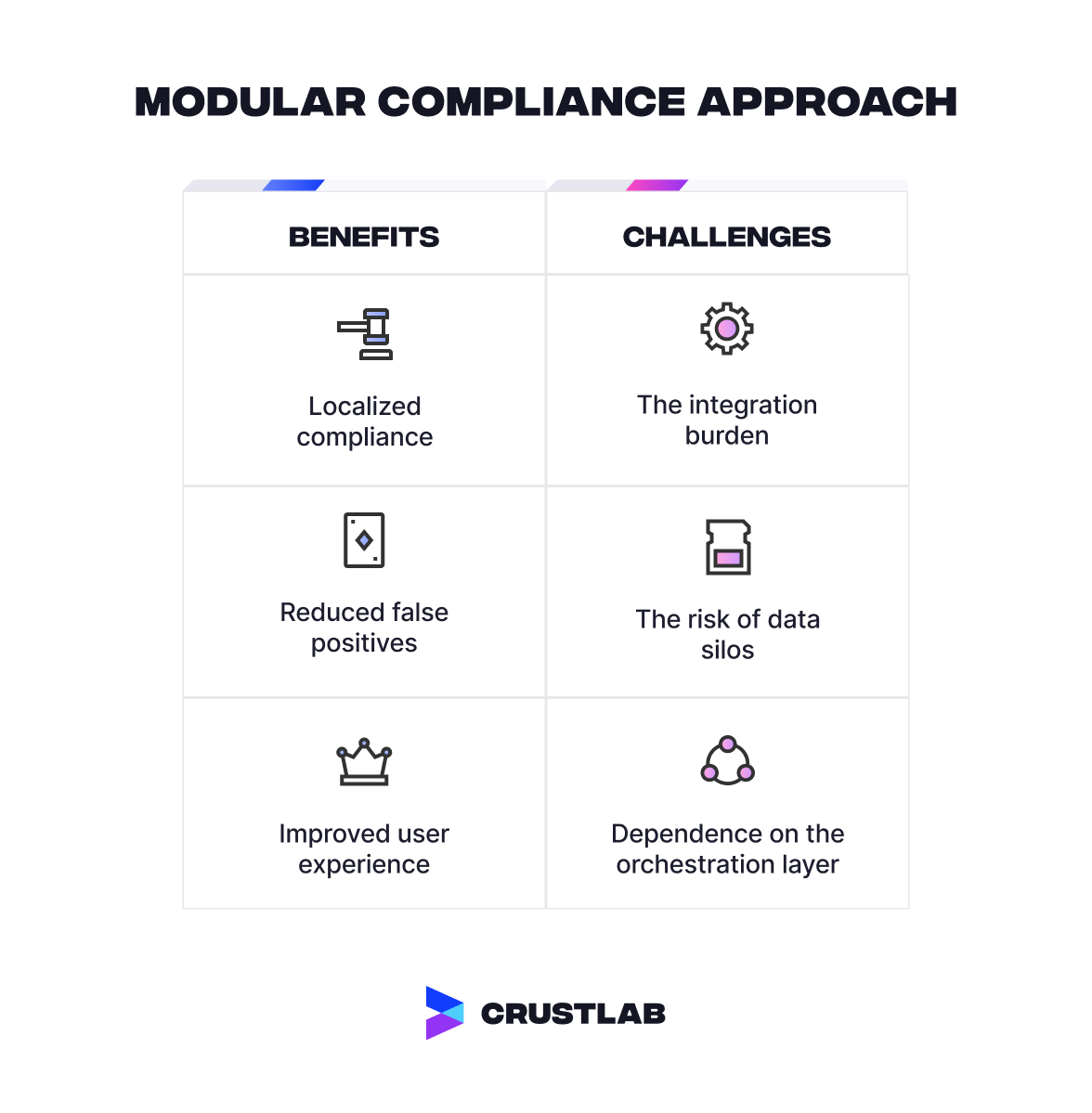
Benefits of a Modular Compliance Approach
- Localized compliance: It allows operators to use jurisdiction-specific verification providers and adapt compliance workflows to local regulatory requirements instantly. If you launch into a new territory that requires unique database checks, you simply connect the regional API directly to the central orchestration layer without rewriting your entire platform code.
- Reduced false positives: Monolithic systems typically utilize overly strict fraud rules that flag an excessive number of legitimate players. Specialized compliance engines improve detection accuracy, reduce unnecessary alerts, and allow compliance teams to focus their resources entirely on genuine threats.
- Improved user experience: Dynamic verification journeys, automated workflows, and optimized onboarding experiences reduce unnecessary friction. This allows operators to verify safe players in seconds, driving down acquisition costs and significantly improving user conversion rates.
Balancing Compliance With User Experience
Effective AML compliance should not come at the expense of player experience. Modern gambling operators must balance regulatory requirements with seamless onboarding journeys that minimize friction and maximize conversion rates.
Poorly designed verification processes can increase abandonment rates, while optimized compliance workflows can improve customer acquisition, retention, and player lifetime value.
The Onboarding and Conversion Bottleneck
Compliance-related onboarding friction is one of the biggest challenges that gambling operators face. Complex KYC procedures, repeated document requests, slow manual reviews, and fragmented verification workflows can cause users to abandon registration before making their first deposit.
Mobile users are particularly sensitive to friction. Lengthy forms, poor document upload experiences, and delayed verification decisions often reduce conversion rates across online casinos and online sports betting platforms.
As a result, the KYC process has become a critical conversion touchpoint. Operators that streamline identity verification, automate reviews, and provide real-time feedback are often better positioned to reduce drop-offs and improve first-time deposit conversions.
Maximizing Player Lifetime Value Through Compliance UX
The quality of the compliance experience directly impacts customer acquisition, retention, and player lifetime value. A frustrating verification process can increase acquisition costs, reduce conversion rates, and drive players toward competing gambling platforms.
To improve long-term performance, operators should focus on reducing unnecessary friction throughout the customer journey. Effective strategies include progressive verification, risk-based KYC approaches, automated verification workflows, mobile-first identity verification experiences, and real-time verification feedback.
Creating a single customer view is equally important. By connecting compliance tools and customer data sources, operators can avoid repeated information requests and streamline verification.
Common Challenges of KYC and AML in Online Gambling
Maintaining effective KYC and AML compliance is becoming increasingly complex as the online gambling industry expands across multiple jurisdictions. Gambling operators must balance regulatory requirements, fraud prevention, customer experience, and operational efficiency while adapting to constantly evolving AML regulations.
Common challenges include false positives, cross-border compliance obligations, rising compliance costs, complex local laws, and the need to scale verification systems as player bases grow. These challenges can create operational bottlenecks, increase compliance workloads, and impact both conversion rates and profitability.
For many gaming operators, the key challenge is building a compliance framework that remains effective and adaptable without creating unnecessary friction for legitimate players.
Challenges of Modular Compliance Systems
While modular compliance architectures offer greater flexibility and scalability, they also introduce new operational challenges. Gambling operators must carefully manage integrations, data flows, and workflows to ensure that all compliance components work together effectively.
- The integration burden: A modular ecosystem often involves multiple compliance tools, APIs, and third-party providers. Integrating and updating these connections can require significant technical resources, especially as regulatory requirements evolve.
- The risk of data silos: When utilizing multiple niche validation tools, customer information can easily become fragmented across disconnected systems. If the transaction monitoring tool does not share updates with the identity verification ledger, it creates inconsistent customer risk scores and hinders regulatory audit tracing.
- Dependence on the orchestration layer: The orchestration layer acts as the operational backbone of a modular compliance infrastructure. If workflows, data synchronization, or vendor coordination fail, compliance processes can be disrupted. For this reason, selecting a reliable orchestration solution is critical to maintaining AML compliance and operational efficiency.
Best Practices for Staying Compliant in iGaming
Sustaining compliance across diverse jurisdictions requires operators to transition away from reactive procedures and embrace proactive system optimization. Automated, data-driven workflows allow online casinos and sportsbooks to protect their licenses while removing unnecessary conversion barriers for legitimate players.
- Deploy intelligent automation: Shift away from manual compliance reviews by implementing automated data matching and AI-powered document processing to verify player accounts accurately within seconds.
- Use a dynamic framework: Implement a flexible verification setup that automatically tightens or loosens onboarding friction based on localized risk indicators. This keeps conversion rates high while satisfying strict regulatory requirements.
- Perform proactive stack audits: Stay ahead of regional regulatory shifts by regularly auditing your validation logic and data-routing rules before new local compliance updates take effect.
- Maintain transparent audit trails: Ensure your case management and orchestration systems log every verification event, API response, and manual override to provide clean data for regulatory reviews.
- Partner with specialized experts: For operators running without an internal engineering team, source your compliance stack from proven iGaming development experts who specialize in API-first software architectures.
Future Trends in KYC and AML for Online Gambling
The global gambling compliance landscape is moving rapidly toward friction-free verification models that replace manual bottlenecks with predictive automation. As regulatory scrutiny tightens across international jurisdictions, operators are adopting AI-driven behavioral monitoring. These machine learning models use real-time risk scoring to automatically adjust individual player transaction thresholds as spending habits or device footprints change.
Simultaneously, the industry is embracing decentralized identity wallets and Open Banking integrations. This allows players to verify their age, identity, and location instantly without repeatedly uploading sensitive, unencrypted documents to multiple private gaming platforms.
Additionally, open banking data feeds automate the complex source of wealth (SOW) and financial vulnerability checks mandated by regulatory authorities. This significantly reduces onboarding friction for high-value VIP players. Operators that invest in smart compliance solutions will be better positioned to adapt to future regulatory changes and capitalize on emerging igaming trends.
Conclusion
KYC and AML compliance has become a fundamental requirement for every operator in the online gambling industry. Beyond meeting regulatory requirements, effective compliance programs help gambling operators prevent fraud, combat money laundering, support responsible gambling, and protect player trust.
As compliance demands continue to grow, many operators are moving from traditional systems to modular compliance architectures. They are combining specialized compliance tools, intelligent orchestration, automation, and real-time monitoring to build more flexible and scalable compliance ecosystems.
Just as importantly, modern compliance infrastructure can improve the player experience. Streamlined onboarding and risk-based verification help reduce friction, increase conversion rates, and maximize player lifetime value.
FAQ
What is KYC in online gambling?
KYC (Know Your Customer) is the process by which gambling operators verify a player’s personal information, such as name, age, and location. It helps prevent identity fraud, underage gambling, and other compliance risks.
Why do online casinos require AML compliance?
Online casinos must comply with anti-money laundering regulations to prevent fraud, money laundering, terrorist financing, and other financial crimes. AML compliance helps operators meet regulatory requirements and maintain their licenses.
How do crypto casinos handle AML regulations?
Crypto casinos typically use blockchain analytics, wallet screening, transaction monitoring, and enhanced customer due diligence procedures to identify suspicious activity and reduce the risk of money laundering.
How can gambling operators reduce KYC-related onboarding drop-offs?
Operators can reduce friction by using automated identity verification, mobile-friendly onboarding, risk-based KYC, progressive verification, and real-time verification feedback.
What are the benefits of a modular KYC and AML architecture?
A modular compliance architecture provides greater flexibility and scalability. It enables operators to integrate specialized compliance tools, adapt to local AML regulations, enhance the user experience, and strengthen AML compliance.