
- CrustLab /
- blog /
- Industry Insights and Regulations /
- Casino Platform Vendor Lock-in: The GGR-Share Math That Changes at Scale
Casino Platform Vendor Lock-in: The GGR-Share Math That Changes at Scale

Operators tend to choose white-label casinos or turnkey solutions because they offer the fastest way to launch an online casino or sports betting brand. In the early stages, the white-label model keeps upfront costs low and speeds up market entry. That makes it the right business decision for many companies.
But as gross gaming revenue grows, so do revenue share payments, while casino platform vendor lock-in makes switching to a new system increasingly difficult. What started as a cost-saving decision can gradually become one of the biggest constraints on profitability and roadmap flexibility.
This article explains why that happens, where the financial crossover occurs, and how operators can reduce vendor lock-in without replacing their entire platform or undertaking a full casino platform build.
- Casino platform vendor lock-in is a business model that evolves with scale, not a mistake made at signing. As gross gaming revenue grows, revenue-share costs increase, while switching becomes harder due to accumulated data, integrations, and regulatory obligations.
- Every operator should identify the GGR-share crossover point. Around €100k in monthly GGR, cumulative revenue share can exceed the cost of owning or decoupling the platform, with a typical 12–36 month payback period.
- Vendor lock-in has four separate dimensions. Commercial terms, proprietary player data, tightly coupled integrations, and regulatory requirements each create different barriers, so each requires its own strategy rather than a one-size-fits-all solution.
- You don’t have to choose between staying and replacing the platform. A staged decoupling approach using a canonical API layer can reduce casino platform vendor lock-in, restore roadmap independence, and strengthen your negotiating position without a full migration.
Casino Platform Vendor Lock-in Is a Cost Curve, Not a Signing Mistake
Many discussions about casino platform vendor lock-in treat it as a bad decision made during contract negotiations. In truth, vendor lock-in is often built into the business model behind a white-label or turnkey model. The commercial terms are designed to help operators launch quickly, but they also become more expensive as the business succeeds.
Two cost curves move together over time. The first is revenue share, which rises with gross gaming revenue because providers charge a percentage of the platform’s earnings. The second is the cost of leaving. Every new market, payment integration, compliance requirement, player record, and marketing tool increases the work required to migrate to a new system.
As a result, lock-in becomes stronger as an online casino grows. A platform that supported rapid launch can later limit operational efficiency, slow product changes, and increase operating costs. At the same time, years of player history, KYC records, bonus data, and sports betting integrations make migration far more complex than it was on day one.
That doesn’t mean the original decision was wrong. For many online casino operators, a white-label casino is the fastest and most cost-effective way to enter competitive markets. The key is recognizing when the economics have changed enough that the original commercial model no longer supports long-term growth.
The GGR-Share Crossover: Where Revenue Share Overtakes the Cost of Owning the Stack
To manage vendor lock, online casino operators must view revenue share as an evolving financial cost line rather than a fixed overhead fee. In a typical white-label model or turnkey solution, providers charge a continuous cut of gross gaming revenue. At lower volumes, this variable pricing protects cash flow. However, as your market share grows, the compounding math of revenue share fundamentally alters your operating expenses.
There is a precise inversion point where this arrangement stops making financial sense. Based on financial analysis across live operations, the financial tipping point for building or decoupling a proprietary tech stack is typically around €300k to €3M in monthly GGR. Below €300k monthly GGR, paying a percentage of Net Gaming Revenue (NGR) remains significantly more cost-efficient than maintaining an internal engineering team, DevOps, and compliance infrastructure.
At €100k monthly GGR, operators usually transition from white-label setups to turnkey solutions to obtain their own licenses, but crossing the €300k–€3M monthly GGR mark is where cumulative NGR/GGR fees exceed proprietary platform operating costs, making decoupling financially viable with a 12–36 month payback period.
At this scale, the cumulative revenue share paid to the platform provider can exceed the cost of building or decoupling your own stack, with a typical payback period of 12–36 months. The exact timing depends on factors such as growth rate, white-label casino costs, and contract terms.
However, the principle remains the same: a pricing model that supports rapid launch can become increasingly expensive as total revenue grows. The question is no longer whether the platform helped you launch successfully, but whether it still delivers the best long-term ROI.
This is why operators should evaluate actual profit, not just casino and sports betting revenue. A platform that once accelerated business growth can eventually reduce margins if rising revenue share outpaces the cost of owning a larger share of the technology stack. The financial crossover is a signal to start modeling your options before the cost gap widens further.
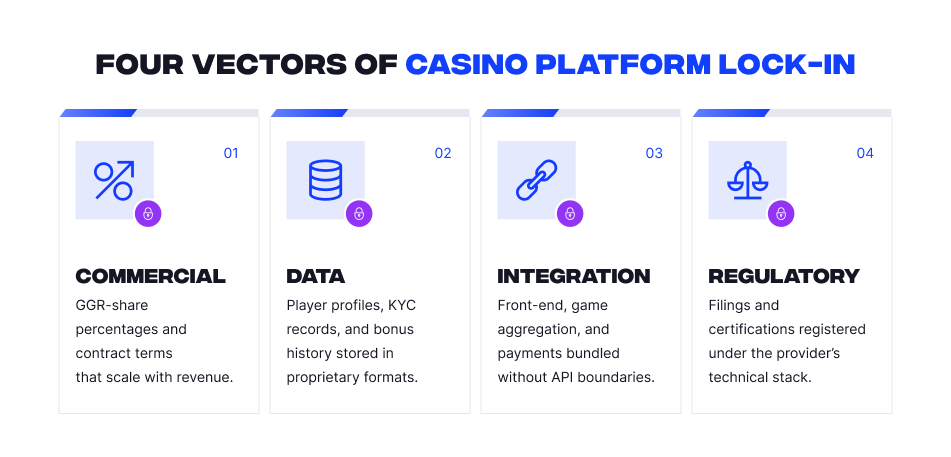
Four Vectors of Casino Platform Lock-in
Treating vendor lock as a single issue makes it almost impossible to solve. Operators often talk about being “locked in” as if it were a solid wall, but in reality, casino platform vendor lock-in comprises four distinct vectors. Each vector creates friction in a different part of your business, and each requires its own specific leverage point to break.
By breaking down the problem into these four areas, online gambling executives can convert an overwhelming challenge into a clear action plan.
Commercial
The commercial vector is the most visible form of lock-in. It includes high baseline GGR-share percentages, strict minimum monthly guarantees, and long-term contract commitments. While total monetary payouts escalate as revenue grows, standard contracts without tiered volume discounts lock operators into fixed rates that eat into margins at scale. Platform providers structure these terms so that as you make more money, your financial penalties for leaving increase. This ensures the provider continues to collect revenue share long after their initial onboarding costs have been fully recovered.
Data
Data lock-in occurs when player information is stored in proprietary technologies or formats. Customer profiles, wallets, KYC records, bonus history, and transaction data become difficult to export without extensive mapping and validation. The longer an operator stays on a single platform, the greater the customer lock-in created by that platform’s data model.
Integration
The integration vector stems from a tightly bundled tech stack. Many white-label casino and turnkey solution platforms blend the front-end user experience, game aggregation, payment processing, and sports betting feeds into one monolithic application without standard API boundaries. If you want to add innovative instant games and slot machine games or upgrade your real-time analytics, you are forced to rely on the vendor’s internal roadmap and timeline.
Regulatory
Expanding into competitive markets requires localized regulatory approvals and game certifications. In a traditional platform partnership, regulatory filings, GLI test reports, and compliance integrations are registered directly under the provider’s technical stack. Moving to a new system means undergoing expensive re-certification processes, paying additional licensing costs, and risking operational delays in key jurisdictions.
Why the PAM Decides How Portable You Really Are: Proprietary Schemas and the Data-Portability Gap
When operators think about switching platforms, they often focus on the website or mobile app. However, the biggest obstacle is usually the Player Account Management (PAM) system. The PAM stores the data that keeps an online casino running, including wallets, KYC records, bonus balances, player limits, transaction history, responsible gambling controls, and regulatory reports. That makes it the platform’s foundation and the main source of vendor lock-in.
The challenge isn’t simply exporting data. Most PAMs organize player information using proprietary technologies and a proprietary format designed around the vendor’s architecture. Even if your contract allows data export, the information often needs to be mapped, validated, and transformed before another platform can use it. For established operators, this can become a months-long project.
What’s more, the problem grows with scale. As your online casino enters new markets, adds payment providers, launches loyalty programs, or expands into sports betting, the volume of data associated with the iGaming PAM continues to grow. Every new integration creates another dependency, making migration more complex and more expensive.
Hence, data portability should be negotiated before the contract is signed, not when you decide to leave. A strong data portability clause should define the export format, delivery timeline, and whether the vendor will provide complete data at no additional cost. Without those terms, casino platform vendor lock-in extends far beyond the commercial agreement.
The Regulatory Cost of Switching: Re-Certification, Dual-Running, and the EU Data Act Nobody Prices In
The cost of switching platforms goes well beyond development. For online casino operators, migration often means re-certification in every regulated market, including approvals from authorities such as the MGA, UKGC, or Swedish Spelinspektionen, as well as fresh testing of regulated components like RNGs. These requirements add both time and cost before a new system can go live.
Most operators also need to run both platforms in parallel during the transition. This dual-running period increases infrastructure, compliance, and operational costs while player accounts, player deposits, and regulatory reporting are validated across both systems.
The EU Data Act, applicable since September 2025, is beginning to shift the balance by introducing switching and data portability rights for certain data processing services, including a maximum 2-month notice period and the removal of switching charges from January 2027. However, it is not a guaranteed escape from casino platform vendor lock-in. Whether the rules apply depends on how the platform is delivered (e.g., SaaS vs on-premises) and on what the contract says. Article 31(1) also includes a partial carve-out for services that are largely custom-built for a single customer.
The takeaway is simple. Review both your platform delivery model and contract before relying on the Data Act. Even where applicable, recertification, dual-running, and data migration remain costly and should be included in any financial analysis of vendor lock.
Stay or Replace Is a False Binary: The Third Option Most Lock-in Discussions Miss
Most discussions about casino platform vendor lock-in focus on whether operators should stay with their current platform or replace it completely. In practice, neither option is ideal. Staying means accepting a growing revenue share and a deeper lock-in, while a full migration is often more expensive and slower than initial project plans suggest.
A complete platform replacement involves more than moving software. Operators must migrate player data, rebuild integrations, complete regulatory approvals, and keep the existing platform running throughout the transition. For many online casino businesses, the cost and operational risk make a full replacement difficult to justify, even when the current platform no longer fits the business.
This false binary causes many operators to delay action altogether. Instead of evaluating ways to reduce vendor lock, they assume the only alternative is a costly, all-or-nothing migration. As a result, they continue paying higher operating costs while losing flexibility.
So instead of staying with or replacing the platform, you should focus on regaining control over your roadmap and margins without disrupting the business. That’s where a staged approach becomes a practical alternative.
Reducing Casino Platform Vendor Lock-in Without a Migration: The Canonical-API Layer That Restores Roadmap Independence
Reducing casino platform vendor lock-in doesn’t always require replacing the entire platform. An excellent option is to introduce a canonical API or adapter layer between the existing PAM and the services that depend on it. Instead of changing the core immediately, you gradually reduce its influence over the rest of your technology stack.
This approach follows the strangler-fig pattern. New applications, integrations, services, and front-end features connect to the canonical API rather than directly to the incumbent platform. Over time, the adapter layer becomes the single source of truth for data contracts, while the legacy PAM continues to handle the functions it already performs well.
The biggest advantage is roadmap independence. Teams can improve the customer experience, launch more games, integrate new services, or expand into new markets without waiting for the platform vendor’s development schedule. The existing platform remains in place, but it no longer dictates how quickly the business can innovate.
This also changes the commercial conversation. As dependence on the incumbent platform decreases, operators gain a stronger position to renegotiate revenue share and service terms. Instead of making an irreversible decision, they create a staged, reversible path that reduces vendor lock-in while preserving business health.
Contract Levers to Pull Before You Sign
The headline revenue share percentage is only part of the deal. The clauses that determine your long-term flexibility often have a much bigger impact on margins than the initial commercial rate. For heads of product and economic buyers, these terms can decide how difficult and expensive it becomes to leave.
The foundation of long-term independence lies in negotiating strict data portability clauses. Contracts should explicitly require the platform provider to supply full, unencrypted player database backups, including detailed bonus histories, transaction logs, and KYC verification records, in standard formats such as JSON or CSV within 14 days of a termination notice. Alongside data rights, operators must secure defined exit and migration assistance. Establishing mandatory SLA support terms during a transition period caps hourly developer rates for vendor assistance and enforces strict timelines for handing over critical system configurations.
Commercial leverage also depends heavily on fee structures. Negotiating tiered revenue-share percentages ensures that the provider’s percentage decreases as gross gaming revenue scales, preventing white-label casino costs from consuming operating margins as total volume grows. Finally, operators must address minimum guarantee terms by placing clear caps on monthly baseline fees and eliminating automatic renewal clauses that lock businesses into multi-year commitments without clear performance criteria. Securing these core terms during initial negotiations ensures that your platform deal preserves genuine optionality as your volume grows.
Conclusion: Treat Vendor Lock-in as a Renegotiation Position, Not a Sunk Cost
Casino platform vendor lock-in is best understood as a strategic renegotiation position rather than an inescapable sunk cost. Operators who model the gross gaming revenue crossover point and map out the four distinct vectors of dependency regain clear control over their technical and commercial roadmap.
Rather than jumping directly into a high-risk platform migration, executive teams can use a canonical API adapter layer to incrementally decouple key player account management features and front-end user experiences. Demonstrating technical independence and retaining direct ownership of player data transforms the relationship with your turnkey solution provider.
For managing directors and heads of product, the immediate next step is not a rushed system migration. The real priority is initiating a structured discovery phase to map core data schemas, review contract exit terms, and evaluate decoupling options. Taking these steps restores genuine optionality and secures long-term growth on your own terms.