Modernizing Your iGaming Stack Without Replacing Your PAM! iGaming PAM Exposed and Explained

For a Tier-1 operator with a full in-house tech stack, owning your proprietary software is your ultimate competitive edge. However, expanding into regulated markets becomes difficult when your engineering team is buried under a massive backlog of local payment and game integration debt.
When marketing demands agile tools to boost player engagement and regulators require rapid updates, a monolithic backend can quickly paralyze your product roadmap. While many iGaming operators assume they must replace their core Player Account Management (PAM) system to solve this, a full “rip-and-replace” is a high-risk architectural move. In this article, we explain how an iGaming platform can decouple its experience layer to bypass backend bottlenecks without undergoing a disruptive core overhaul.
- An iGaming PAM serves as the core player account management system, handling player data, compliance, financial transactions, bonuses, and responsible gaming across the entire platform.
- Replacing a legacy PAM system immediately is often risky and expensive, especially for operators in regulated markets managing complex integrations and compliance workflows.
- A phased modernization strategy focused on frontend control, middleware orchestration, and integration stability helps operators improve operational efficiency and boost player engagement without disrupting the core platform.
- Building for “PAM optionality” gives operators more control and long-term scalability by reducing dependency on a single platform provider and creating a more adaptable tech stack.
iGaming PAM Explained
To build a scalable architecture across competitive regulated markets, engineering leaders must separate core transactional logic from user-facing presentation layers. At its foundation, the iGaming PAM (Player Account Management) system serves as the definitive primary ledger and player database for the entire operation. It acts as the underlying transactional backbone that handles critical backend states while remaining fundamentally distinct from the outward-facing game content, sports betting modules, and frontend layers.
When managing player accounts, the PAM software operates as a secure ecosystem optimized for high-performance data processing. While game engines handle spin mathematics and sportsbooks manage live odds feeds, the PAM platform is responsible for validating that the person interacting with those external services is authenticated. By treating the PAM system strictly as a transaction and security engine, iGaming operators can isolate sensitive financial data and compliance logic from the volatile changes required by frontend marketing tools.
Why the iGaming PAM is the Heart of the Tech Stack
The iGaming PAM sits at the center of the entire platform because it controls the most critical operational and compliance functions. Every player registration, account creation, payment processing event, bonus trigger, and player interaction depends on the PAM system to maintain accurate real-time data. It also supports responsible gaming, player protection, identity verification, and compliance logic required in regulated markets.
Without a stable player account management platform, operators risk fragmented data, poor operational efficiency, and limited control over the player journey. A modern iGaming PAM also provides businesses with the foundation to support multiple brands, new markets, and long-term player engagement on a single platform.
iGaming PAM vs. White Label vs. Turnkey Solutions
As an engineering leader evaluating architectural freedom, your choice of a delivery model dictates your software’s long-term capabilities. Choosing a white-label or turnkey platform provider severely restricts access to the core data engine, forcing dependence on their development timeline. In contrast, deploying an independent PAM system gives operators total control over their technical destiny, allowing engineers to modify systems without vendor interference.
The table below breaks down the structural differences between these models:
| Architectural Metric | White Label Solution | Turnkey Solution | Independent iGaming Platform (PAM) |
| Data Ownership & Access | Shared database; restricted, delayed access to player data. | Dedicated instance; read-only access. | Complete control; real-time data ownership. |
| Frontend Customization | Rigid templates; changes require vendor approval. | Semi-flexible UI; limited by provider APIs. | Total freedom; complete frontend decoupling. |
| Integration Independence | Zero; locked into pre-existing vendor libraries. | Limited; the platform provider must build connections. | Full autonomy; build proprietary adapters freely. |
| Regulatory Agility | Slow; completely dependent on vendor roadmap. | Bounded by the provider’s regulatory update speed. | Immediate; change compliance logic to enter new markets. |
Core Features of a Modern iGaming PAM System
To maintain a competitive edge in 2026, a modern PAM platform must be different from the monolithic designs of the past. Top-tier PAM software does not try to do everything. Instead, it provides hyper-efficient, specialized services via secure APIs.
A high-performance system requires these core building blocks:
- Player Registration & Lifecycle Management: Manages the user registration journey from initial account creation to background identity verification. It integrates automated KYC tools and AML risk management workflows to instantly detect identity theft and prevent fraudulent sign-ups.
- Wallet & Payment Orchestration: Handles secure payment processing and financial transactions across multiple currencies. It functions as a secure central ledger that records player balances with microsecond-accurate time stamping and high-throughput ACID guarantees..
- Bonus & Promotion Engines: Executes complex bonus logic and targeted campaigns. It provides flexible tools for calculating free bets, managing real-time wagering requirements, and distributing rewards to increase customer acquisition without degrading database performance.
- Responsible Gaming (RG) Tools: Features native mechanisms for player protection. The system analyzes player behavior to support automated self-exclusion and deposit limits, in line with modern compliance mandates.
- Back Office & BI: Provides secure administrative access and real-time data streams. It tracks player interactions and login history to give operators total visibility over platform security and operational metrics.
Why “Rip and Replace” is the Wrong First Move for Your iGaming PAM
When a proprietary system struggles under heavy traffic or bottlenecks your roadmap, your immediate instinct might be to look for a brand-new platform provider. However, executing a full “rip-and-replace” migration right out of the gate is a high-risk project. It is the most disruptive architectural move an operator can make.
A full core replacement forces you to change your database structure, compliance logic, and live financial transactions simultaneously. The business risks are massive:
- Operational Disruption: Moving millions of active player accounts and sessions to a new core engine often causes unexpected platform downtime and technical errors.
- Data Fragmentation: Migrating historical login history, KYC validation trails, and multi-currency transaction ledgers creates significant risks of data corruption or loss.
- Regulatory Danger: If your underlying player protection mechanisms or tax reporting features break during deployment, you risk heavy fines or losing your license in regulated markets.
Before risking your entire operation on a massive backend migration, engineering leaders should look for pragmatic solutions. The real problem is rarely the database ledger itself, but that your frontend and third-party services are permanently tangled up in it.
Strategic Modernization: A Phased Approach to iGaming PAM Optionality
Instead of a high-risk replatforming, engineering leaders should adopt a pragmatic approach built on PAM optionality. This means transitioning your monolithic architecture into a decoupled system where the underlying database ledger is completely isolated from user-facing services. Modernizing in calculated phases allows you to resolve integration debt and update business tools without risking platform stability.
Phase 1: Regaining Control of the Frontend and Experience Layer
Owning the presentation layer is your first step toward platform independence. Decoupling the user interface from the backend lets your team instantly change the player experience without submitting a support ticket or waiting for a vendor’s update cycle.
When you isolate the frontend, your product teams gain total freedom to optimize player registration, personalize push notifications, and build responsive layouts that boost player engagement. Frontend changes no longer require modifications to your compliance logic or financial engines, allowing you to sustain rapid product iterations safely.
Phase 2: The Middleware Layer as a Control Plane
Middleware acts as a stabilizing interface rather than just another operational layer. By building an independent control plane between the presentation layer and the core ledger, you establish a unified gateway for all incoming data requests.
This orchestration layer manages live player sessions, validates user permissions, and efficiently routes traffic. Since the middleware provides a single, permanent interface to your frontend, you can update or completely replace underlying backend services in the future without disrupting the player experience.
Phase 3: Normalizing Integrations Behind Stable Contracts
Maintaining direct, fragmented connections to dozens of external game studios and payment gateways creates massive technical debt. True modernization requires moving away from provider-specific code and toward canonical APIs.
Standardizing how your platform handles financial transactions, game results, and bonus triggers ensures that external updates cannot break your core system. This architectural choice future-proofs your tech stack by turning third-party services into easily swappable modules.
Integration Debt: The Hidden Tax on iGaming Modernization
Operators underestimate the extent to which integration debt slows innovation across the iGaming platform. Over time, legacy PAM solutions often accumulate fragmented connections between games, payment processing services, sportsbook feeds, bonus engines, and compliance tools, creating a difficult-to-manage tech stack filled with provider-specific logic. This makes even simple platform updates risky and expensive because every change can affect multiple services and player account management workflows simultaneously.
As operators expand into new markets, complexity increases, reducing operational efficiency and slowing the development of new player engagement features. A modern orchestration layer helps solve this problem by isolating integrations behind stable interfaces. This gives businesses more control over data, compliance logic, and long-term scalability without constantly rebuilding the core PAM system.
Architecting for PAM Optionality: The Power of the Adapter Pattern
To transform your player account management core into a replaceable commodity, your engineering team must implement the Adapter Pattern. This structural design pattern decouples your business domain from provider-specific logic by introducing a dedicated translation layer between the middleware and the backend platform.
Instead of allowing your frontend or middleware to make direct, proprietary API calls to your PAM system, the architecture routes all financial transactions and identity verification checks through a standardized internal contract (a canonical interface). The adapter translates these generic internal commands into the specific payload formats, headers, and authentication protocols required by your current PAM software.
Isolating the backend ledger behind an abstraction layer eliminates direct architectural dependencies. If your platform provider fails to support your business goals or scale with your player base, you can build a new adapter for a different backend engine. The entire core database can be replaced over time while your frontend apps, bonus engine pipelines, and third-party tools remain completely untouched.
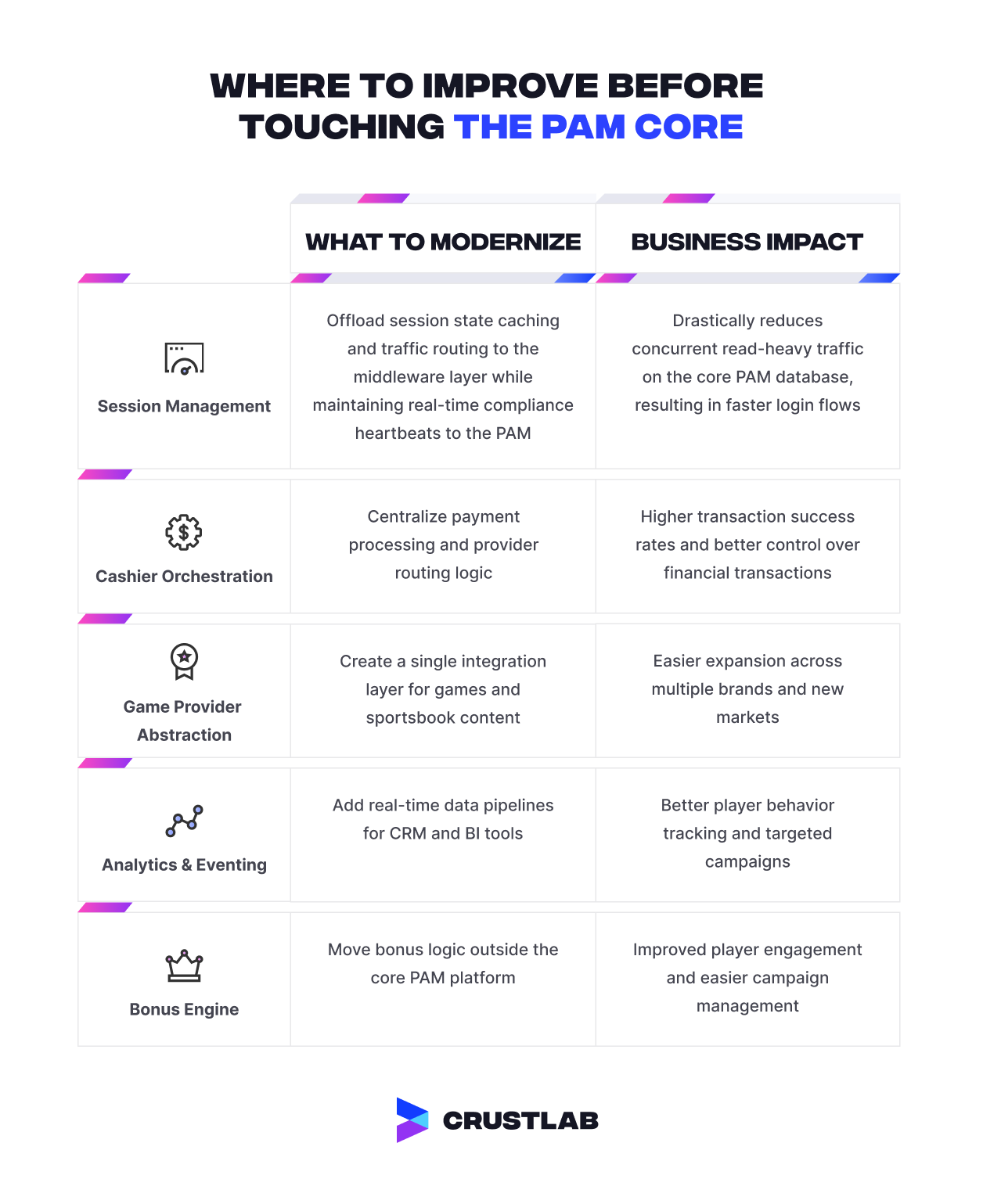
Modernization Quick Wins: What to Fix Before Touching the Core
Before replacing the core iGaming PAM, operators can achieve major improvements by modernizing high-impact areas around the platform first. This pragmatic approach improves operational efficiency and control while reducing the risks tied to full player account management migrations.
| Area | What to Modernize | Business Impact |
| Session Management | Offload session state caching and traffic routing to the middleware layer while maintaining real-time compliance heartbeats to the PAM | Drastically reduces concurrent read-heavy traffic on the core PAM database, resulting in faster login flows |
| Cashier Orchestration | Centralize payment processing and provider routing logic | Higher transaction success rates and better control over financial transactions |
| Game Provider Abstraction | Create a single integration layer for games and sportsbook content | Easier expansion across multiple brands and new markets |
| Analytics & Eventing | Add real-time data pipelines for CRM and BI tools | Better player behavior tracking and targeted campaigns |
| Bonus Engine | Move bonus logic outside the core PAM platform | Improved player engagement and easier campaign management |
The iGaming Decision Framework: When is it Finally Time to Replace Your PAM?
While decoupling your application protects your operational efficiency, it does not mean your existing player account management core will last forever. Engineering leaders must continuously evaluate the structural integrity of their transaction engine. When your tech stack no longer aligns with your long-term business goals, you need a clear strategy to address the bottleneck.
Instead of jumping straight into a high-risk migration, apply this pragmatic four-step decision framework to evaluate your core:
1. Retain
Keep your existing core if the database ledger effortlessly handles peak sports betting traffic, settlements are accurate, and your regional compliance logic is stable.
Action: Leave the transaction engine completely alone. Direct your engineering resources toward optimizing presentation layers and building real-time data pipelines.
2. Extend
Choose this path when your ledger is performant, but your marketing teams cannot build targeted campaigns because the built-in bonus engine or loyalty features are outdated.
Action: Bypass the legacy system entirely. Connect your middleware to modern, third-party promotional software and external bonus logic engines via clean API integrations.
3. Wrap
Wrap your core when your underlying database architecture is highly fragile, poorly documented, or burdened by severe legacy code that makes change requests dangerous.
Action: Completely isolate the core ledger behind your middleware control plane and specialized adapters. Turn the PAM into an invisible transaction processor, hiding its structural debt from the rest of your tech stack.
4. Replace
Execute a complete platform migration only when the database engine fails to scale or experiences frequent database lockouts during peak betting events.
Action: Since you have already decoupled your frontend, frontend applications, and orchestration layers in the previous phases, you can swap out the underlying ledger with minimal risk. Your player experience remains completely untouched during the transition.
Conclusion: Building for the Future, Not Just the Next Replatform
An iGaming PAM is not just about replacing old software with a newer platform. The real goal is to build a flexible tech stack that gives operators greater control over player engagement, compliance, payment processing, and long-term business growth.
By focusing on frontend ownership, middleware orchestration, and integration stability first, businesses can improve operational efficiency without risking the core player account management system. This phased and pragmatic approach allows operators to scale across regulated markets and launch services faster without constantly rebuilding the entire platform. In the modern iGaming industry, the operators with the strongest competitive edge are not always the ones with the newest PAM software, but the ones with the most adaptable architecture.
FAQ
What is the difference between a Player Account Management and a Sportsbook?
A player account management PAM handles player accounts, wallets, compliance, bonuses, and player data, while a sportsbook manages betting markets, odds, events, and wager settlements. The PAM system serves as the core platform that connects all services.
Can I change my frontend without changing my iGaming PAM?
Yes, by completely decoupling your user interface from the backend core using a modern middleware layer and stable APIs. This architecture allows you to launch custom user layouts and optimize player interaction without modifying your underlying database ledger.
How much does a full iGaming PAM migration cost?
The cost depends on the size of the business, compliance requirements, integrations, and the number of services connected to the platform. For large operators in regulated markets, a full migration can become a major multi-million-dollar modernization project.
What is “PAM Optionality”?
PAM optionality is an architectural approach in which operators reduce their dependency on a single PAM system by using middleware, orchestration layers, and stable integrations. This gives businesses more flexibility to modernize or replace the core platform later with lower operational risk.