Casino Payment Processing: Guide on Payment Gateways for Gambling Business

- How the Transaction Flow Works: From Deposit to Payout
- Processor vs Gateway vs Merchant Account vs Acquiring Bank
- Acquirer Instability and the Risk of Sudden Delisting
- Chargeback Rates and Regional Approval-Rate Variance
- KYC and AML as Risk Infrastructure
- Plug-and-Play Compliance: Stacking KYC, AML, and Geolocation by Region
- Jurisdiction Snapshot: MGA, UKGC, Curaçao Reform, and US State Licensing
- Step 1: Obtain a Gambling License
- Step 2: Prepare Underwriting Documentation
- Step 3: Choose a High-Risk Acquirer or Processor
- Step 4: Pass Underwriting and Risk Review
- Step 5: Integrate the Gateway Into Your Platform
- Understanding Rolling Reserves
- MCC Codes and Why They Matter
- The Business Case for Orchestration
- Dynamic Smart Routing: Minimizing Fees, Maximizing Margin
- Cascading Transactions: How a Failed Deposit Gets Silently Saved
- Localization as a Retention Strategy
- Instant Payouts as a Marketing Weapon
- Designing Around KYC Friction Instead of Hiding It
- API-First Integration Strategy
- Connecting Payments to Your PAM (Player Account Management) System
- Common Integration Pitfalls and How to Avoid Them
- Security and Compliance During Development
- Processing Rates and Setup Fees
- Rolling Reserves and Chargeback Penalties
- Tips to Reduce Your Processing Costs
For online casinos, payment infrastructure does far more than process deposits and withdrawals. In this competitive industry, payment speed and approval rates can directly influence player retention and revenue. Modern casino payment processing requires gambling operators to balance regulatory compliance, fraud prevention, and support for local payment methods across multiple markets.
Gambling businesses must also manage the challenges that come with operating in a high-risk industry, from banking restrictions to chargeback pressure. This guide explains how custom online casino software solutions can optimize your transaction framework, protect customer information, and shield your platform from vendor lock-in.
- Modern casino payment processing is a business-critical function that directly impacts approval rates, player retention, regulatory compliance, and long-term revenue growth.
- Payment orchestration helps gambling operators reduce single-provider risk, improve transaction performance, increase approval rates, and maintain operational resilience.
- Fast withdrawals, localized payment methods, and seamless cashier experiences play a major role in building player trust, satisfaction, and loyalty.
- Flexible, API-driven payment infrastructure enables operators to adapt quickly to changing regulations, banking relationships, market demands, and growth opportunities.
What Is Casino Payment Processing?
Casino payment processing is the system that enables online casinos to securely manage financial transactions. It involves multiple components working together, including a payment gateway, a payment processor, a merchant account, an acquiring bank, and various payment methods. This framework translates real-world cash, e-wallets, crypto, or bank cards into a digital balance inside a player’s account, and vice versa.
Unlike traditional e-commerce businesses, gambling operators must support players across different regions while complying with strict regulatory requirements. This means handling multiple currencies, local payment methods, fraud-prevention controls, and anti-money laundering procedures throughout the payment process. Since the gambling industry is considered high risk, payment processing capabilities are often more complex than those used in many other industries.
How the Transaction Flow Works: From Deposit to Payout
Every gambling payment starts when a player chooses one of the available payment methods and initiates a deposit. The payment gateway securely captures the transaction details and passes them to the payment processor, which communicates with the relevant banks and payment networks to authorize or decline the transaction.
Once approved, the funds are routed through the acquiring bank and settled into the casino’s merchant account. The player can then use those funds on the online gambling platform to place bets or play games.
The payout process follows a similar path in reverse. When a player requests a withdrawal, the casino verifies the request, performs the necessary compliance checks, and sends the funds through the appropriate payment systems. Depending on the payment method used, payouts may be delivered through bank transfers, e-wallets, debit cards, instant banking solutions, or other payment options.
Processor vs Gateway vs Merchant Account vs Acquiring Bank
The terms payment gateway, payment processor, merchant account, and acquiring bank are often used interchangeably, but they serve distinct functions in casino payment processing.
- Payment gateway: The technology that securely captures and transmits transaction data between the player, the casino, and the payment infrastructure. If you’d like a deeper explanation, see our guide on what is a payment gateway and how does it work.
- Payment processor: The engine that handles the actual transmission of data. It retrieves transaction information from the gateway, routes it through the card networks (such as Visa or Mastercard), and coordinates security validation and fraud-prevention checks.
- Merchant account: A specialized bank account required for gambling businesses. It acts as a temporary holding pen for funds from approved player deposits, which are then settled into your primary business account.
- Acquiring bank: The financial institution that hosts your merchant account and assumes the ultimate financial risk for your transactions. The acquirer ensures payments are collected from the player’s bank and manages any customer disputes or network penalties.
Why Casino Payment Processing Is a Business Problem, Not Just a Technical One
In the online gambling industry, payment processing is closely tied to business performance. Every declined deposit is a lost opportunity to generate revenue, while slow payouts can push players toward competing online casinos. At the same time, gambling businesses must navigate regulatory compliance, fraud prevention requirements, and the challenges that come with operating in a high-risk sector.
That’s why leading gambling operators view payment processing as a strategic asset rather than a back-office function. The right setup can improve conversion rates, support local payment methods, strengthen banking relationships, and create a smoother player experience. A proactive igaming payment risk management is therefore essential to insulate your brand from unexpected platform outages and protect your bottom line.
Acquirer Instability and the Risk of Sudden Delisting
Due to the high-risk nature of online gaming, traditional financial institutions continuously evaluate their exposure to compliance overhead and reputational risk. It is common for an acquiring bank or payment processor to abruptly decide that a specific gambling market is no longer worth the compliance burden.
When an acquirer undergoes a policy shift, it can delist a merchant account with little to no advanced warning. If your brand is tied to a single payment gateway or processor, this sudden delisting will completely freeze your business overnight, leaving you unable to accept deposits or settle player payouts. This constant instability is why relying on a single connection is a massive operational liability and justifies the move toward a modular architecture.
Chargeback Rates and Regional Approval-Rate Variance
Chargeback rates in the online gambling industry run significantly higher than standard e-commerce. Disgruntled players often attempt to claw back their losses by falsely claiming unauthorized card use to their bank account providers. If your chargeback management is weak, high dispute rates will trigger heavy financial penalties and risk the termination of your merchant account.
Simultaneously, approval rates for identical transaction volumes can swing dramatically by region, card issuer, and local bank policies. A card processing attempt that succeeds on one banking network might fail on another due to overly restrictive gambling risk profiles. Without a system capable of managing regional approval-rate variance in real time, you may consistently lose clean transactions simply because your single processor couldn’t navigate the local issuer’s automated filters.
Legal and Regulatory Compliance: Why Compliance Enables the Business
For gambling operators, compliance is about more than avoiding fines. Strong regulatory compliance practices help maintain the banking and payment relationships that make casino payment processing possible in the first place.
Payment providers closely evaluate a casino’s risk profile before agreeing to support its transactions. Weak controls around fraud prevention, money laundering, player verification, or responsible gaming can increase the likelihood of account restrictions, higher reserve requirements, or even the loss of a merchant account.
Viewed this way, compliance becomes a business enabler rather than an administrative burden. Operators with strong compliance frameworks are often better positioned to secure payment processing capabilities and maintain stable relationships with financial institutions that support their growth.
KYC and AML as Risk Infrastructure
Far too many gambling businesses view Know Your Customer (KYC) and anti-money laundering (AML) protocols as friction points that drive away players. In reality, these systems are the essential risk infrastructure that keeps high-risk payment networks willing to process your transactions.
Weak AML controls or a failure to stop money laundering will result in catastrophic fines and the blacklisting of your platform by major card brands and payment providers. Without robust compliance tools, your processing setup will collapse because no legitimate payment processor will handle your financial transactions.
To maintain stable casino payment processing, an online gambling platform must approach KYC and AML in online gambling as foundational revenue protection. Proactive risk monitoring reassures acquiring banks that you can actively reduce fraud and identify suspicious transaction volume before it triggers a network alert.
Plug-and-Play Compliance: Stacking KYC, AML, and Geolocation by Region
Top gambling operators rarely rely on a single compliance solution across all markets. Instead, they combine specialized compliance tools for KYC, anti-money laundering checks, geolocation verification, and real-time transaction monitoring based on regional requirements.
This modular approach gives operators more flexibility as they enter new markets or adapt to changing regulatory requirements. Rather than rebuilding an entire compliance stack, they can add or upgrade individual services as needed.
Jurisdiction Snapshot: MGA, UKGC, Curaçao Reform, and US State Licensing
You need a clear understanding of the specific demands enforced by major gaming jurisdictions to be a global operator. Each top gambling license impacts how your platform must manage financial transactions and player data:
- Malta Gaming Authority (MGA): Securing a Malta gaming license demands rigorous player fund segregation and strict auditing. This establishes your platform as a highly trusted corporate entity among high-risk payment providers.
- UK Gambling Commission (UKGC): Operating under a UK gaming licence requires absolute enforcement of responsible gaming metrics, an outright ban on credit card gambling, and zero tolerance for weak AML checks.
- Curaçao Gaming Authority (CGA): The completed Curaçao gaming license reform is dramatically tightening previously relaxed oversight. The implementation of the LOK framework has fully replaced the legacy master license system with direct state-led licensing. Operating in Curaçao now mandates strict FATF-aligned AML/KYC protocols, mandatory local compliance officers, and physical technical substance within the jurisdiction, effectively elevating its international regulatory credibility.
- US State Licensing: Launching in the United States requires navigating a fragmented patchwork of state-by-state frameworks. Online betting rules, transaction tracking, and payment processor approvals vary significantly from state to state.
Opening a Casino Merchant Account
Since online gambling falls into the high-risk category, opening a merchant account typically involves more scrutiny than in standard e-commerce. Gaming operators must complete every onboarding phase meticulously to avoid immediate application rejection.
Step 1: Obtain a Gambling License
Licensing must come first. No reputable high-risk payment processor or acquiring bank will review an application without verified regulatory approval from a recognized jurisdiction.
Step 2: Prepare Underwriting Documentation
Underwriters typically request documentation that helps them assess the operator’s risk profile. This may include incorporation documents, ownership information, bank statements, processing history, business plans, and details about the online gambling platform.
Step 3: Choose a High-Risk Acquirer or Processor
Not every financial institution supports gambling businesses. Operators should focus on providers with experience serving high-risk industries and strong payment processing capabilities. Beyond pricing, factors such as approval rates, geographic coverage, supported payment methods, and compliance support should all be considered.
Step 4: Pass Underwriting and Risk Review
The underwriting process evaluates the business model, expected transaction volume, fraud prevention measures, chargeback history, and regulatory standing. Approval can take anywhere from 24 hours to several weeks, depending on the jurisdiction, provider, and complexity of the application.
Step 5: Integrate the Gateway Into Your Platform
Once approved, the operator can connect the payment gateway to its online casino or online betting platform. This usually involves API integration and sandbox testing before processing live transactions.
Understanding Rolling Reserves
A rolling reserve is a risk-mitigation tool used by an acquiring bank to mitigate sudden financial losses in high-risk industries. The acquirer holds a fixed percentage of the casino’s daily gross transaction volume in a separate bank account for a predetermined period before returning it to the operator. Standard high-risk terms typically require a 5% to 10% rolling reserve held for 90 to 180 days.
These requirements are not permanently fixed. An acquiring bank may abruptly increase your reserve percentage or extend the holding period if your platform experiences a sudden spike in chargebacks, a drastic shift in geographic coverage, or an unmanaged wave of fraudulent transactions. Conversely, maintaining clean processing histories and low dispute rates gives operators the leverage to negotiate lower reserve terms over time.
MCC Codes and Why They Matter
A Merchant Category Code (MCC) is a four-digit number assigned by card processing networks to classify a business type based on its risk profile and operational nature. In the online gambling industry, the most critical identifiers are MCC 7995 (the generic code for standard betting and wagering) and highly critical, jurisdiction-specific identifiers like MCC 7801 (Government-Licensed Online Casinos) and MCC 7802 (Government-Licensed Sports/Race Betting).
These codes directly dictate transaction approval rates. Many global banks configure their consumer card systems to automatically block or flag any financial transactions with a high-risk MCC, such as 7995. If your platform is misclassified or uses an incorrect code, it triggers a cascade of automated bank declines, regardless of the player’s actual bank account balance. Gambling operators must coordinate closely with their payment provider to ensure every transaction is tagged with the precise, legally accurate MCC for their license type.
Payment Methods Every Casino Should Offer
To serve a diverse user base, an online gambling platform must go beyond basic transaction processing. Balancing standard card processing with alternative payment methods ensures that gambling merchants can capture diverse player demographics and reduce transaction friction.
- Credit and Debit Cards – Visa and Mastercard are the most widely used payment options in the online gambling industry. While they are universally understood and vital for driving fast deposits, card decline rates remain a persistent pain point for gambling operators due to restrictive bank risk filters. To protect conversions, card networks must be coupled with smart alternative channels.
- E-Wallets (PayPal, Skrill, Neteller) – Popular for fast deposits and withdrawals, e-wallets can also help reduce chargebacks because players transact through an intermediary rather than directly with the casino. However, operators must account for localized availability constraints, such as strict PayPal regulations on online betting in the US.
- Prepaid Vouchers (Paysafecard) – Prepaid cards and vouchers eliminate chargeback rates entirely, as prepaid transactions are funded with cash upfront. This method is highly favored by privacy-conscious players or unbanked users within specific geographic regions.
- ACH, Bank Transfers, and Open Banking – Traditional bank transfers and ACH processing provide secure mechanisms for large transactions, as they operate under NACHA rules rather than card-network dispute frameworks. Modern operators are shifting toward open banking frameworks, such as Trustly, for instant bank transfers that bypass card network fees and eliminate automated card decline triggers entirely.
- Cryptocurrency and Stablecoins – Crypto payment systems and stablecoin networks appeal to modern demographics by offering accelerated cross-border transaction speed and near-zero chargeback risk. While integrating digital assets dramatically reduces fraud liability, gambling businesses must carefully weigh ongoing regulatory compliance shifts and regional licensing restrictions before implementation.
- Mobile Wallets and Instant Payouts – Apple Pay and Google Pay streamline mobile checkout by utilizing biometric authentication to reduce fraud and maximize instant deposit authorization. Concurrently, integrating specialized instant payout rails (such as Visa Direct and Mastercard Send) enables gambling platforms to deliver winnings within minutes, turning withdrawal efficiency into a primary retention tool. Discover how optimizing a mobile payment gateway can transform your platform’s conversion rates in our mobile payment gateway technical guide.
The Orchestration Layer: Why Modular Architecture Is the Real Differentiator
Processor outages, declining approval rates, compliance issues, and sudden changes in banking relationships can disrupt revenue overnight. For this reason, leading gambling operators are moving beyond single-provider setups and investing in payment orchestration. A modular architecture makes it easier to adapt to regional differences and keep transactions flowing when individual providers fail.
The Business Case for Orchestration
Aside from being a technical upgrade, adopting payment orchestration is also an executive growth decision. In high-risk sectors, vendor stability is never guaranteed. If your turnkey platform provider relies on a monolithic framework, a single compliance shift at their chosen bank can halt your entire deposit volume overnight.
A modular orchestration layer safeguards your operation against this exact vulnerability. By maintaining active connections to multiple payment gateways, your business can absorb sudden processor delistings or localized network drops without a second of customer-facing downtime. It gives operators the power to route transaction volume based on live performance data and negotiate better commercial terms with competing payment providers.
Dynamic Smart Routing: Minimizing Fees, Maximizing Margin
Not all transactions cost the same to process. Fees and processing performance can vary based on geography, card issuer, transaction value, and the payment processor handling the request.
With intelligent routing, a payment orchestration platform automatically directs transactions to the most suitable provider in real time. This allows gambling operators to improve approval rates and lower transaction fees without adding complexity for players.
Over thousands of daily transactions, even small improvements in routing efficiency can translate into significant margin gains and higher revenue retention.
Cascading Transactions: How a Failed Deposit Gets Silently Saved
A primary cause of player churn in the online gambling industry is the automated card decline. When a player attempts a fast deposit with a valid card, their bank account provider may still block the transaction simply because it flags an online gambling Merchant Category Code (MCC). In a traditional single-gateway setup, this results in an immediate failure message that prompts the player to leave the platform.
Cascading transactions fix this friction through an automated mechanism:
- The block: A player initiates a deposit, and the primary payment processor returns a decline due to restrictive bank filters.
- Interception: The payment orchestration layer detects the failure code within milliseconds, before the player even realizes a problem has occurred.
- Reroute: The engine instantly duplicates the transaction data and pushes it to a secondary high-risk payment processor or alternative payment channel.
- Success: The secondary acquirer approves the transaction. The deposit is completed seamlessly, and the player simply sees a successful transaction screen. This silently saves the deposit and protects casino revenue.
Designing the Cashier: Why Cashout Speed Wins or Loses Players
Most operators focus heavily on deposits, but it’s in withdrawals where trust is truly earned or lost. While players expect fast deposits, their long-term loyalty is often shaped by how quickly and smoothly they can access their winnings. A well-designed cashier can improve retention and turn payment infrastructure into a competitive advantage.
Localization as a Retention Strategy
To build sustainable player lifetime value, your digital cashier must look and feel completely native to the end user. True localization requires dynamic multi-currency processing that automatically adapts to a player’s geographic coverage. When a user opens the cashier, they should immediately see their local currency, familiar terminology, and regional payment options prominently displayed at the top of the interface.
Forcing a player to convert funds manually or navigate unfamiliar international payment methods introduces immediate friction. Offering local payment methods reduces registration abandonment and ensures that your platform aligns perfectly with regional user preferences. It transforms the checkout layout into a powerful retention lever.
Instant Payouts as a Marketing Weapon
Fast withdrawals have become a major differentiator in the online gambling industry. While many online casinos still take days to process payouts, operators with instant or near-instant cashouts can turn transaction speed into a competitive advantage.
Modern payment systems allow operators to separate payout infrastructure from deposit infrastructure. By connecting your platform to instant payout frameworks like Visa Direct or Mastercard Send, you can deliver winnings to a player’s bank account or e-wallet within minutes rather than days.
For players, quick access to funds builds trust. For operators, it can improve retention, increase repeat transactions, and create a marketing message that is far more compelling than another bonus offer.
Designing Around KYC Friction Instead of Hiding It
It is impossible to make the payment journey completely frictionless. KYC checks are essential parts of regulatory compliance, especially when players reach certain deposit or withdrawal thresholds.
The problem arises when operators treat these requirements as unexpected obstacles rather than planned user experiences. A generic “verification required” message can create confusion and make players feel that payouts are being delayed unnecessarily.
A better approach is to explain the process clearly and at the right moment. Simple messaging, progress indicators, and transparent expectations help players understand why information is needed. This reduces frustration while supporting compliance and fraud prevention goals.
Fraud Prevention and Chargeback Management
Operating in high-risk industries requires a proactive security approach. For gambling merchants, robust fraud prevention is a critical defense mechanism needed to protect customer information, reduce fraud, and maintain clean processing relationships with acquiring banks.
Key components of an effective fraud prevention strategy include:
- Real-time fraud scoring and machine learning: Risk models analyze behavioral and transactional patterns to identify suspicious transactions before they are completed.
- Device fingerprinting and geolocation checks: These tools help detect account takeovers, identify duplicate accounts, and block users from restricted jurisdictions.
- 3D Secure, tokenization, and encryption: Security layers that protect customer information, reduce fraud liability, and secure card processing activities.
- Chargeback interception tools (Ethoca and Verifi): Alert networks that notify operators about potential disputes, allowing them to issue refunds before formal chargebacks occur.
- Avoiding the Mastercard MATCH list: Maintaining strong compliance, fraud prevention, and chargeback management practices helps operators avoid being added to this high-risk merchant database. Landing on this list can make future payment processing relationships much harder to secure.
How to Choose the Right Casino Payment Gateway: Selection Criteria Beyond Price
Many gaming operators make the mistake of evaluating a payment processor or gateway solely on headline transaction fees. While low fees are naturally desirable for protecting margins, they mean nothing if your processing system suffers from frequent technical outages or low transaction authorization rates. True operational efficiency requires assessing providers on deeper structural criteria.
When selecting a payment partner, prioritize architectural flexibility. The ideal system must offer robust multi-currency support and native payment orchestration capabilities to allow your platform to scale into new territories smoothly.
Additionally, look for gateways that provide advanced compliance tools and automated chargeback management features out of the box. Choosing an adaptable, API-first payment provider ensures you can continually optimize approval rates, minimize rolling reserve requirements, and turn your payment architecture into a genuine growth lever.
Operators considering digital assets should also evaluate support for cryptocurrency payments. Our guides to the best cryptocurrency payment gateway and how crypto payment gateway works provide a deeper look at this growing segment of the gambling payment ecosystem.
Best Casino Payment Processors and Gateways Compared
There is no single payment processor that works best for every gambling business. The right choice depends on your target markets, payment methods, compliance requirements, and growth strategy. The table below compares some of the most widely used solutions in the gambling industry.
| Provider | Core Strength | Supported Methods | Ideal Use Case |
| Payneteasy | Payment orchestration and intelligent routing | Cards, e-wallets, bank transfers, other payment methods | Gambling operators managing multiple processors and payment gateways |
| Nuvei | Global reach and high-risk processing | Cards, e-wallets, bank transfers, instant banking, crypto | Online casinos operating across multiple jurisdictions |
| Paysafe | Strong iGaming ecosystem | Cards, Skrill, Neteller, Paysafecard | Operators focused on online gambling and sports betting markets |
| Trustly | Open and instant banking | Instant bank transfers and bank account payments | Markets where players prefer direct bank transfers |
| Worldpay | Enterprise-scale payment processing | Card, digital wallets, bank transfers | Large gambling businesses with high transaction volume |
| Checkout.com | Global card processing infrastructure | Cards, digital wallets, alternative payment methods | Operators prioritizing approval rates and geographic coverage |
Integrating Payment Gateways Into Your Casino Platform
For gaming operators relying on turnkey architecture, executing multiple payment integrations can quickly lead to crippling technical debt. When you do not have an in-house engineering group, your business becomes entirely dependent on your platform provider’s slow roadmap priorities.
You can avoid this issue with a deliberate approach to backend architecture. A good understanding of how to create a payment gateway or implement flexible connections frees your business from vendor lock-in.
API-First Integration Strategy
An API-first approach makes it easier to connect payment gateways, payment processors, compliance tools, and other third-party services without creating unnecessary complexity. Instead of building custom integrations for every new provider, operators can use standardized APIs to add or replace services as business needs change.
This flexibility is especially valuable for gambling operators that support multiple payment methods, multiple currencies, and multiple markets. It also reduces long-term technical debt and makes payment orchestration easier to implement as the business grows.
To learn more about the benefits of this model, explore our guide to the API-first approach.
Connecting Payments to Your PAM (Player Account Management) System
Every completed financial transaction must be instantly reflected in your Player Account Management (PAM) system. The PAM serves as the master database of your online gambling platform, tracking user balances, processing KYC statuses, and maintaining vital compliance logs.
When a player initiates a transfer via an integrated payment gateway, the system must trigger synchronous webhooks to update the PAM layer. This ensures that approved deposits are immediately reflected in the active player wallet, while withdrawal requests automatically lock the corresponding funds to prevent double-spending. Maintaining real-time communication between your processing setup and your iGaming PAM is essential for accurate business reporting, tax calculations, and reliable financial auditing.
Common Integration Pitfalls and How to Avoid Them
Even the best payment gateway can create problems if the integration is not implemented correctly. Small technical issues can lead to failed transactions and inaccurate reporting.
Some of the most common challenges include:
- Webhook failures: Missing or delayed notifications can cause balance discrepancies and incomplete transaction records.
- Currency rounding errors: Poor handling of multiple currencies can lead to reconciliation problems and incorrect payments.
- Duplicate transactions: Retry mechanisms that are not properly configured may accidentally process the same payment multiple times.
- Sandbox-to-production gaps: A payment flow that works in testing may behave differently in a live environment due to real-world banking rules and transaction volume.
Security and Compliance During Development
During the active integration phase, it is non-negotiable to maintain strict security standards to protect customer information and reduce fraud. Software development teams must leverage tokenization practices to ensure that sensitive credit and debit card data never touches the casino’s local servers.
By using secure iFrames or hosted payment fields provided directly by the payment processor, operators can drastically reduce their PCI DSS scope. This protective architecture ensures that advanced encryption layers wrap the transaction data immediately at the point of capture. It secures vital financial transactions while satisfying strict regional regulatory requirements during bank underwriting.
Costs of Casino Payment Processing
Casino payment processing involves more than just transaction fees. Gambling operators must account for processing rates, rolling reserves, compliance costs, chargeback penalties, and the infrastructure needed to support secure, reliable transactions. Understanding these costs upfront makes it easier to budget effectively and avoid surprises as transaction volume grows.
Processing Rates and Setup Fees
Turnkey operators must budget for multiple operational cost layers when setting up their payment system:
- Card processing fees: While standard merchant card processing often falls around 1.5%–3%, high-risk gambling merchants may pay 3%–6% or more once interchange, scheme fees, processor markups, and risk premiums are included. Actual costs vary by jurisdiction, transaction type, chargeback history, and provider.
- Alternative payment methods fees: E-wallets and instant banking solutions may reduce card-network costs and improve approval rates, but pricing models differ widely. Some providers charge percentage-based fees, while others combine percentage fees with fixed per-transaction charges. Hence, total costs are dependent on transaction volume and average deposit size.
- Setup and integration fees: Many top payment gateways require upfront integration costs ranging from $500 to several thousand dollars per connection. This is coupled with ongoing monthly maintenance minimums.
Rolling Reserves and Chargeback Penalties
As established earlier, acquiring banks mitigate their financial exposure by maintaining a rolling reserve, typically holding 5% to 10% of gross transaction volume for 90 to 180 days. This mandatory withholding acts as an ongoing cash flow constraint that operators must account for in their working capital models.
Operators may also face additional costs when chargeback rates exceed acceptable thresholds. Excessive disputes can trigger higher reserve requirements, penalty fees, increased scrutiny from acquiring banks, or even restrictions on payment processing services.
Tips to Reduce Your Processing Costs
To defend your platform’s operational margins, gaming operators can utilize several practical levers to systematically reduce transaction fees:
- Deploy dynamic smart routing: Program your payment orchestration layer to route domestic debit card transactions through local acquiring banks to bypass expensive cross-border interchange penalties.
- Incentivize low-fee payment methods: Use targeted user preferences and cashier design to steer players toward open banking, instant banking, or digital wallets. These options carry significantly lower fees than credit cards.
- Implement proactive pre-dispute tools: Integrate alert systems like Ethoca or Verifi to intercept disputes before they mature into formal chargebacks. This prevents your merchant account from incurring compounded network penalties.
- Negotiate reserve terms dynamically: Once your platform establishes a proven 6-to-12-month track record of low fraud and low chargeback rates, formally petition your acquiring bank to lower your rolling reserve percentage or shorten the holding window.
Future Trends in Casino Payment Processing
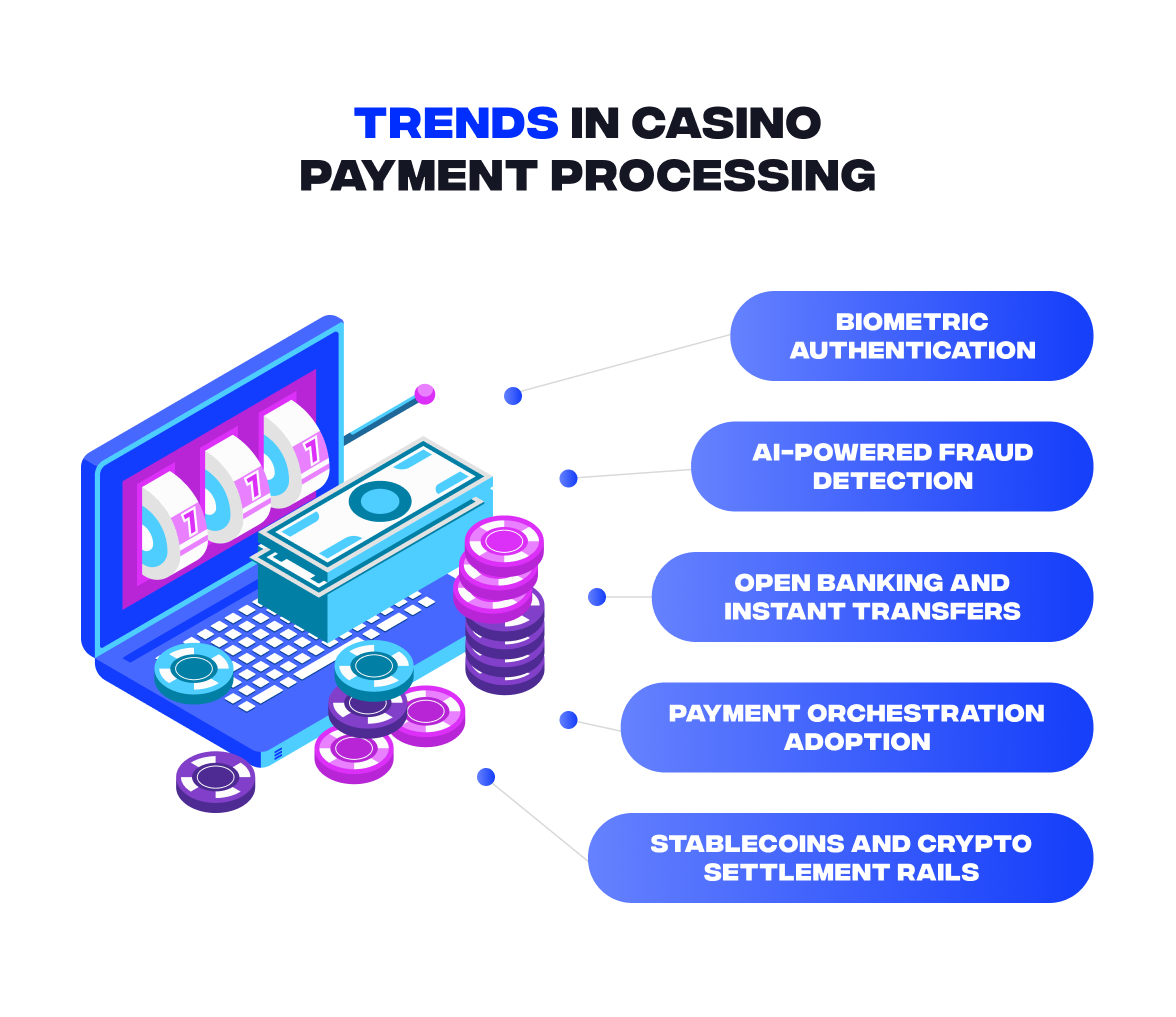
As the online gambling industry evolves, gaming operators must keep pace with emerging financial technologies to retain a competitive edge. Staying ahead of modern processing trends enables you to optimize your transaction framework and meet evolving user preferences.
- Payment Orchestration Adoption – More gambling platforms are abandoning single-processor relationships in favor of advanced payment orchestration networks. Relying on a single payment gateway creates an operational risk. If that provider undergoes an unexpected compliance shift, your cash flow can freeze overnight. Adopting a modular orchestration architecture enables you to seamlessly connect multiple payment gateways, implement intelligent routing, meet regulatory requirements, and insulate your brand from unexpected platform outages.
- Stablecoins and Crypto Settlement Rails – Stablecoins are gaining traction in the online gambling industry because they offer faster settlement times and fewer intermediaries than traditional payment systems. For gambling operators handling cross-border transactions, this can improve efficiency and reduce delays associated with international bank transfers. Unlike traditional cryptocurrencies, stablecoins maintain a stable value that makes them more practical for everyday financial transactions. They can also help operators move funds between payment providers, merchants, and banking partners more quickly. Finally, blockchain settlement rails drastically reduce transaction fees and fraud liability.
- AI-Powered Fraud Detection – Artificial intelligence is becoming an increasingly important tool for fraud prevention in the gambling industry. Modern systems can analyze large volumes of transaction and behavioral data in real time to identify suspicious activity that traditional rule-based systems might miss. Machine learning models continuously improve as they process more data, helping operators detect fraud patterns more accurately. This allows gambling businesses to reduce fraud while minimizing false declines that can negatively impact approval rates and the player experience.
- Open Banking and Instant Transfers – Open banking is gaining momentum as an alternative to traditional card processing. By using secure application programming interfaces (APIs), open banking software enables players to make instant bank transfers directly from their personal bank account without entering sensitive debit card data. This method completely bypasses expensive card network processing fees, provides absolute chargeback protection, and aligns with user preferences for instant transaction speed.
- Biometric Authentication – The traditional password and one-time password (OTP) verification steps are rapidly being replaced by biometric authentication methods. Integrating face and fingerprint recognition software into mobile wallets, such as Apple Pay and Google Pay, drastically reduces checkout friction. Biometrics offer robust security that protects customer information, lowers chargeback rates, reduces account takeover risks, and ensures full regulatory compliance without compromising the player experience.
Final Thoughts: Payment Infrastructure as a Growth Lever
You are making a business error by treating casino payment processing as a secondary IT requirement. Payment infrastructure is a primary driver of player acquisition, brand trust, and operational margin.
To scale successfully, you must view your payment architecture as a strategic growth lever. By building a flexible payment stack that supports multiple processors, local payment methods, and intelligent routing, operators can reduce risk, improve player experiences, increase profit, and adapt more quickly to changes in the online gambling industry.
Are you launching a new platform or scaling an existing one? Investing in the right payment architecture today can create a stronger foundation for growth tomorrow. Contact our team to discover the right custom online casino software solutions for your business.
FAQ
What is payment orchestration in iGaming?
Payment orchestration is a software layer that connects a casino’s cashier to multiple payment gateways simultaneously. It automatically routes transactions to the best processor to prevent single points of failure and platform downtime.
Why do casino deposits get declined even with a valid, funded card?
Common reasons include issuer restrictions, fraud checks, gambling-related bank policies, and regional compliance rules.
How fast should casino withdrawals be processed?
The best operators process withdrawals within minutes or hours. Faster payouts generally lead to higher player trust and retention.
What is the difference between a payment processor and a payment gateway?
A payment gateway is the secure software layer inside the cashier that captures and encrypts player data. Meanwhile, a payment processor is the backend engine that actually transmits that encrypted data across financial networks to complete the transaction.
What fees should operators expect for casino payment processing?
Operators can expect all-in high-risk card processing fees ranging from 3.0% to 6.0% per transaction. Additional expenses include upfront setup fees ($500 to several thousand dollars), rolling reserves (5% to 10% withheld for 90 to 180 days), and flat chargeback penalties.