How Product Discovery in iGaming Drives Frontend Modernization
iGaming operators invest heavily in frontend modernization, only to discover too late that the new experience doesn’t improve their conversion and retention rates. These projects often fail because they focus on redesigning interfaces before validating what players and the underlying technology actually need. Product discovery in iGaming helps prevent that by combining user research, customer feedback, technical feasibility, and business goals before development begins.
For regulated casino and sportsbook operators, this approach to iGaming software development reduces feasibility risk, uncovers opportunities hidden in existing product analytics, and helps product teams make data-driven decisions instead of relying on assumptions. In this article, you’ll learn how product discovery guides frontend modernization and builds a roadmap that delivers measurable business outcomes.
- Product discovery in iGaming reduces modernization risk by validating user needs, technical feasibility, business goals, and compliance requirements before development begins.
- Discovery helps operators prioritize the right frontend improvements by combining user research, product analytics, and retention data to identify the journeys that will deliver the greatest business value.
- Successful modernization goes beyond design by accounting for platform limitations, avoiding clone syndrome, and following a phased implementation strategy that minimizes disruption and accelerates time-to-market.
- A discovery-led roadmap turns frontend modernization into a measurable investment, using KPIs such as FTD conversion, D7/D30 retention, and player engagement to justify spending and evaluate success.
Product Discovery Isn’t Just an Audit – It’s Where the First Visual Direction Comes From, Too
Many operators treat product discovery as a simple audit that ends with a go-or-no-go decision. In reality, the product discovery process is where product teams shape the product vision, define the minimum viable product, and begin exploring the first visual direction for the frontend. It combines business analysis, user research, competitive analysis, and technical assessments to ensure the development team solves the right problems from the start.
This early process also helps identify pain points, uncover market trends, and understand user behavior before design or development begins. Instead of handing designers a list of requirements, the product discovery process provides the insights needed to create journeys that align with user expectations and support business goals.
Skipping discovery often leads to costly redesigns that improve the wrong screens or add features players don’t value. That’s why successful operators use this process to decide what deserves investment before starting development. For sportsbook operators in particular, aligning discovery with proven sportsbook UX principles helps ensure modernization efforts improve the player experience instead of simply refreshing the interface.
The Four Risks Every iGaming Frontend Redesign Should Clear Before It’s Funded
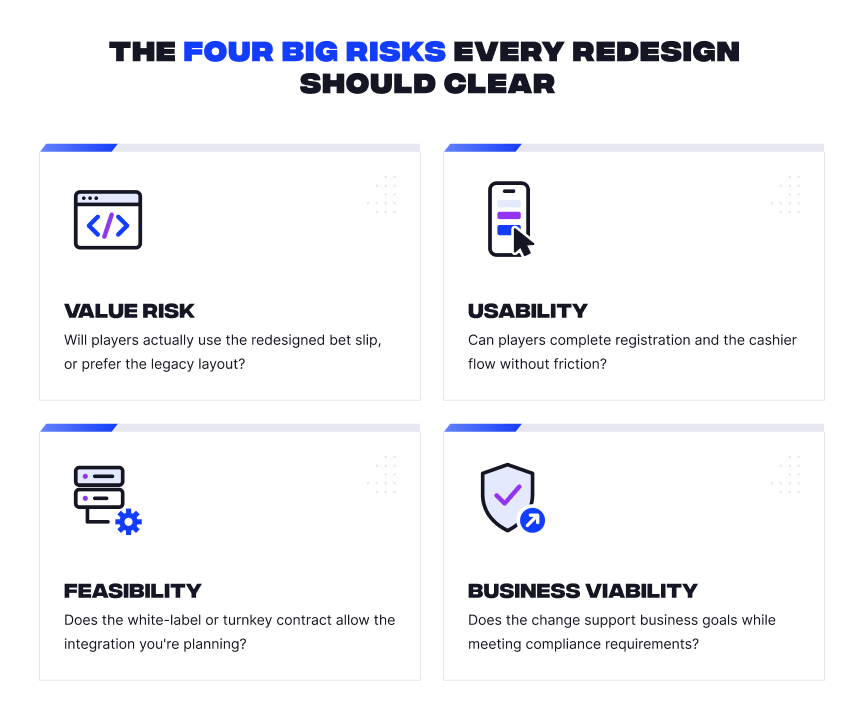
Every frontend modernization project starts with an idea, but not every idea deserves funding. During product discovery, product teams evaluate proposed changes using the Four Big Risks framework popularized by Marty Cagan: Value, Usability, Feasibility, and Business Viability. This framework helps product managers make informed product decisions before committing resources.
- Value risk: Will players actually use the updated features? For example, testing whether a redesigned live bet slip improves player engagement or if users simply prefer the legacy layout.
- Usability: Can players complete key journeys, such as registration or the cashier flow, without friction? Testing with real users helps identify gaps between the design and user expectations.
- Feasibility: Can your existing infrastructure support the change? This means identifying platform boundaries early, such as vendor constraints that limit custom WebSocket integrations, push feeds, or event-driven APIs required for real-time odds updates.
- Business viability: Does the change support business goals while meeting regulatory requirements? A feature that creates value but cannot pass compliance testing is unlikely to make it into the final product.
Mapping the Frontend Surfaces Worth Modernizing: Lobby, Cashier, and Bet Slip Against Retention Data
All frontend screens don’t have the same impact on business performance. During product discovery, product teams should combine user insights with product analytics to identify which journeys create the most friction and where modernization can deliver the greatest value. This approach helps product managers prioritize investments based on evidence instead of assumptions.
Start by mapping the key frontend surfaces players interact with every day, including the lobby, cashier, bonus wallet, and bet slip. Then compare those journeys with user feedback, customer feedback, and user behavior to identify patterns that affect player engagement and lifetime value. For example, a complicated cashier directly harms First-Time Deposit (FTD) conversion, while an unoptimized lobby increases user friction and degrades Day 1 (D1) retention. During the discovery stage, product teams analyze these baseline metrics to validate hypotheses, while the actual lift in conversion and retention serves as the post-launch output of implementation.
This data-first approach helps teams focus on the changes that matter most instead of redesigning every screen at once. It also creates a stronger product roadmap, ensuring development efforts target the areas with the highest potential return. Following modern frontend development trends can then help turn those insights into a frontend that supports stronger retention and sustainable growth.
The White-Label Ceiling: Why Discovery Should Test What Your Platform Contract Actually Allows
Many frontend modernization projects slow down because operators discover platform limitations after development has already started. During product discovery, product teams should review not only design ideas but also what their white-label or turnkey agreement actually allows. This includes API access, customization options, and change-request terms that could affect the project.
This discovery stage helps reduce feasibility risk by identifying technical and contractual constraints before the development team commits to a new feature or redesign. For example, an operator may want a custom cashier or bet slip, only to find that the vendor only supports limited branding changes or requires lengthy approval cycles. Catching these issues early helps key stakeholders make informed product decisions and avoid unnecessary delays.
Testing platform constraints during product discovery in iGaming also improves product strategy. Instead of planning features that cannot be delivered, product managers can focus on opportunities that fit both the platform and the business goals. The result is a modernization roadmap that delivers value faster while avoiding the costly surprises that often derail frontend projects.
Clone Syndrome vs the Bespoke Layer: Letting Discovery Findings, Not Vendor Defaults, Scope the Rebuild
One of the biggest challenges for white-label operators is clone syndrome. Shared templates may speed up product delivery, but they make it harder to stand out or meet evolving customer needs. As a result, operators often compete on bonuses rather than on player experience.
This is where product discovery creates value. Instead of accepting a vendor’s default upgrade package, product teams should use user insights, customer feedback, and product analytics to decide which journeys deserve a bespoke frontend layer. A custom lobby, cashier, or bet slip may deliver far greater business impact than redesigning every screen.
Letting discovery efforts shape the scope also reduces risk. Product managers can prioritize the features that address real pain points, support business goals, and create meaningful differentiation. Rather than funding a full platform migration, operators can build a targeted solution that delivers a unique experience while continuing to use the existing backend. This approach helps create the right product without investing in customization that adds little value.
Wrap, Augment, Replace: One Way to Sequence a Modernization Roadmap After Discovery
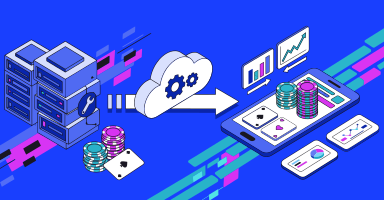
Once product discovery is complete, the next challenge is deciding how to modernize without disrupting the existing platform. Instead of replacing everything at once, you can adopt a phased approach to reduce risk, speed up product delivery, and help development teams deliver value sooner. One practical strategy is wrap, augment, replace (a Strangler Fig-based approach).
- Wrap: Start by building a modern frontend layer around the existing platform rather than replacing the backend. This lets product teams improve high-impact areas, such as the lobby or bet slip, while keeping core systems unchanged.
- Augment: Once the new frontend is live, gradually add capabilities that address the highest-priority user needs identified during product discovery. This could include a new feature, personalized promotions, faster navigation, or improved payment flows, allowing the development team to validate improvements before expanding them further.
- Replace: Replace legacy frontend components only after the new solution has proven its value through testing and real-world usage. By this stage, product managers have the insights and performance data needed to make informed product decisions. This ensures the final product delivers measurable business value without the disruption of a full rip-and-replace migration.
Product, Engineering, and Compliance: Why Discovery Has to Happen in the Same Room
Frontend modernization isn’t just a design or engineering project. In regulated iGaming, product discovery works best when product managers, the development team, compliance specialists, and other key stakeholders collaborate from the start. Bringing these perspectives together helps product teams balance customer needs, technical constraints, and regulatory requirements before development begins.
Compliance should be part of the discovery stage, not an afterthought. KYC and AML checks, geo-compliance, deposit limits, and responsible gaming controls all shape the user experience. If these requirements are overlooked, even the best ideas can require significant rework when compliance reviews the design. Early collaboration helps teams make informed decisions that support both business goals and regulatory obligations.
Additionally, discovery creates a shared understanding of what success looks like. Instead of working in silos, every team contributes insights that strengthen the product strategy and smooth the path to product delivery. Understanding the requirements around KYC and AML in online gambling early in the product development process helps operators avoid unnecessary redesigns and launch compliant frontend experiences with greater confidence.
Discovery ROI: The KPIs That Justify (or Kill) a Frontend Modernization Budget
Before approving a budget for frontend modernization, operators should be able to answer one question: How will we know if this investment succeeds? Product discovery provides that answer by establishing a measurable baseline before any development begins. Instead of starting with a redesign, product teams first define which business outcomes matter and how they will be measured after launch.
For example, a redesigned cashier might aim to improve First-Time Deposit (FTD) conversion, while changes to the lobby could focus on increasing D7 and D30 retention. If the goal is to make players spend more time exploring the platform, session length and player engagement become useful indicators. Measuring these online casino KPIs before and after implementation gives product managers objective insights into whether the changes created real value or simply refreshed the interface.
This also changes the conversation with key stakeholders. Rather than asking for funding based on design concepts or market trends, product teams can present a business case supported by data, expected outcomes, and a clear measurement plan. That makes it easier to stop weak ideas early and invest in improvements with the greatest potential return.
Conclusion: Product Discovery as the De-Risking Layer Before You Fund Frontend Modernization
Frontend modernization succeeds long before the first screen is redesigned. The real value comes from product discovery, where product teams validate ideas, uncover user needs, assess technical and compliance constraints, and build a roadmap grounded in business goals instead of assumptions. That early process helps operators reduce risk and focus on the changes most likely to improve player engagement and long-term lifetime value.
For Heads of Product, CTOs, and engineering leaders, the next step shouldn’t be a design sprint or a platform migration. It should be a structured product discovery within the iGaming initiative that brings together product, engineering, compliance, and business stakeholders before development begins. The result is a modernization strategy backed by evidence.
Are you ready to modernize your casino or sportsbook frontend? Explore CrustLab’s BETFAN sportsbook case study to see how a modern betting experience was delivered in practice.