
- CrustLab /
- blog /
- Explainers /
- Sportsbook UX as a Strategic Growth Layer: Building a Future-Proof Sports Betting Frontend
Sportsbook UX as a Strategic Growth Layer: Building a Future-Proof Sports Betting Frontend

Odds and markets are becoming increasingly similar across sportsbook platforms. This trend has turned sportsbook UX into one of the few remaining ways sportsbook operators can make their betting apps stand out and create a better sports betting experience for users.
Today, user experience directly influences how quickly bettors place bets and return to sports betting apps across mobile devices. Yet, many operators still depend on rigid platform providers that slow innovation and create roadmap bottlenecks.
Smart companies are building bespoke frontend systems to improve critical user journeys, such as event discovery, bet slip flows, and checkout funnels. This article explores why sportsbook UX is no longer just a design layer but a strategic growth engine tied to engagement, conversion rates, retention, and long-term competitive advantage.
- Sportsbook UX has evolved from a visual design layer into a strategic growth system that directly affects engagement, conversion rates, retention, and betting activity across online sports betting platforms.
- Many operators are using bespoke front-end layers to improve critical user journeys like live betting, event discovery, checkout funnels, and bet slip interactions without replacing their entire sportsbook platform.
- In a market where odds and betting options are increasingly commoditized, the overall sports betting experience has become a key competitive advantage for attracting and retaining bettors.
- Front-end ownership gives sportsbook operators greater control over user experience, analytics, personalization, product execution, and long-term innovation across mobile devices and desktop platforms.
Why Sportsbook UX Is No Longer a Design Layer but a Revenue Engine
For a long time, sportsbook UX was treated as a visual concern focused mainly on UI design and color schemes. That approach is now outdated because user experience directly affects how users interact with a sportsbook.
Modern bettors expect speed, intuitive navigation, real-time updates, and a seamless user experience throughout the betting process. If a sportsbook platform feels slow or difficult to use, users quickly switch to competitors that offer a better online sports betting experience. This is even more important during live events, where delays inside the bet slip or checkout funnel can frustrate users and reduce engagement.
To put it simply, the frontend is now a revenue engine that directly influences user engagement, conversion, retention, and long-term growth.
Experience vs. Odds: Why UX Is the Only Sustainable Edge
Many sportsbook operators still rely heavily on external providers for their frontend systems and core features. While this model speeds up initial launch timelines, it often creates long-term dependencies that slow innovation and limit control over the user experience.
For Heads of Product and CPOs, the biggest frustration is usually not a lack of ideas. The problem is being unable to launch high-impact features because they are stuck inside a provider’s global roadmap queue. A sportsbook may want to improve the bet slip, create better live betting flows, add new payment options, or personalize the user journey for mobile users, but every change depends on external approval and development timelines.
This dependency creates major business problems inside the sports betting industry. Operators struggle to react quickly to user preferences, release new features during major sports events, or optimize conversion rates fast enough to stay competitive. Over time, the sportsbook experience becomes generic, and operators lose flexibility in critical growth areas like engagement and user satisfaction.
UX as the Only Sustainable Competitive Advantage
Most operators in the sports betting industry are locked in a race to the bottom, competing primarily on odds to attract bettors. However, this is a battle with no true winner because betting markets have become commoditized. In a saturated industry where every sportsbook has access to identical data feeds, offering a slightly better price is no longer a unique selling point.
When every platform offers nearly identical markets and prices, the sports betting experience becomes the only true differentiator. Relying solely on odds is a risky strategy because it builds no long-term loyalty. If your only edge is a decimal point, your users will defect the moment a competitor undercuts you. This creates a cycle of high churn where operators are forced to spend more on aggressive bonuses just to keep their customers from leaving for a better deal elsewhere.
A bespoke user interface creates a sticky environment that commoditized odds cannot match. High-quality sportsbook UX addresses user needs by providing intuitive navigation that lets mobile users find prematch and live events in seconds. By focusing on a seamless user experience, operators also reduce the friction that leads to abandoned bets. Investing in unique UX is the only way to build a sustainable edge and turn casual bettors into loyal advocates.
The Front-End Wedge: Breaking Free From Sports Betting Platform Roadmap Constraints
Several CPOs and Heads of Product feel trapped by their platform providers. When a high-impact marketing idea or a necessary feature update is proposed, the answer is often a frustrating delay because the “feature is on next year’s roadmap.” This dependency occurs because most legacy platforms are monolithic, with the user interface so tightly coupled to the backend that simple changes require complex core overrides. This roadmap paralysis forces operators to surrender their product strategy to a third-party vendor’s global priorities.
The solution is the front-end wedge, a strategic decoupling of the presentation layer from the legacy engine. Instead of a risky, multi-year platform replacement, operators can peel off the user interface and build a bespoke frontend layer that communicates via APIs. By separating the UI from the backend heavy lifting, the product team gains the autonomy to innovate at the speed of marketing without waiting for a vendor’s queue to clear. Teams can respond faster to user preferences, optimize the betting experience across mobile devices, and launch experiments without waiting for provider roadmap approvals.
The Hybrid Tier: White-Label and Bespoke Are Not Binary
Companies in the sports betting industry still see platform strategy as a choice between two extremes: either stay fully dependent on a white-label sportsbook platform or invest in a complete bespoke rebuild. In practice, most sportsbook operators now operate somewhere in the middle.
A hybrid approach allows operators to keep their existing backend infrastructure while building a custom front-end layer around the most important parts of the user journey. This means they can improve sportsbook UX, create a stronger brand identity, and optimize critical flows without replacing the entire platform.
For many teams, this model offers a more realistic path to innovation. Operators can keep core systems like odds feeds, payment options, and account management while gaining more freedom over UI design, live betting experiences, mobile-first approach strategies, and engagement features. The result is a more flexible betting app that improves user satisfaction and helps operators stay competitive without taking on the risk of a multi-year migration project.
How the Bespoke Frontend Layer Delivers 80% of Value With 20% Risk
A bespoke frontend layer can deliver most of the commercial value of a complete platform replacement by optimizing critical user journeys like event discovery and live betting while keeping the existing sports betting platform in place. This approach reduces technical risk, shortens delivery timelines, and gives teams greater freedom to improve the sportsbook’s UX and conversion rates.
Critical User Journeys That Drive Betting App UX Performance
Not all parts of a betting app have the same commercial impact. In most sports betting platforms, a small number of critical user journeys directly influence engagement, conversion rates, and how often users place bets. These journeys include event discovery, rapid market browsing, the bet slip experience, checkout funnels, and live betting interactions across mobile devices.
When friction appears in these areas, users abandon bets or leave the platform entirely. A strong sportsbook UX strategy focuses on reducing delays, simplifying decisions, and creating a seamless user experience during high-pressure betting moments. This helps sportsbook operators improve user satisfaction and overall betting activity.
Event Discovery as the First Conversion Gate
Event discovery is often the first point where users decide whether to stay engaged with a sportsbook or leave the platform. If bettors cannot quickly find a specific match or markets, the likelihood of an abandoned session skyrockets. This is especially important on mobile devices, where users expect fast access and intuitive navigation.
A well-structured sportsbook UX reduces search friction by using personalized recommendations, smart categorization, real-time updates, and clear user interface patterns. The faster users discover betting opportunities, the faster they place bets and move deeper into the sports betting experience.
Rapid Market Browsing and Decision Compression UX
Today’s bettors process large amounts of information in short periods. They compare odds, scan markets, track bets, and react to real-time updates while trying to place bets before conditions change. If the sportsbook platform feels cluttered or slow, decision-making becomes harder and users disengage.
For this reason, sportsbook UX must focus on reducing cognitive load and simplifying the betting process. Intuitive navigation, responsive design, and clear visual elements help users quickly navigate between sports, events, and betting markets on mobile devices. Faster decision-making creates a smoother sports betting experience and increases overall engagement and betting activity.
The Bet Slip as a Monetization Surface, Not a Utility Component
Many sportsbook operators still treat the bet slip as a simple utility where users review and confirm bets. In reality, the bet slip is one of the most important revenue-driving areas inside a betting app because it directly influences engagement and basket size.
A well-designed bet slip can encourage users to place additional bets and explore related markets. Features such as intelligent recommendations, social proof, real-time updates, and simplified checkout funnels create a more engaging user experience across mobile devices.
The “Sticky” Bet Slip: Driving Basket Size Through UX Intelligence
Modern sportsbook UX is increasingly borrowing mechanics from social media and e-commerce to deepen engagement. Features like copy-bet systems, trending bets, community picks, and shared bet slips create a more interactive sports betting experience while helping new users feel more confident.
These systems also reduce decision friction. Instead of building every bet manually, users can follow popular selections and react to live events faster. Gamified elements like achievements, streaks, and progress tracking further increase user engagement and retention.
Ownership of the Return Journey: Recovering Lost Revenue Moments
Many sportsbook platforms focus heavily on user acquisition but overlook what happens when the betting process is interrupted. Failed payments, app crashes, session timeouts, or abandoned bet slips often lead to lost revenue because generic systems provide very little control over the return journey.
With a custom UX, operators can recover these lost moments through personalized prompts, push notifications, saved bets, and seamless re-entry flows across mobile devices. Rather than forcing users to restart the process, the platform can guide them back to unfinished actions quickly and with minimal friction. This increases completed bets and helps sportsbook operators recover engagement that would otherwise be permanently lost.
Turning Payment Failures Into Conversion Recovery Opportunities
Payment failures are among the most common reasons for revenue leakage in a sportsbook. In a standard setup, a declined transaction often results in a generic error message that kills the user’s momentum and sends them straight to a competitor. Owning the frontend enables you to replace these dead ends with active recovery flows that keep the player in the app.
Instead of a simple “Transaction Failed” notification, a custom interface can suggest alternative payment methods or provide a one-click retry option. This proactive approach turns a moment of frustration into a seamless pivot, guiding the user back to their bet slip without them having to restart the entire process. Push notifications, saved payment information, and clear user interface messaging also help reduce abandonment.
Analytics Sovereignty: Why UX Ownership Means Data Ownership
Many sportsbook operators still rely on provider-controlled dashboards that offer limited visibility into user behavior across their betting platform. Without ownership of the front-end, teams often struggle to track detailed user journeys, understand engagement patterns, or optimize conversion rates effectively.
A bespoke sportsbook UX layer gives operators direct access to behavioral data tied to bet slip activity, live betting interactions, checkout funnels, and user preferences. This creates deeper insights for better decision-making and more control over the long-term growth strategy.
Data Blindness in White-Label Sportsbook Platforms
Relying on a standard white-label platform often leads to data blindness, where operators see the final bet but remain unaware of the journey that preceded it. Because the vendor controls the frontend code, you are restricted to the telemetry they choose to expose.
Teams may see overall betting activity or conversion numbers, but they often lack visibility into critical parts of the user journey, such as abandoned bet slips, failed checkout funnels, navigation friction, or live betting interactions across mobile devices.
This creates a major optimization problem inside the sports betting industry. Without granular data, sportsbook operators struggle to identify why users disengage or which features improve engagement and retention. A bespoke front-end layer helps eliminate this data blindness by giving operators direct ownership over tracking and insights.
Analytics as a Board-Level Asset
In modern online sports betting, data has moved from a product or marketing resource to a strategic business asset that influences decisions and long-term company valuation. Sportsbook operators who control their sportsbook UX gain deeper insights into how users place bets, interact with features, respond to push notifications, and navigate the betting process.
This level of visibility helps teams improve conversion rates, personalize the sports betting experience, and identify new revenue opportunities faster. It also strengthens investor confidence because operators own valuable behavioral data instead of relying entirely on third-party sportsbook platform reporting systems.
KPI Ownership Through Bespoke UX Systems
Bespoke UX systems shift the focus from vanity metrics to hard KPI ownership. When a product team owns the frontend, they gain the levers needed to move the needle on specific business goals, such as Average Revenue Per User (ARPU) and Retention Rate.
Instead of accepting the default performance of a vendor’s template, operators can run A/B tests on high-impact components like the “Quick Bet” interface or deposit flows. This level of control ensures that every design choice is data-driven, improving unit economics. Ultimately, custom UX transforms the interface into a precision tool for hitting aggressive growth targets.
Live Betting UX: Designing for Real-Time Commercial Impact
In live betting, speed is the biggest currency. A custom frontend eliminates the update lag common in monolithic platforms, ensuring that odds changes and match events are reflected instantly.
By designing for real-time commercial impact, operators can create a sticky experience that keeps users in the app throughout a match. Features like integrated live streams, rapid-fire markets, and one-tap betting during high-leverage moments (like a penalty kick) drive significant turnover. When the UX is optimized for the intensity of live play, it reduces the time between a user’s observation and their action. This maximizes the profitability of every second.
Performance and Real-Time UX: Speed as a Revenue Driver
There is a direct link between speed and revenue generation in sports betting. Every millisecond of delay in odds updates or bet acceptance increases the risk of price-sensitive churn. This is when players abandon a bet because the market moved too fast for the platform.
A custom frontend optimizes the critical path by stripping away legacy bloat, ensuring the interface remains responsive even during peak traffic events like the World Cup. Reducing latency in the user journey enables operators to capture more live volume and improve the win rate at the last mile of the conversion funnel.
Mobile First Approach in Sports Betting UX
Since the vast majority of sports wagers are placed on the move, a mobile-first approach has become the baseline for survival. Legacy desktop ports often fail on handheld devices due to cluttered layouts and fat-finger errors that kill conversion. A bespoke frontend allows operators to design specifically for the thumb zone, prioritizing reachability and one-handed navigation.
When you streamline complex odds tables into mobile-responsive components, you ensure that the betting process remains fluid on smaller screens. This focus on mobile-centric UX directly reduces session abandonment and maximizes user engagement during high-intensity, live sporting moments.
Information Architecture as a Conversion Acceleration System
Information architecture plays a major role in how quickly users move through a sportsbook platform and place bets. If navigation feels cluttered or markets are difficult to find, users spend more time searching and less time engaging with betting opportunities.
A strong sportsbook UX structure organizes sports, live events, odds, and betting categories to reduce cognitive load and support faster decision-making. Intuitive navigation, smart filtering systems, and clear user interface patterns help users move efficiently between markets across mobile devices and desktop platforms.
UX Personalization as a Revenue Optimization Lever
Personalization allows sportsbook operators to create a more relevant and engaging user experience for different types of bettors. Instead of showing the same content to every user, modern sportsbook UX systems can adapt based on user preferences, favorite teams, past bets, betting behavior, and engagement patterns.
Personalized recommendations, push notifications, tailored promotions, and dynamic market displays help users discover betting opportunities faster and stay engaged longer across mobile devices. This also improves the overall sports betting experience by reducing unnecessary friction during the betting process. For sportsbook operators, personalization increases engagement, strengthens retention, improves conversion rates, and creates more opportunities for cross-sell activity inside the sportsbook platform.
Reducing Cognitive Load to Increase Betting Velocity
Cognitive overload is the silent killer of conversion in the high-pressure environment of live betting. When a user interface is cluttered with excessive data points, flashing odds, and redundant menus, the paradox of choice sets in, causing bettors to hesitate or abandon their slips entirely.
A strong sportsbook UX combats this by applying a minimalist design philosophy that highlights only the most relevant information. By simplifying complex markets and streamlining the betting process, operators enable users to act on instinct rather than analysis. This increases engagement and helps users place bets more confidently during high-pressure moments.
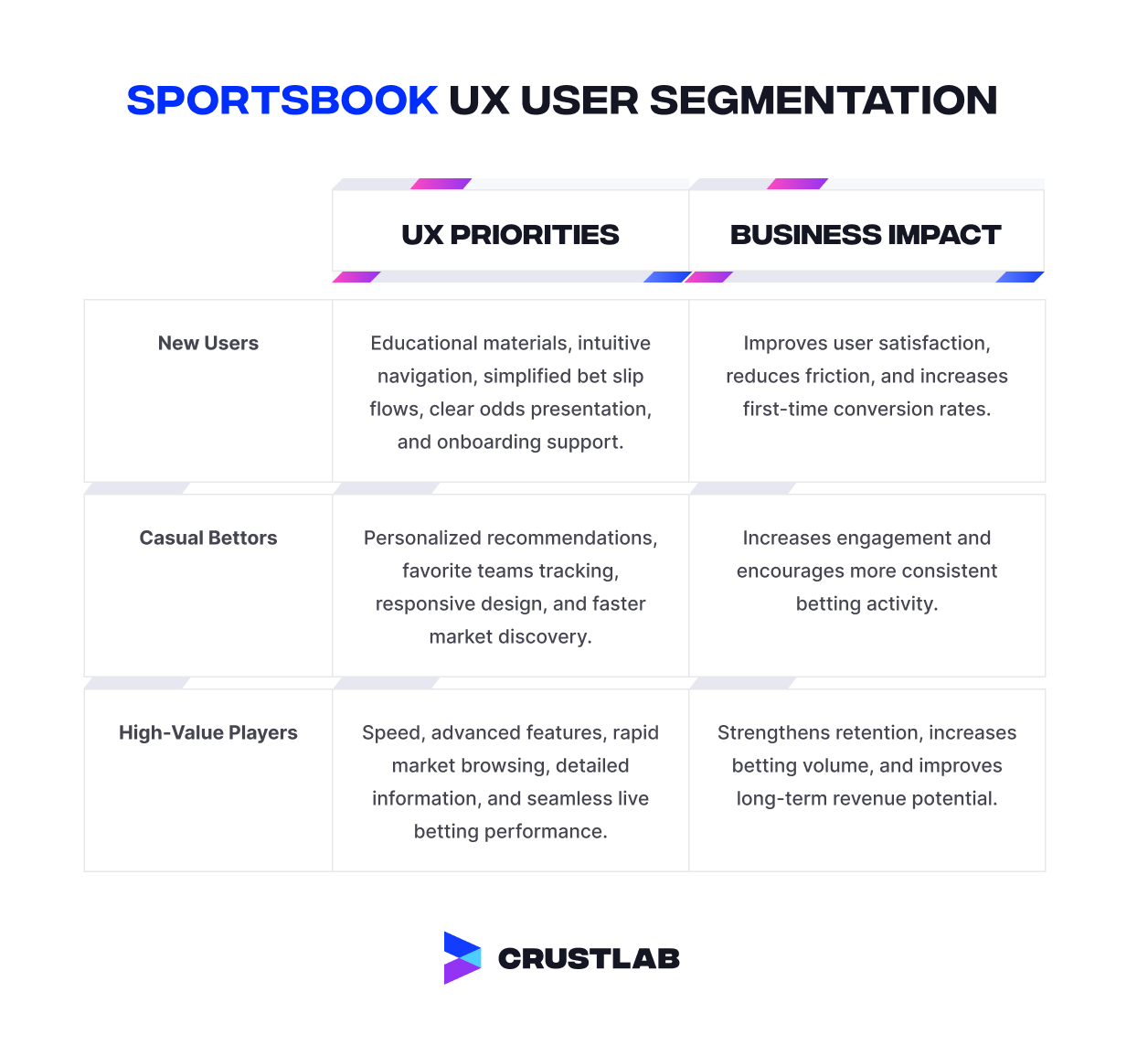
UX for Different User Segments: Beginners vs. High-Value Players
A one-size-fits-all interface fails to monetize the diverse spectrum of your player base. So, your sportsbook UX should adapt to varying user needs and experience levels.
| User Segment | UX Priorities | Business Impact |
| New Users | Educational materials, intuitive navigation, simplified bet slip flows, clear odds presentation, and onboarding support. | Improves user satisfaction, reduces friction, and increases first-time conversion rates. |
| Casual Bettors | Personalized recommendations, favorite teams tracking, responsive design, and faster market discovery. | Increases engagement and encourages more consistent betting activity. |
| High-Value Players | Speed, advanced features, rapid market browsing, detailed information, and seamless live betting performance. | Strengthens retention, increases betting volume, and improves long-term revenue potential. |
UI Design as a Differentiation Layer in Commoditized Markets
In a landscape where odds and markets are largely standardized, UI design has become an important differentiation layer for sportsbook operators. A distinctive user interface helps create a recognizable brand identity while improving user interaction with the betting app across mobile devices and desktop platforms.
However, strong UI design goes beyond visual elements or color schemes. It shapes the overall sports betting experience by influencing navigation, readability, betting speed, and engagement during live events. A sportsbook platform with an intuitive and consistent design feels more trustworthy and modern to bettors.
BETFAN: How Bespoke UX Creates Market Differentiation
The BETFAN case study serves as a blueprint for using bespoke UX to achieve market dominance. Facing the technical debt of legacy systems and the looming pressure of the FIFA World Cup, BETFAN moved away from generic white-label constraints to build a proprietary frontend using CrustLab’s domain expertise.
By prioritizing a “Core Wager Pad” and a high-performance mobile-first interface, we eliminated the lag that plagues standard platforms during high-traffic spikes. The result was a seamless, high-velocity betting process that handled massive surges without downtime. In addition to improving stability, this strategic shift created a distinct brand identity that resonated with players. It proved that owning the frontend is the most effective way to turn a commoditized utility into a unique, high-conversion asset.
UX as a Retention Engine: Designing for Long-Term Engagement
While acquisition gets users through the door, a bespoke UX is the engine that keeps them there. Designing for long-term engagement means moving beyond the transaction and focusing on the habit loop. Features like personalized rewards progress, interactive match centers, and custom notifications can transform a seasonal app into a daily destination.
When the user interface feels intuitive and rewarding, it builds a cognitive switching cost that discourages users from moving to a competitor. When you treat the frontend as a living retention tool, you foster deep brand loyalty and maximize lifetime value.
Regulatory and Platform Constraints in Sportsbook UX Strategy
A sportsbook UX strategy must operate within strict regulatory and technical constraints that shape how betting platforms function across different markets. Requirements related to responsible gambling, payment information, user verification, and regional compliance rules often affect how sportsbook operators design user journeys and introduce new features.
A bespoke frontend lets you embed these constraints directly into the UX strategy rather than tacking them on as intrusive pop-ups. By designing compliant elements that feel like a native part of the betting process, you maintain momentum while meeting legal standards. Ultimately, owning the interface ensures you can pivot quickly as regional laws evolve.
Conclusion: From UX Execution to Growth Strategy Ownership in Sports Betting Industry
The transition from a white-label utility to a proprietary frontend marks a shift from a passive, vendor-dependent entity to an active market leader. In the modern sports betting industry, UX execution is no longer a cosmetic layer but a fundamental framework of a growth strategy. By owning the interface, operators reclaim control over their data, their conversion funnels, and their brand identity.
A bespoke platform lets you launch new features quickly, optimize performance in real time, and personalize the experience for every player. This ensures every part of the app works toward your growth. In a crowded market where everyone offers the same odds, a custom-built user journey is the only way to truly stand out and keep players coming back. This approach is at the heart of effective sports betting software development, combining innovation with strategic product ownership.