
Top 18 Online Casino KPIs: The CPO’s Guide to Data-Driven iGaming Growth

- 1. Registration Conversion Rate
- 2. First-Time Deposit (FTD) Rate
- 3. Deposit Conversion Rate (Cashier Success)
- 4. Time-to-First-Bet
- 5. Day 7 & Day 30 Retention
- 6. Daily Active Users (DAU) to Monthly Active Users (MAU) Ratio
- 7. Average Session Length & Frequency
- 8. Game Rounds per Session
- 9. Feature Adoption Rate (Gamification)
- 10. Lifetime Value (LTV)
- 11. Average Revenue Per User (ARPU) and Paying User (ARPPU)
- 12. Gross Gaming Revenue (GGR) vs. Net Gaming Revenue (NGR) Contribution per Feature
- 13. Bonus Cost Efficiency (Bonus-to-GGR)
- 14. Cross-sell Rate (between Casino and Sportsbook)
- 15. Time-to-Market (TTM) for New Releases
- 16. Experiment Velocity (A/B Testing)
- 17. Platform Uptime & Crash Rate
- 18. Customer Support Tickets per 1,000 Players
For a Head of Product, online casino KPIs are the foundation for every roadmap decision and the clearest way to prove impact on financial performance. In 2026, success depends on improving the right key performance indicators rather than shipping more features.
With organic traffic now delivering conversion rate benchmarks where First-Time Deposit (FTD) rates can reach 35%, the real challenge is turning visitors into paying players on your casino website. Every friction point, from registration to real-money deposit, directly affects gross gaming revenue (GGR), net gaming revenue (NGR), and overall revenue generated.
Therefore, you must invest in scalable casino software development to ensure your platform efficiently converts and retains players. In this article, we break down the main online casino KPIs every product leader should track and how to use them to improve your online casino.
- The most effective online casino KPIs are grouped into four areas (acquisition, retention, monetization, and operations), helping product leaders focus on metrics that directly influence conversion, retention, and overall financial performance.
- Metrics like FTD rate, churn rate, bonus cost efficiency, and customer lifetime value go beyond surface-level data, revealing real player behavior and showing how well your platform converts users into long-term customers.
- Strong product teams use these key performance indicators to guide decisions and improve user experience, rather than relying on constant feature releases or increased marketing efforts.
- A data-driven online casino platform enables faster experimentation, better personalization, and more efficient operations, enabling operators to optimize marketing campaigns, retain players, and drive consistent revenue growth.
Why Product Leaders Must Move From Feature Shipping to Metric Ownership?
Many online casinos still measure success by how many features they launch. But in today’s iGaming industry, that approach no longer works. What matters is how those features affect key performance indicators such as conversion and churn rate.
Product leaders are now expected to focus on outcomes over outputs. If active players drop or retention rate declines, the issue is rarely a lack of features. It is usually friction in the experience. This could be slow onboarding, poor mobile UX, or weak player engagement.
For this reason, modern CPOs focus on improving financial performance through data. Every change must connect to revenue growth.
To do this effectively, teams need clear software development KPIs that link product work to business results. Instead of asking “what should we build next?”, the better question is: “which metric are we trying to move and why?”
The KPI Metrics for Casino Product Leaders: Top 18 Casino KPIs
Product leaders need a focused set of key performance indicators that directly impact financial performance and revenue growth. The most effective approach is to group these metrics into four areas: acquisition & activation, engagement & retention, monetization, and product operations. Together, these categories form a clear framework for improving how online casinos convert and retain active players.
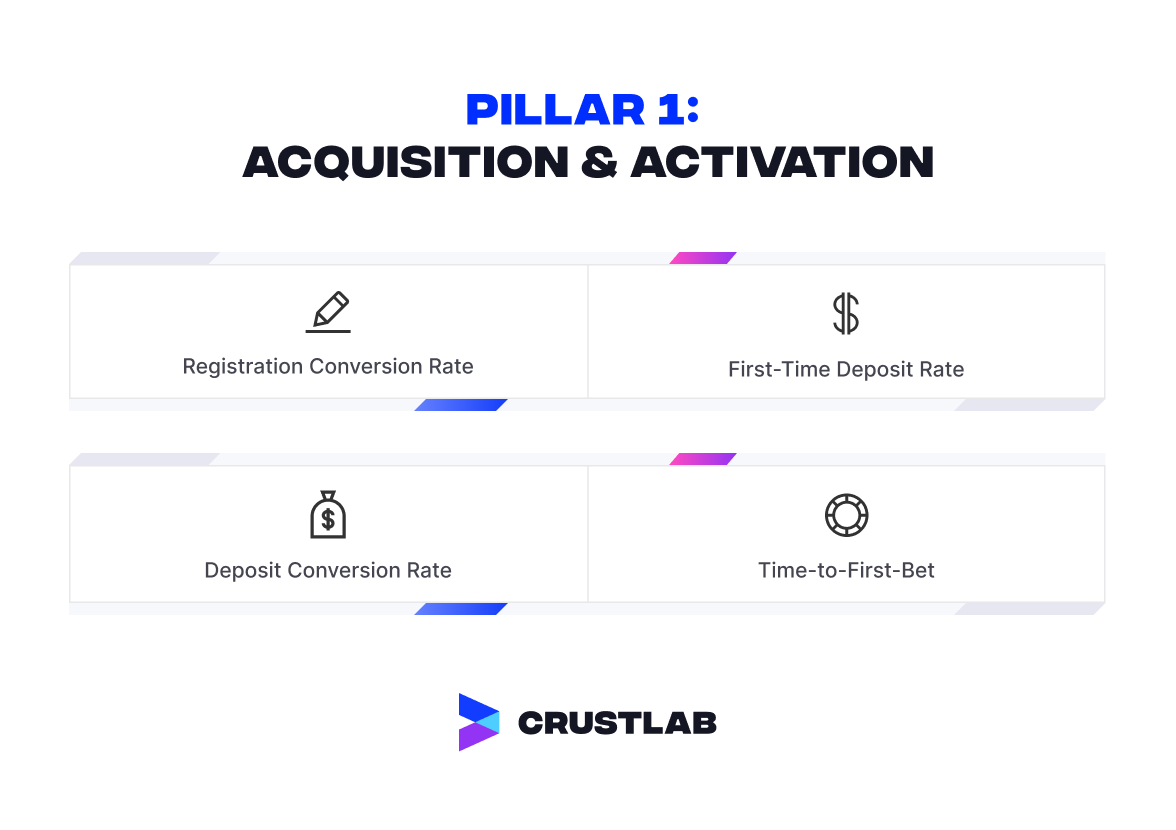
Pillar 1: Acquisition & Activation (The Onboarding KPIs)
This is where most online casinos win or lose new users. A strong conversion rate at this stage determines how effectively you turn traffic into active players and first-time depositors. For product leaders, these online casino KPIs reveal how well the onboarding experience drives real revenue.
1. Registration Conversion Rate
Registration conversion rate measures the percentage of visitors who complete the sign-up process on your casino website. It is one of the most important online casino KPIs because it shows how effectively your platform turns traffic into potential active players.
A low conversion rate here usually points to friction, which can result from long forms, complex KYC steps, or a poor mobile experience. Even if your marketing efforts drive high-quality traffic, weak onboarding will limit total revenue and reduce the impact of your campaigns.
From a product perspective, this metric should guide clear decisions. If conversion drops, you may need to simplify registration fields, introduce social sign-on, or redesign the flow for mobile-first users. Improving this step is often the fastest way to unlock more new customers without increasing customer acquisition cost.
2. First-Time Deposit (FTD) Rate
This is the moment that matters most, when a registered user makes their first real-money deposit. The FTD rate tells you how many users actually cross that line and start generating revenue for your online casino platform.
If this number is low, it usually points to a trust or UX issue. Players tend to hesitate when the cashier feels unreliable, payment methods are limited, or bonus terms are hard to understand. That hesitation directly affects overall financial performance.
For product leaders, this KPI should trigger immediate changes. Improve how bonuses are presented, simplify deposit flows, and make payment options feel fast and secure. Small improvements here can unlock more total revenue generated without increasing customer acquisition cost.
3. Deposit Conversion Rate (Cashier Success)
Getting users to click “deposit” is one thing; getting the transaction to go through is another. Deposit conversion rate measures the percentage of attempted deposits that succeed, making it a critical online casino KPI for revenue generation.
A drop here often points to payment friction. Failed transactions, slow processing, or missing local methods can break trust instantly. Even motivated users will leave if they cannot fund their account smoothly, which hurts both gross gaming revenue (GGR) and net gaming revenue (NGR).
This is a clear signal that product teams should never ignore. Add relevant payment providers and improve the speed of the flow.
4. Time-to-First-Bet
This metric tracks how quickly a new user places their first bet after making a real-money deposit. It shows how fast your online casino platform delivers value and turns intent into action.
If this takes too long, users are getting lost or distracted. A cluttered lobby or slow loading times can delay that first action and increase churn rate before engagement even begins. This results in fewer active players and weaker early player retention.
Fortunately, this KPI highlights what product leaders should do. Improve lobby speed, surface relevant game offerings, and guide users with “Recommended” or quick-play options. The faster users reach their first bet, the stronger your early conversion rate and long-term player lifetime value.
Pillar 2: Engagement & Retention (The Personalization Flywheel)
Once players make their first bet, the focus shifts to keeping them engaged. Today, over 70% of players value platform reliability and a smooth experience more than bonuses. To improve retention, product teams must focus on personalization, consistency, and strong mobile app engagement.
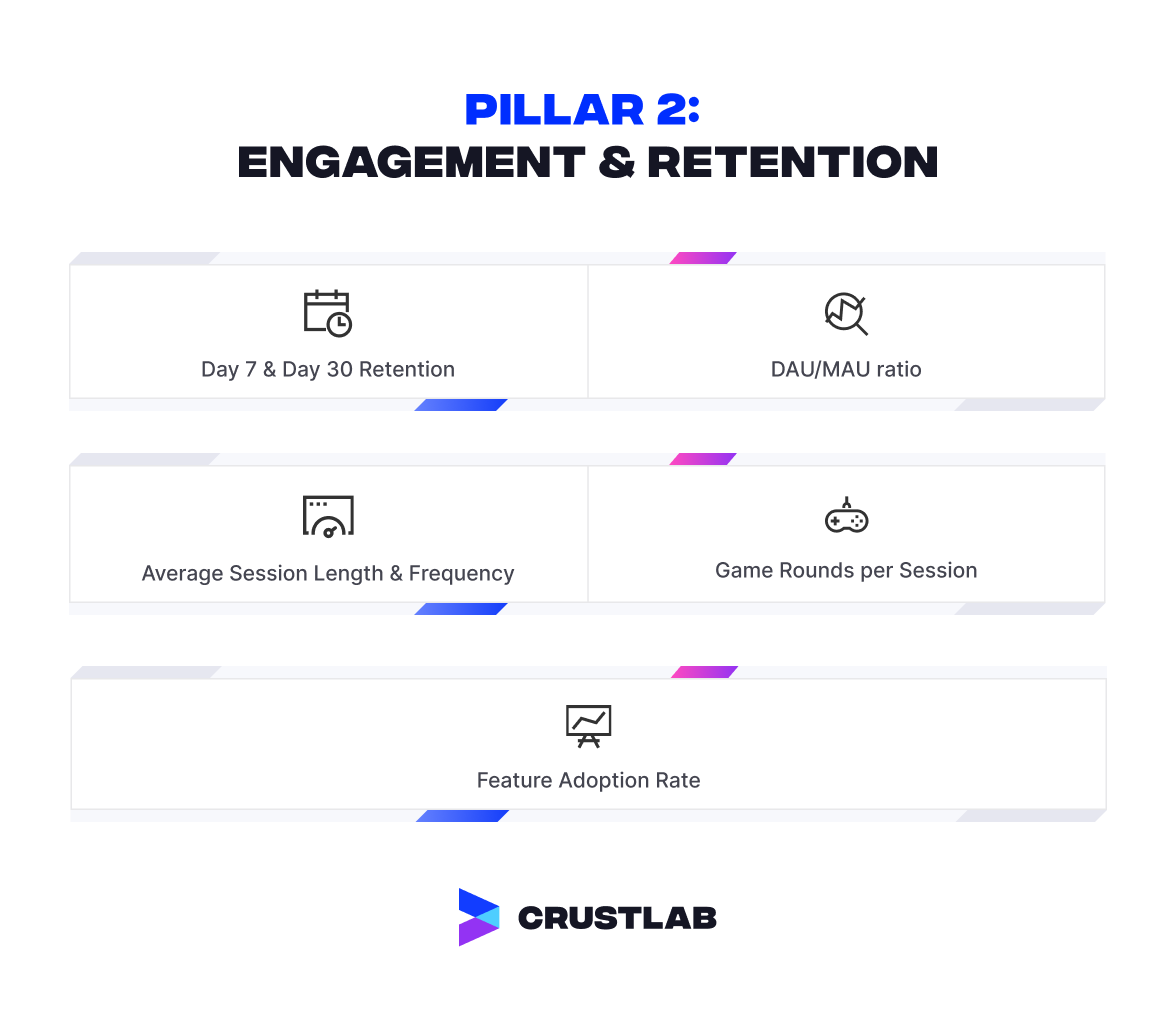
5. Day 7 & Day 30 Retention
This KPI is typically measured at Day 7 and Day 30 to track how many players return after their first session. It tells you whether your online casino platform is building real player retention or losing users early.
Low mobile app user retention is usually due to weak engagement, limited content variety, or a lack of meaningful progression. If players try your platform once but don’t see a reason to return, it increases churn and reduces overall customer lifetime value.
Product leaders should review these numbers to determine where to invest. Strong early retention may justify deeper gamification and VIP programs, while weak retention signals the need for simpler incentives, such as daily rewards or improved onboarding loops.
6. Daily Active Users (DAU) to Monthly Active Users (MAU) Ratio
This KPI shows how often players come back. The DAU/MAU ratio measures how many active players use your online casino platform daily compared to monthly. As a result, it is considered a key signal of product “stickiness.”
A low ratio means players visit occasionally but don’t build habits. This often leads to a higher churn rate and unstable revenue generated over time. Even with a strong acquisition, poor engagement limits long-term financial performance.
If you are struggling with low stickiness, focus on habit-forming features such as daily rewards, streaks, and personalized offers based on player behavior. They will help you move from one-off visits to consistent usage that supports stronger retention and long-term customer lifetime value.
7. Average Session Length & Frequency
Together, session length and frequency reveal whether your product keeps active players interested or pushes them to leave early. Product teams use them to determine how deeply players engage with their online casino and how often they return.
Short or infrequent sessions may signal weak experience. Players quickly lose interest when they struggle to find relevant game offerings or experience slow performance. Over time, this increases churn rate and reduces player satisfaction and revenue generated.
The best way to solve this problem is to improve the core experience. You can achieve this by simplifying navigation, optimizing mobile UX, and personalizing content.
8. Game Rounds per Session
This KPI measures the number of bets or rounds a player completes in a single session. It reflects how engaging your game offerings are and how smoothly your online casino platform performs during play.
If players place only a few total bets per session, something is holding them back. It could be slow loading times or a lack of quick-to-play games. These issues reduce engagement.
As a product lead, you can improve session depth by improving game performance, introducing quick-play formats, and reducing interruptions between rounds.
9. Feature Adoption Rate (Gamification)
Players engage with some features more than others, and this KPI makes it visible. The feature adoption rate shows how many players actually engage with tools such as loyalty programs, streaks, missions, and other engagement strategies.
Low adoption is a warning sign. It usually means the feature is hard to find, poorly designed, unclear, or simply not valuable to users. As a result, product teams invest time and budget without improving player retention or revenue growth.
To improve adoption, product teams should improve visibility, simplify access, or reposition the feature within the core journey. If it still fails to gain traction, it may be better to remove it and focus on what players actually care about.
Pillar 3: Monetization & Economic Efficiency (Financial Performance Metrics)
At this stage, the focus shifts from engagement to actual revenue growth. This set of online casino KPIs measures how well your online gambling platform generates revenue from players while maintaining strong financial health.
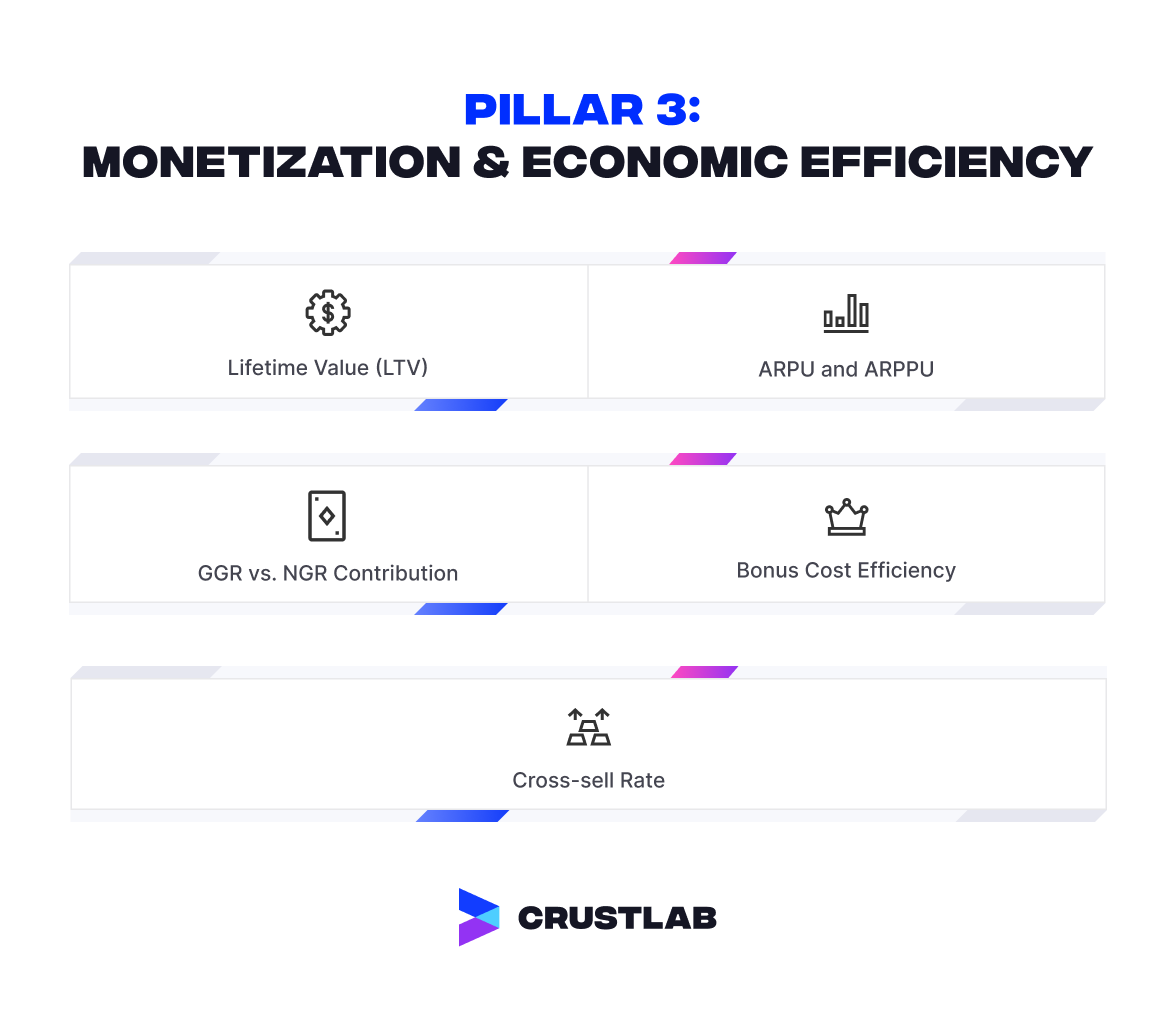
10. Lifetime Value (LTV)
This metric answers a simple question: How much is each player really worth over time? Lifetime value is the total revenue generated by a user throughout their journey on your online casino.
Poor LTV means fragile growth. You may be bringing in new customers, but they are not staying long enough to create meaningful player value. This leads to weaker financial performance and pressure on marketing investment.
Therefore, LTV data should be used to shape long-term strategy. It will help you decide whether to focus on high-value players, better segmentation, or improved retention strategies.
11. Average Revenue Per User (ARPU) and Paying User (ARPPU)
While total revenue tells you if the business is growing, Average Revenue Per User (ARPU) and Average Revenue Per Paying User (ARPPU) show how much revenue each player generates. Average revenue per user (ARPU) looks at all users, while ARPPU focuses only on those who spend.
If ARPU is stagnant while customer acquisition costs rise, the business model is under threat. Players may not find enough reasons to spend more, or the experience does not support consistent play.
Smart CPOs use these KPIs to guide monetization strategy. You may choose to increase spending among active players through better progression systems or expand the base by attracting more paying users.
12. Gross Gaming Revenue (GGR) vs. Net Gaming Revenue (NGR) Contribution per Feature
Understanding the gap between Gross Gaming Revenue (GGR) and Net Gaming Revenue (NGR) is essential for maintaining financial health. GGR shows total player losses, while NGR reflects what you actually keep after bonuses and promotional expenses. For a CPO, the critical insight lies in measuring these metrics at the feature level.
A feature may generate high GGR, but if it relies heavily on bonuses, the NGR can remain low. This suggests players are only engaging due to heavy subsidies rather than genuine player loyalty.
By analyzing player behavior through this lens, you can adjust your bonus logic or refine rewards. Focus on features that grow revenue without eroding margins.
13. Bonus Cost Efficiency (Bonus-to-GGR)
Bonus cost efficiency measures the ratio of promotional expenses to Gross Gaming Revenue (GGR). In a market where players often defect for larger rewards, this KPI reveals the true cost of player acquisition and retention.
If promotional expenses are too high, you may see strong acquisition but weak net gaming revenue (NGR). In this case, the product relies on incentives rather than real value.
When your bonus-to-GGR ratio rises without a proportional rise in player lifetime value, it’s a signal to move away from raw cash rewards. By shifting to non-cash rewards, such as daily streaks or loyalty shop points, you can reduce bonus dependency while still driving strong revenue growth.
14. Cross-sell Rate (between Casino and Sportsbook)
For casino operators managing multiple verticals, the cross-sell rate measures your ecosystem’s synergy. It tracks the percentage of players who primarily engage with the casino but eventually place bets on sports betting markets. This is a critical driver of financial health, as it maximizes the average value of your existing user base without increasing your customer acquisition cost.
If you are a CPO dealing with a low cross-sell rate, you must address the technical or UI silos preventing movement between your products. You may design a shared wallet or unified navigation to make switching between products seamless.
Pillar 4: Product Operations & Delivery Velocity (The Technical Moat)
Strong products are not defined solely by features but by how quickly and reliably they evolve. These online casino KPIs measure operational efficiency and the speed at which teams can ship improvements. They are the foundation that enables consistent revenue growth and long-term financial performance.
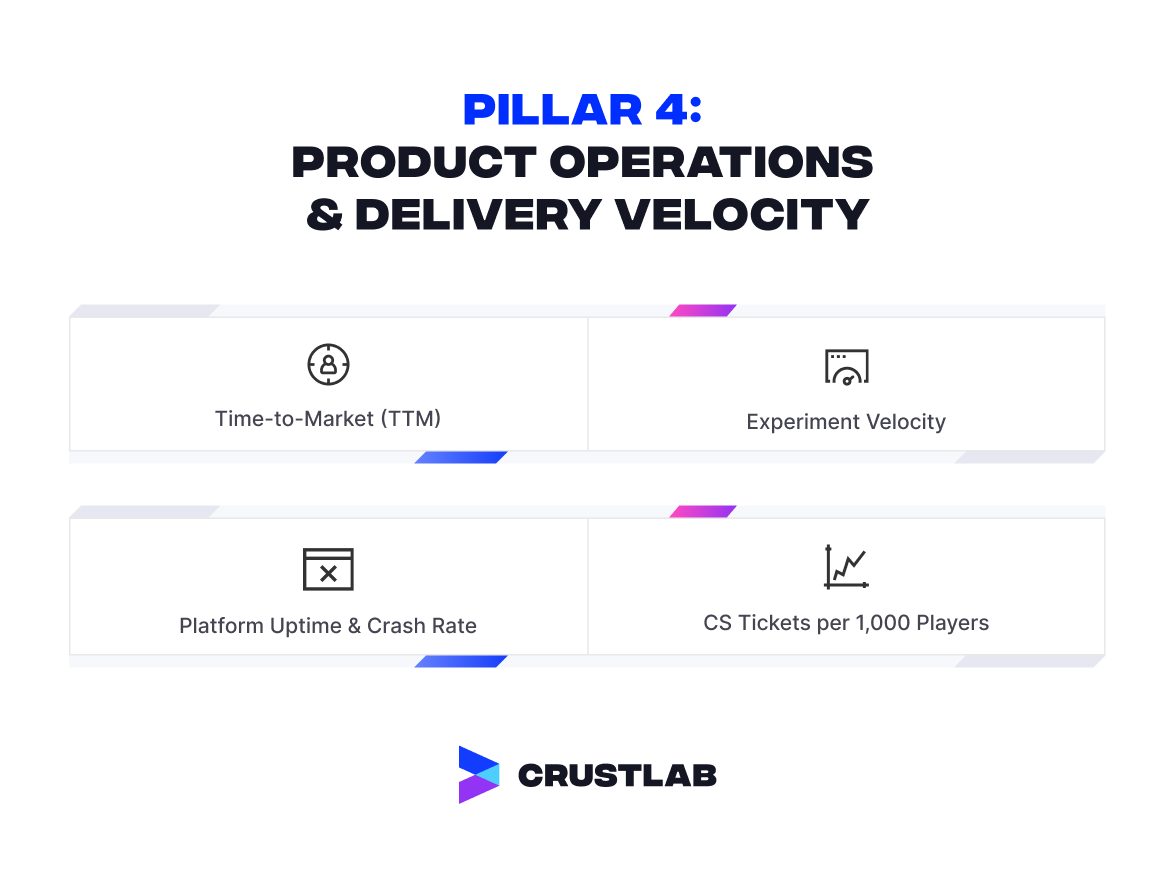
15. Time-to-Market (TTM) for New Releases
In the fast-moving iGaming industry, speed is often the difference between leading and falling behind. Time-to-Market (TTM) measures the duration from a feature’s conception to its live deployment on the casino platform.
For scaling operators, high TTM is a silent killer. It means competitors integrate the latest games or seasonal bonus features months before you. This delay often stems from vendor lock-in, in which your roadmap is held hostage to a third-party provider’s priorities.
If TTM is lagging, you must address the operational efficiency of your tech stack. This often necessitates a move away from monolithic legacy systems toward a modular, headless architecture. By owning the frontend, your team can implement strategies and launch unique game offerings independently.
16. Experiment Velocity (A/B Testing)
This KPI measures how quickly your team can test and validate ideas. Experiment velocity shows how many A/B tests you run and how fast you turn results into product decisions.
In a market where the majority of users are on mobile devices, finding the right conversion rate optimization through continuous testing is vital for online operations. Low velocity means you are essentially guessing which engagement strategies will work, rather than letting player behavior guide your roadmap. It often points to gaps in tooling or a lack of structured testing processes.
This KPI is an essential driver of improvement. As a product leader, you should invest in better internal tooling or a robust feature-flagging system. Learn more about the technical side of this by checking out our guide on frontend testing.
17. Platform Uptime & Crash Rate
CPOs use this KPI to gauge how stable their online casino platform is in real-world use. High uptime and low crash rates are essential for maintaining player satisfaction and protecting revenue.
Even small disruptions can have a big impact. If players experience crashes or slow performance, especially on mobile, they are more likely to leave. During peak periods, this can significantly hurt revenue.
If mobile crash rates exceed industry benchmarks, you must make the tough call to re-prioritize the roadmap. This involves shifting focus from new features to addressing technical debt and stability. High crash rates on high-end devices indicate that the casino website is struggling with outdated web wrappers. The strategic decision here is to invest in a native or high-performance frontend.
18. Customer Support Tickets per 1,000 Players
High support volume is often a symptom of poor operational efficiency and a confusing casino website experience. By tracking the number of tickets per 1,000 active players, a CPO can identify specific areas where the product falls short of expectations.
If tickets spike, particularly around payment or verification, it’s an urgent call to redesign the user flow. For instance, a high volume of “Where is my money?” queries suggests the withdrawal status UI is unclear.
The product decision should be to implement real-time progress trackers or automated FAQ triggers within the casino platform. Proactively addressing these friction points through better UX reduces the promotional expenses needed to re-acquire frustrated users and significantly contributes to long-term player loyalty.
Strategic Deep-Dive: Vanity Metrics vs. Actionable Online Casino KPIs
Many online casinos focus on surface-level KPIs, such as registrations or traffic, but these rarely reflect real financial performance. High sign-ups mean little if users don’t make their first real-money deposit or fail to return.
This is the “registration trap.” You can acquire thousands of new customers, but without a strong conversion and retention rate, you won’t generate sustainable revenue growth. Vanity metrics create the illusion of progress while hiding deeper problems in player behavior.
For product leaders, the focus must shift to actionable metrics. Track what directly impacts net gaming revenue, customer lifetime value, and long-term player retention. These are the signals that drive real decisions and results.
Growth Stage Matrix: Which KPIs Matter Most and When?
As a CPO, your focus must shift as the business evolves. Tracking everything at once often leads to strategic paralysis.
For new market entry, the focus is on acquisition and activation. Metrics like conversion rate and first real-money deposit are critical to turning traffic into active players and generating early revenue. At this stage, speed and early validation matter more than optimization.
As the product scales, attention shifts to player retention, churn rate, and customer lifetime value. Here, improving player engagement and retention strategies is key to sustainable revenue growth.
For mature operators, efficiency is the priority. Metrics like net gaming revenue (NGR), average revenue per user, bonus cost efficiency, and operational KPIs define long-term financial performance. The goal is to maximize player value, reduce waste, and remain profitable.
The Future of iGaming Data: AI and Predictive Analytics
Machine learning is fundamentally shifting KPI tracking from historical reporting to predictive action. Instead of reacting to past player behavior, modern online casino platforms are beginning to forecast outcomes such as customer lifetime value and churn before they occur.
This shift allows product teams to act earlier. AI models can identify high-risk users, trigger personalized retention strategies, and optimize marketing campaigns in real time. It also supports smarter decision-making by turning raw data into actionable insights that improve both player retention and financial performance.
Looking ahead, metrics like predicted LTV and automated responsible gambling triggers will become standard. Operators that pay attention to iGaming trends and invest early in these capabilities will gain a clear advantage in driving sustainable revenue growth.
Conclusion: Turning Online Casino KPIs into a Winning Roadmap
In the 2026 iGaming landscape, the role of the CPO has evolved from managing features to engineering commercial outcomes. These 18 online casino KPIs are the tools you need to transform raw data into a defensible, data-driven product strategy. By moving away from vanity metrics and focusing on actionable insights like FTD rate and Time-to-Market (TTM), you can justify critical roadmap decisions to the board and protect your financial health.
Winning in a saturated market requires more than just a generic clone platform. It demands operational efficiency and the technical agility to pivot when player behavior shifts. Turn these metrics into a winning roadmap that ensures every iGaming development effort directly contributes to sustainable revenue growth and long-term player loyalty.