Casino Frontend Customization: How to Escape the Generic Platform Look?

- Where Monolithic White-label Architecture Reaches Its Ceiling
- The Hidden Cost of Template-Based Casino Design
- Why Brand Differentiation Matters in Competitive iGaming Markets
- Off-the-Shelf Templates vs. Bespoke Frontend Engineering
- No-code Casino Builders vs. Full Frontend Code Ownership
- Stronger Brand Recognition
- Improved Conversion Rates
- Better Player Retention
- Greater Flexibility for Marketing Teams
- Homepage and Landing Page Design
- Casino Lobby Customization
- Navigation and Search Experience
- Registration and Deposit Flows
- Promotional and Bonus Sections
- Mobile-First Design Principles
- Responsive vs. Adaptive Casino Interfaces
- Performance Optimization for Mobile Players
- Engineering Dynamic and Hyper-Personalized Game Lobbies
- Seamless Onboarding, Authentication, and Wallet Interfaces
- Elevating Player Retention with Bespoke Gamification Hubs
- Transitioning to a Headless iGaming Setup
- The Ideal Frontend Stack for Modern Casinos in 2026
- Optimizing for Web Performance and Low-Latency Rendering
- AI-Driven User Experiences
- Real-Time Frontend Adaptation
- No-Code and Low-Code Frontend Builders
- Immersive Casino Experiences
- Slashing Time-to-Market with Modular Design Components
- Driving Down CAC and Amplifying Long-Term Player Value
The iGaming market moves at an exceptional pace, making turnkey solutions sensible at launch. While out-of-the-box turnkey platforms offer a perfect starting point, growing brands eventually face the challenge of breaking away from identical layouts used by competitors.
This article explores how targeted casino frontend customization and casino frontend modernization let you transform your presentation layer without risking a backend overhaul. You will learn how to transition across the platform maturity spectrum, optimize high-impact conversion funnels, and leverage headless architecture to gain roadmap autonomy.
- Casino frontend customization modernizes the player-facing experience while leaving the backend, PAM, RNG, and payment gateways unchanged, making it possible to differentiate without rebuilding the platform.
- White-label and turnkey platforms remain practical choices for many operators, while frontend customization becomes more valuable as brand differentiation and multi-market growth become strategic priorities.
- Personalization, mobile-first design, and modular frontend architecture help create faster, more engaging player experiences that support long-term retention and operational flexibility.
- A decoupled, headless frontend enables operators to scale across brands and regions, adapt to local compliance requirements, and evolve the user experience independently of core gaming systems.
Why Do So Many Online Casinos Look the Same?
Many online casino brands look similar because they rely on the same turnkey solutions and pre-built templates to launch quickly and cost-effectively. For new operators, this is often the right decision, as it reduces development effort and speeds market entry. As a business grows, however, visual differentiation becomes more important for attracting and retaining players. That’s where casino frontend customization comes in.
Instead of rebuilding the entire online gambling platform, operators can modernize the casino frontend and user interface alone while keeping the backend, PAM, and payment gateways unchanged. The key is understanding your growth stage and whether a standard template or a tailored experience better supports your goals. You can learn more about frontend development in our frontend guide.
Where Monolithic White-label Architecture Reaches Its Ceiling
Monolithic white-label platforms are highly efficient, low-risk solutions for an early-stage launch. When a business is establishing its footing, binding the user interface, Player Account Management (PAM systems), and game engines into a single system minimizes technical complexity.
However, brand growth and ambition introduce distinct operational trade-offs in this tightly coupled architecture. Since the front and back ends are bound together, any meaningful UI change is directly tethered to the platform provider’s global update roadmap. If your provider manages feature queues for dozens of other operators, a localized optimization or a real-time marketing layout change can take months to deploy.
As a brand scales past its initial validation phase, this dependence can introduce administrative overhead and slow down product development, making it difficult to react quickly to shifting player expectations. To explore how modern engineering decouples these layers, read our comprehensive guide to micro frontend architecture.
The Hidden Cost of Template-Based Casino Design
A template-based casino website doesn’t automatically hurt performance or profitability. The trade-off becomes more noticeable as competition increases and several brands begin offering nearly identical experiences.
When players see little difference between one online casino and another, marketing teams may need to spend more to attract attention. This can gradually increase Customer Acquisition Cost (CAC) while making it harder to improve Player Lifetime Value (LTV). A distinctive casino frontend alone won’t guarantee better results, but it can support stronger positioning and longer-term player loyalty as an operator scales.
Why Brand Differentiation Matters in Competitive iGaming Markets
As the iGaming industry becomes more competitive, brand recognition is about more than logos and color schemes. A distinctive casino frontend helps create a consistent gaming experience that reflects an operator’s identity and gives players a reason to remember the brand.
For operators in growth mode, thoughtful frontend customization can boost player engagement, build trust, and encourage repeat visits by delivering a more polished, user-friendly interface. It isn’t essential for every business from day one, but as competition increases, differentiation can become an important contributor to long-term growth and a stronger competitive position.
What is Casino Frontend Customization?
Casino frontend customization is the process of tailoring the player-facing side of an online casino to better match a brand’s identity and business goals. It covers the user interface (UI/UX), navigation, layouts, web elements, and other key components that players interact with every day.
It’s important to distinguish simple surface design elements from deep structural engineering. While surface-level changes may involve branding or layouts, deeper customization can introduce custom features, improve player journeys, and support a more personalized gaming experience. Throughout the process, the backend, including PAM systems, RNG, and payment gateways, continues to operate as usual. In other words, the presentation layer changes, while the core gaming infrastructure remains the same.
Off-the-Shelf Templates vs. Bespoke Frontend Engineering
Choosing between pre-built templates and custom code is a matter of business maturity rather than a binary “right or wrong” decision. For example, smaller regional operators or affiliate-driven brands where the software layout isn’t the primary differentiator can choose to remain on standard templates indefinitely.
| Off-the-shelf templates | Bespoke frontend engineering |
| Faster to launch using proven turnkey solutions | Built around your brand and long-term strategy |
| Best for validating a concept or serving smaller markets | Better suited for operators focused on differentiation and growth |
| Uses standard layouts with limited customization | Supports deeper casino frontend customization and custom features |
| Vendor manages most updates and ongoing support | Greater control over the source code |
| Integrates standard platform capabilities | Designed to integrate cleanly with PAM, CMS, payment systems, regulatory tools, and other services from the start |
A primary differentiator here is the integration boundary concept. Bespoke frontend engineering is constructed from day one with strict data discipline. The platform is designed to integrate additional extensions seamlessly via secure APIs with existing PAM systems, Remote Game Servers (RGS), Content Management Systems (CMS), and regulatory monitoring overlays. Conversely, generic or un-engineered template changes often overlook these deep data relationships, resulting in functional friction, broken web elements, and slow load times downstream.
No-code Casino Builders vs. Full Frontend Code Ownership
When operators seek to alter their presentation layer, they generally follow one of two strategic paths. They can use a platform vendor’s proprietary no-code drag-and-drop page builders or invest in full ownership of the frontend source code.
Visual no-code constructors are excellent solutions where speed, low technical overhead, and operational simplicity matter. They allow marketing teams to rapidly swap out banners or alter basic homepage text without waiting for developer availability. However, they limit the brand to the specific components, widgets, and logic blocks provided within that vendor’s walled garden.
On the other hand, full frontend code ownership provides complete access to the underlying code repository. Owning your source code allows your development team to build completely customized user experiences and deploy features instantly. This independent architectural control builds long-term corporate asset value as a brand grows, giving the business full control over its digital assets and making it far more attractive to future investors.
The Business Benefits of Casino Frontend Customization
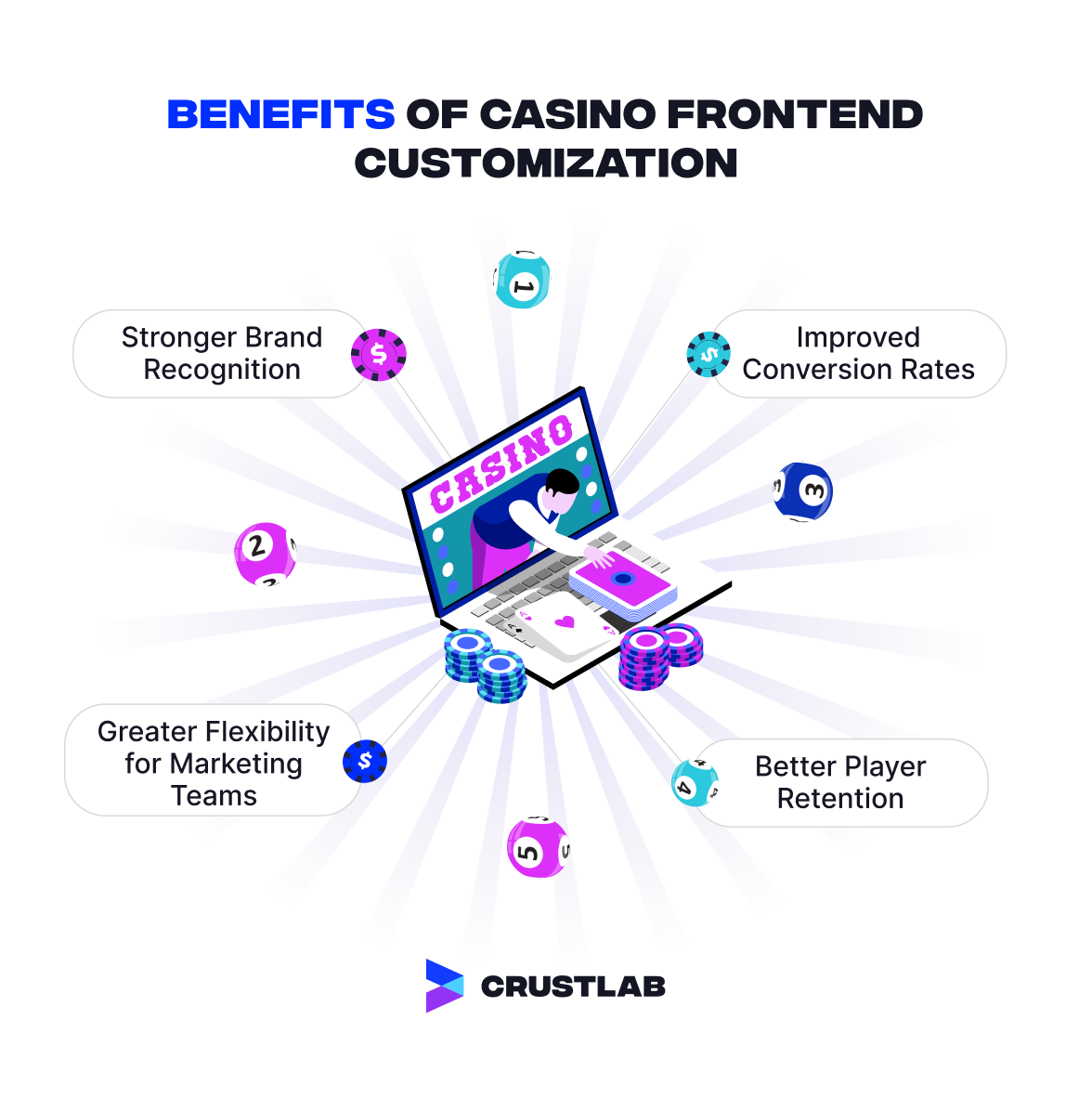
The value of casino frontend customization goes beyond appearance. When aligned with clear business goals and executed well, it can support stronger user engagement, improve the gaming experience, and help operators build a more recognizable brand. While results depend on execution, a tailored casino frontend gives operators more flexibility to shape how players interact with their online casino.
Stronger Brand Recognition
A unique casino app or website helps players recognize and remember your brand. Consistent visual identity and messaging can make an operator stand out in a crowded market where many platforms look similar.
Improved Conversion Rates
A well-designed user interface with clear navigation, intuitive registration, and visible calls to action can reduce friction during the player journey. These improvements may support more registrations and first-time deposits but work best alongside strong marketing and competitive offers.
Better Player Retention
Personalized content and smoother navigation encourage players to spend more time on the platform. Combined with relevant casino games, promotions, and loyalty initiatives, these improvements can contribute to stronger user retention over time.
Greater Flexibility for Marketing Teams
A customizable casino frontend makes it easier to launch seasonal campaigns, highlight welcome bonuses, promote live dealer games, or create market-specific landing pages. This gives marketing teams greater control over the player experience without changing the underlying casino platform.
The Most Important Areas of Casino Frontend Customization
A successful casino frontend customization is built around the parts of the player journey that have the greatest impact on user engagement and satisfaction. Instead of redesigning everything at once, operators can focus on the areas that influence how players complete key actions and interact with the online casino.
Homepage and Landing Page Design
The homepage sets the tone for a casino website. Clear hero banners, featured promotions, dynamic content blocks, and well-placed calls to action help guide players toward the next step.
Casino Lobby Customization
The casino lobby is where players spend most of their time. A well-organized layout with featured titles and intuitive navigation makes it easier to discover new casino games and improves the overall gaming experience.
Custom Game Categories
Organizing games by themes, popularity, providers, or player preferences helps users find relevant content faster. Flexible categories also support different business goals and promotional campaigns.
Personalized Recommendations
Recommendation engines can suggest casino games based on player behavior, favorite genres, or previous activity. This creates a more personalized experience and can support stronger player engagement.
Featured, Trending, and New Games Sections
Highlighting trending releases, recently added titles, or seasonal favorites keeps the lobby fresh. They get players excited and encourage them to explore more content.
Navigation and Search Experience
Simple menus, powerful search, and logical navigation reduce friction in an online casino. A user-friendly structure helps players reach their preferred games more quickly.
Registration and Deposit Flows
Short, intuitive onboarding and deposit journeys reduce unnecessary steps. Also, clear forms and support for popular bank transfers and payment methods can improve the overall experience for new players.
Promotional and Bonus Sections
Dedicated areas for welcome bonuses, tournaments, loyalty rewards, and limited-time offers are a big plus. They make promotions easier to find and support ongoing player activity.
Mobile Casino Frontend Customization
With the majority of global iGaming traffic coming from mobile devices, mobile optimization has become a foundational business necessity. A clunky, slow-loading desktop layout crammed onto a small screen will quickly alienate users and drive up churn rates. Investing in a tailored mobile presentation layer ensures your platform is built specifically for on-the-go betting.
Mobile-First Design Principles
Mobile-first design starts with the smallest screen and builds outward, ensuring every feature works naturally on smartphones before being adapted for larger devices. This approach encourages cleaner layouts, larger touch targets, and simplified navigation. It results in a more user-friendly interface that matches modern user expectations and helps development teams prioritize the features players use most, rather than carrying over desktop elements that add little value on mobile.
Responsive vs. Adaptive Casino Interfaces
Responsive design automatically adjusts page layouts to fit different screen sizes using a single codebase, making it a practical and cost-effective choice. Adaptive design takes a different approach by delivering layouts optimized for specific devices or screen types. This way, operators can provide more tailored UI/UX experiences. The right choice depends on the operator’s business goals, target audience, and available technical expertise, with both approaches aiming to deliver a consistent gaming experience.
Performance Optimization for Mobile Players
Mobile bettors have zero patience for technical lag. If your casino lobby takes longer than two seconds to load, a large portion of your paid traffic will abandon the site before placing a single bet. Hence, implementing mobile usability best practices is essential for protecting your customer acquisition investments.
Custom frontend engineering addresses this by optimizing loading speed through aggressive code minification, image compression, and lazy-loading scripts that only fetch game tiles as the player scrolls. This technical discipline ensures fast load times even on spotty cellular networks. Concurrently, it enhances navigation efficiency by keeping complex menus hidden behind clean slide-outs and providing an advanced search experience with auto-complete. This allows mobile players to move from your landing page to an active game session in seconds.
Maximizing the Player Journey: High-Impact Customization Areas
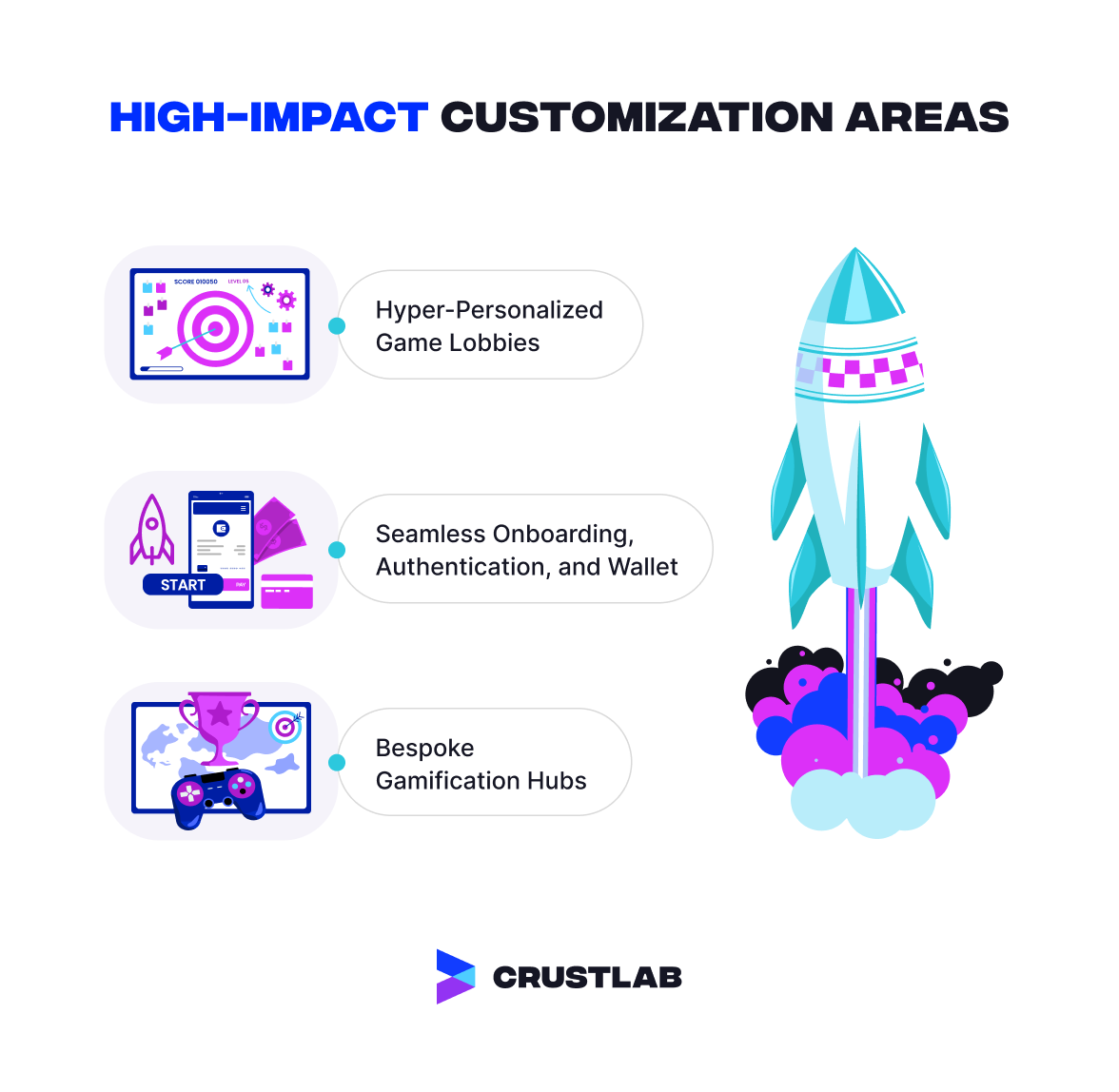
Aside from being visually appealing, a great casino frontend makes every step of the player journey feel simple and intuitive. Thoughtful UI/UX design improves the moments that matter most, from discovering casino games to making deposits and joining loyalty programs. By tailoring these touchpoints, operators can create a more immersive gaming experience that supports long-term player engagement.
Engineering Dynamic and Hyper-Personalized Game Lobbies
Traditional game lobbies display the same content to every player. Modern online casino websites can go further by using AI-powered recommendation engines to personalize the experience. Categories, game providers, featured banners, and suggested casino games can be reordered based on player preferences and habits, creating a lobby that feels relevant to each individual player.
Seamless Onboarding, Authentication, and Wallet Interfaces
Registration and payments are some of the biggest friction points on any casino or sports betting platform. If your onboarding process feels clunky or confusing, player abandonment rates will soar. A custom solution addresses this by optimizing the visual mechanics of your security and financial layers.
From an architectural standpoint, your development team can design frictionless login flows using JSON Web Tokens (JWT) to enable secure session authentication without repetitive password prompts. This ease of entry carries directly into the cashier interface, where a customized frontend supports a multi-method checkout screen. This setup allows players to seamlessly switch between traditional fiat payment gateways and fast cryptocurrency wallets on a single, intuitive screen.
Furthermore, pairing this checkout with a transparent player ledger history builds deep institutional trust. It reassures users that their bankroll, bonuses, and transaction data are handled carefully.
Elevating Player Retention with Bespoke Gamification Hubs
Modern casino frontend customization also makes it easier to introduce engaging gamification features. Achievement badges, tournament leaderboards, loyalty missions, progress trackers, and personalized reward dashboards give players additional reasons to return beyond the games themselves. When integrated naturally into the interface, these interactive elements help create a richer experience that contributes to stronger user satisfaction and boosts user engagement over time.
Personalization: The Next Stage of Casino Frontend Customization
As the iGaming industry becomes more competitive, delivering the same experience to every player is no longer enough. Casino customization allows operators to create more relevant journeys by adapting content and promotions to individual preferences. The result is a more engaging and user-friendly experience that better meets changing player expectations.
Behavioral Segmentation
Behavioral segmentation groups players based on factors such as favorite games, playing frequency, deposit habits, and overall engagement. Instead of treating every visitor the same, operators can tailor the casino frontend to different player segments and deliver more relevant experiences.
Dynamic Content Personalization
Modern online casino platforms can display different banners, promotions, game categories, and bonus offers to different user groups. For example, new players might see welcome bonuses, while returning players receive loyalty rewards or recommendations based on their recent activity. This helps keep content fresh and aligned with each player’s interests.
AI-Powered Recommendations
Artificial intelligence is making personalization even more effective. AI can analyze player behavior in real time to recommend relevant casino games, highlight promotions, and automatically adjust featured content. When used responsibly, these recommendations create a more personalized gaming experience that supports player engagement without changing the core casino platform.
Regional Adaptation: Localization and Compliance on the Frontend
Frontend customization doesn’t just create casinos with nice aesthetics. It also helps operators adapt their online casino platform to different markets by supporting local languages, currencies, payment options, and regulatory requirements. A flexible casino frontend makes it easier to enter new regions while keeping the same backend infrastructure.
As operators grow, the same frontend foundation can also support multiple brands. Instead of launching several nearly identical online casino sites, they can create distinct experiences for different markets and target audiences while reusing the same underlying architecture.
Tenant-Aware Theme Switching for Global Brands
Modern casino frontend development can use tenant-aware CSS variables to change themes automatically based on the player’s location or brand. Color schemes, images, layouts, and other web elements can be updated instantly without changing the underlying source code. This allows operators to deliver localized experiences that better match regional preferences while managing multiple brands from a single casino platform.
For example, a platform targeting European players might opt for a minimalist, clean layout with subdued tones, while the same platform switching to a Latin American market might instantly load high-vibrancy color schemes and prioritize crash games. Furthermore, this setup handles critical localized layout structures, such as rendering right-to-left (RTL) text flows seamlessly for Middle Eastern audiences or adapting to localized currencies without breaking web elements.
Designing UI/UX for Strict Regulatory Compliance
Every regulated market has its own compliance requirements, and the frontend plays a crucial role in meeting them. A well-designed UI/UX can integrate KYC document uploads, responsible gaming tools, self-exclusion options, and geo-specific promotional banners in a way that feels natural to users. By integrating these features directly into the player journey, operators can support regulatory compliance while maintaining a smooth, user-friendly experience.
The Technical Backbone: Headless Architecture and Modern Tech Stacks
Modern casino frontend customization is built on the idea of separating the presentation layer from the backend. Instead of rebuilding an entire platform, operators keep their PAM systems, RNG, and payment gateways running as they are while replacing or enhancing only the player-facing experience.
This decoupled approach gives teams far more freedom to improve the casino frontend, introduce new features, and evolve the brand without disrupting core gaming operations. To learn more about the technologies behind this approach, explore our guides to front-end technologies and headless CMS comparison.
Transitioning to a Headless iGaming Setup
In a headless iGaming platform, a secure API layer connects the backend to a fully customized frontend. This middleware passes player data, game information, authentication, and transactions between systems, allowing the interface to evolve independently of the backend. As a result, operators can modernize the casino website without replacing the underlying technology. Learn more about this architecture in our guide to headless CMS vs traditional CMS.
The Ideal Frontend Stack for Modern Casinos in 2026
Building a fast and reliable casino interface in 2026 requires a carefully selected set of modern frontend frameworks. At the core, React 19 handles component rendering to keep game lobbies fluid and responsive, while Next.js 16 (with the App Router) provides a powerful foundation for managing complex, multi-brand environments.
For styling, Tailwind CSS 4 allows developers to build lightweight layouts that use minimal browser memory and keep page sizes small. To prevent technical glitches, TypeScript 6 adds strict data type safety across the entire codebase, heavily reducing bugs on critical deposit and registration screens. Finally, everything is organized using NX Monorepos, allowing teams to manage multiple regional brands in one place, safely sharing core layout elements while deploying independent updates instantly.
Optimizing for Web Performance and Low-Latency Rendering
Speed directly impacts the player experience. If a mobile player experiences even a brief rendering delay, they will quickly abandon the registration or deposit screen.
Modern frontend engineering solves this issue by using Server-Side Rendering (SSR) and efficient code splitting. SSR allows Next.js 16 to pre-assemble the webpage layout on the server, delivering a complete, interactive page to the player’s browser instantly. At the same time, code splitting breaks the site’s code into small pieces and downloads only the specific files needed for that immediate screen rather than forcing the phone to load the entire platform at once.
This drastically minimizes Time-to-Interactive (TTI), ensuring your casino website loads instantaneously even on older smartphones or weak cellular networks. Crucially, this technical speed connects directly to your long-term return on investment. By using a pre-optimized, modular component framework, you not only stop player drop-off but also slash your time-to-market. So, you can launch fully customized secondary brands in a fraction of the usual development time.
Common Mistakes in Casino Frontend Customization
Casino frontend customization offers an immense competitive edge, but only when backed by a clear strategy and solid technical execution. Custom development that ignores integration requirements or user needs can introduce unnecessary complexity and reduce the value of the investment. The goal isn’t to customize everything but to improve the parts that matter most.
- Prioritizing design over user experience: A visually impressive casino website isn’t enough if players struggle to complete basic tasks. Attractive graphics should support a clear user interface, intuitive navigation, and fast interactions. Good UI/UX balances appearance with usability to create a smoother gaming experience.
- Ignoring mobile users: Designing primarily for desktops can lead to poor experiences on mobile devices, where most players now access online casinos. Buttons that are difficult to tap, slow web pages, and cluttered layouts can reduce user satisfaction and increase abandonment. Building with a mobile-first design helps avoid these issues.
- Overcomplicating navigation: Adding too many menus, icons, animations, or interactive elements can make a casino website harder to use. Players should be able to quickly find casino games, promotions, support, and payment options. Simple, predictable navigation generally delivers a better experience than unnecessary complexity.
- Neglecting performance optimization: Large images, excessive scripts, and poorly optimized code can slow down the frontend, affecting the player experience and search visibility. Fast-loading pages support better engagement, while a lightweight design helps improve frontend performance across desktop and mobile.
Future Trends Shaping Casino Frontend Customization
As the iGaming world evolves, operators must keep up with the latest frontend development trends to stay competitive. The line between static betting sites and interactive digital entertainment is blurring rapidly. Emerging technologies are giving brands the power to create lightning-fast, deeply engaging user experiences that adapt effortlessly to modern player expectations.
AI-Driven User Experiences
AI can analyze player behavior to recommend casino games and personalize promotions. This helps create more relevant experiences and supports stronger player engagement.
Real-Time Frontend Adaptation
Modern casino frontend solutions can update banners, featured games, and promotions in real time based on player activity. This keeps the interface fresh and better aligned with user expectations.
No-Code and Low-Code Frontend Builders
Visual builders allow teams to update new web pages and launch campaigns without writing code. They work well for everyday changes, while custom development is better suited to more advanced requirements.
Immersive Casino Experiences
AR, VR, and richer interactive elements are opening new possibilities for online casino platforms. As these technologies mature, they could make live dealer games and other experiences more engaging and immersive.
The Business Case for Customization: ROI, TTM, and LTV
Investing in custom frontend development pays significant dividends across all key performance indicators of an iGaming enterprise. However, it is important to view this transition as a strategic choice for a specific stage of corporate growth.
For a brand-new startup testing the market, a standard, off-the-shelf template may suffice. But once an operator reaches a stage of serious scaling and high ambition, a generic interface becomes a growth bottleneck. At this level of maturity, taking complete control of your presentation layer becomes an essential investment to protect your margins and stand out in a hyper-competitive environment.
Slashing Time-to-Market with Modular Design Components
Custom frontend development doesn’t always mean starting from scratch. Using modular design components and reusable frontend presets allows development teams to build new features and launch new brands much faster than rebuilding the entire interface. Combined with a headless architecture, this modular approach can reduce deployment timelines by up to 3x while keeping the existing casino platform and backend services intact.
Driving Down CAC and Amplifying Long-Term Player Value
A uniquely tailored user interface serves as a powerful commercial engine that lowers your Customer Acquisition Cost (CAC) and strengthens your Lifetime Value (LTV). While marketing campaigns work hard to drive paid traffic to your site, a friction-free UX and fast load times ensure those expensive clicks actually convert into active players. Reducing layout friction directly reduces onboarding drop-off, allowing your acquisition funnels to operate at peak efficiency.
Once players are inside your platform, the benefits of custom positioning continue to pay off. A distinct visual identity, paired with personalized lobby recommendations and immersive retention hubs, creates an environment where players prefer to stay.
Conclusion
Casino frontend customization stands out as a highly effective lever for differentiation in an increasingly crowded market. By decoupling the presentation layer from backend engines, ambitious operators can transform standard player touchpoints into unique, high-performing digital environments. This enables scaling brands to optimize their mobile user experience, adapt seamlessly to local regulatory frameworks, and implement dynamic personalization strategies that support long-term player engagement.
The right approach depends on your growth stage and business goals. Turnkey solutions and pre-built templates remain a strong foundation for many operators, while others may benefit from targeted frontend improvements or a bespoke solution as their needs evolve. If you’re evaluating your options, explore our custom frontend development services to see how you can modernize your frontend without rebuilding your platform..