
- CrustLab /
- blog /
- Industry Insights and Regulations /
- How to Increase Casino Retention Without Changing My Platform?
How to Increase Casino Retention Without Changing My Platform?

- Presentation Layer: Lobby, Cashier, and the Mobile Shell
- Engagement Layer: Orchestration You Can Attach Beside the Platform
- Core Layer: PAM, Wallet, and Bonus Engine
- Event Granularity: Bet-Level, Session-Level, or Daily Aggregate?
- Latency and Delivery: Real-Time Webhooks or a Nightly Batch File?
- Historical Depth, Raw Data, and Export Rights
- Identity Resolution Across Casino, Sportsbook, and Mobile
- Weeks 1–2: Find the Constraints
- Weeks 3–6: Fix Measurable Product Friction
- Weeks 7–12: Test One Retention Lever
Most operators running on legacy software assume they need a multi-million-dollar platform migration to enhance player lifetime value. However, the reality is simpler. For operators with an in-house tech team, improving retention in iGaming does not always mean replacing the platform underneath the business.
Many of the best player retention strategies can be built around the existing core by improving the frontend, data flow, and engagement layer. The key is knowing what your team controls and what the platform exposes. This guide explains how casino software development can target those areas without turning a retention project into a full replatforming exercise.
- Strong retention in iGaming starts with reliable player data, fast event delivery, and APIs that let your retention tools act when player interest is still high.
- Fixing cashier, KYC, mobile, and performance friction can significantly boost lifetime value while creating a better gaming experience for existing players.
- Frontend personalization, social and community features, missions, and programs that reward consistency can improve engagement without replacing the core platform.
- The best strategies for iGaming operators test what the current architecture can support first, then use cohort data to prove which changes actually boost lifetime value (LTV).
Why Retention in iGaming Stalls While Your CRM Keeps Doing Everything Right
Most advice on retention in iGaming focuses on what happens inside the CRM. They urge operators to segment players more accurately, send better offers, build VIP programs that reward consistency and loyalty, and add gamification and personalized campaigns based on player behavior.
While those tactics matter, there is a limit to what a CRM can achieve when the underlying platform does not give it enough to work with. Picture a player who normally plays slots suddenly making several large bets and ending a session earlier than usual. That change could trigger a relevant offer while the player is still active. But if your platform only exports activity once a day, the CRM learns about it tomorrow. The segmentation may be perfect, but the opportunity is already gone.
The same problem arises when player events lack detail, identities are fragmented across casino and sports betting, or APIs allow your team to read an account but not write rewards back to the wallet. At that point, adding another retention tool does not remove the constraint.
As a result, you should treat player retention in iGaming as an architecture question before it becomes a campaign question. Your retention ceiling depends on what player data the platform exposes, how quickly that data reaches your systems, and what your in-house team is allowed to do with it.
Also Read: How a Custom Front-end Improves User Experience in iGaming Applications.
The Three Layers of a Casino Retention Stack and Which Ones You Already Control
Before choosing new player retention strategies, it helps to separate the casino stack into three layers. Each gives your team a different level of control, and that distinction tells you which retention strategies for iGaming you can pursue without replatforming.
Presentation Layer: Lobby, Cashier, and the Mobile Shell
The presentation layer covers what players directly interact with: the casino lobby, game discovery, navigation, cashier journey, and mobile app shell. Much of this can be rebuilt or overlaid without replacing the underlying platform. Your frontend can consume the same platform APIs while presenting players with a different experience.
That opens up practical ways to boost player retention. You can personalize game rails around favorite games, improve search and discovery, reduce unnecessary steps in the cashier, or create a seamless mobile experience without touching the systems responsible for balances and account records.
For an in-house team, this is often the fastest layer to improve because changes can be shipped and measured without starting a platform migration.
While game lobbies, navigation, and mobile shells can easily be decoupled from legacy Player Account Management (PAM) systems via standard APIs, rebuilding or overlaying a custom cashier journey on the frontend is significantly more complex. Cashiers handle sensitive payment card data, requiring strict compliance with PCI-DSS Level 1 standards and integration with Payment Service Provider (PSP) tokenization frames or hosted iFrames.
Engagement Layer: Orchestration You Can Attach Beside the Platform
The engagement layer sits between the player experience and the casino core. It can include CRM, messaging, missions, tournaments, loyalty progression, offer orchestration, and other features designed to engage players.
These capabilities do not necessarily need to live inside your existing platform. An external service can consume player events, maintain its own engagement state, and send instructions or content back to the frontend. This gives operators more freedom to test personalized marketing campaigns, new loyalty mechanics, or cross-product journeys between casino and sports betting.
However, there is one important dependency. The platform must expose enough player data, quickly enough, for the engagement service to make useful decisions. Without that access, sophisticated player segmentation still produces limited results.
Core Layer: PAM, Wallet, and Bonus Engine
Eventually, some retention ideas reach the part of the stack your team cannot simply work around. The Player Account Management (PAM) system is the system of record for critical account information, including balances, KYC status, bonus grants, and regulatory reporting. The wallet and bonus engine also sit close to this core.
A new lobby can read data from the core, while a loyalty service can track a player’s progress outside it. But if you want that service to credit real money or issue a bonus, the iGaming PAM, wallet, or bonus engine must provide the necessary write permissions.
Some mechanics, therefore, cannot be delivered cleanly through an external layer. If a retention strategy requires fundamental changes to wallet logic, account management, or platform-level bonus rules, and the required APIs do not exist, it falls outside a no-migration program.
The useful question is not simply, “Can we build this?” but, “Which layer does this feature need to change?” That answer quickly separates improvements your in-house team can ship from those that genuinely depend on the core platform.
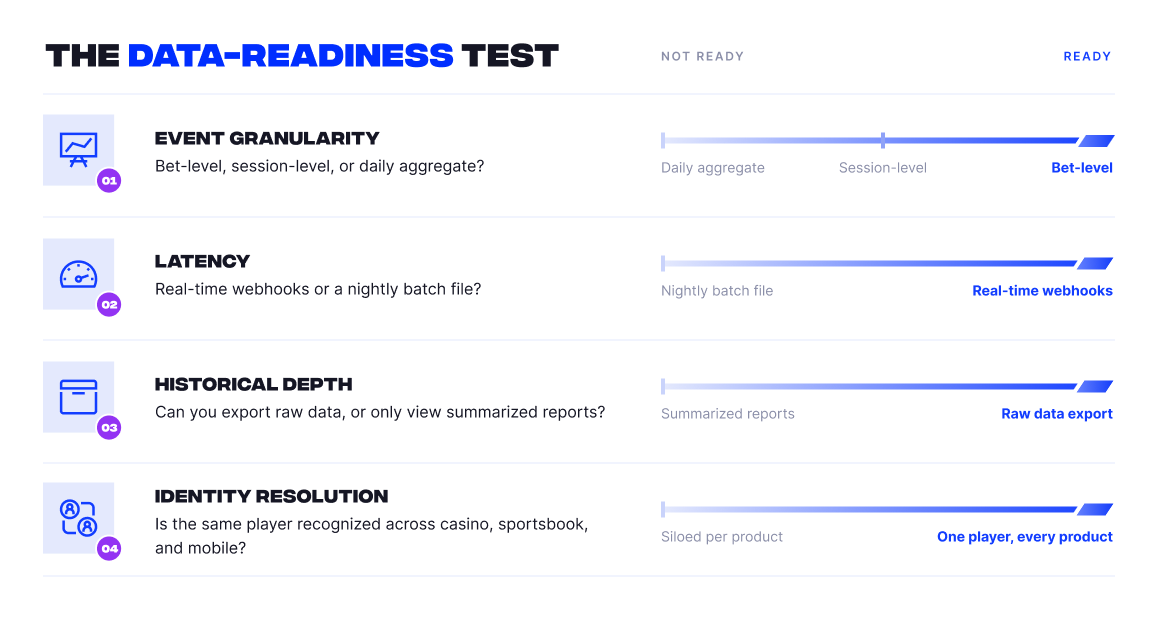
The Data-Readiness Test: What Your Platform Emits Before You Buy Another Retention Tool
A new retention tool cannot act on data it never receives. Before adding another CRM or personalization engine, you should check what your existing platform actually offers.
This is where many retention strategies for iGaming operators run into trouble. The segmentation logic works, but the underlying event arrives too late, lacks enough detail, or cannot be connected to the same player across products. Your data analytics team ends up working around platform limitations instead of generating useful data-driven insights.
You can get a good picture of your current position by running this four-step diagnosis.
Event Granularity: Bet-Level, Session-Level, or Daily Aggregate?
Start by asking how detailed your player data really is. Bet-level data gives you individual wagers, games, stakes, timestamps, wins, losses, and other events. This level of detail can support in-session triggers, analysis of spending patterns, game-affinity models, and much more precise views of player behavior.
Session-level data tells you what happened during a visit but removes some of that detail. You can still identify changes in session frequency, duration, deposits, or broad playing patterns, but it becomes harder to react to a specific event.
Daily aggregates are much more restrictive. If you only learn tomorrow that a player changed their usual behavior today, you cannot respond during the session. Your “real-time” retention strategy becomes a next-day campaign.
Hence, granularity sets a practical limit on personalization. Before buying a tool promising sophisticated, data-driven insights for personalization, make sure your platform produces the events needed to generate them.
Latency and Delivery: Real-Time Webhooks or a Nightly Batch File?
Data is only useful if it arrives at the right time. A platform may expose excellent player events but deliver them through a nightly SFTP export. While that can work for reporting, longer-term segmentation, and scheduled campaigns, it does little for an offer that needs to appear while a player is still in the lobby.
Event streams, and message queues allow downstream systems to react much faster. A player completes a qualifying action, the event reaches the engagement service, and the relevant experience can be updated while the session is still active.
This distinction matters when evaluating retention vendors. “Real-time personalization” describes what a tool can do when supplied with real-time data. If your platform sends a batch file every 24 hours, the tool cannot create the illusion of immediacy upstream.
Historical Depth, Raw Data, and Export Rights
Next, find out what you can retrieve, not just what you can see in the back office. Ask how many months or years of player history are accessible. Check whether your team can export raw transactions and events or only view summarized reports. Then, confirm the available formats and whether data can be moved to your own warehouse or event store.
Historical depth becomes particularly important when modeling churn. A few weeks of activity may reveal a recent decline, but churn-propensity models need enough history to distinguish meaningful changes from normal fluctuations in player behavior.
Having access to raw historical data also gives your team more freedom to develop players’ data-driven insights rather than relying exclusively on the platform’s predefined reporting views.
Identity Resolution Across Casino, Sportsbook, and Mobile
Finally, check whether your systems know that the same person is the same person everywhere. A player might use a casino on a desktop and place sports betting wagers through a mobile app later that evening. If those activities are under separate identifiers, your retention systems see several incomplete profiles rather than a single customer journey.
That creates practical problems. A loyal cross-product player can be classified as inactive in one vertical. The same person might enter conflicting segments or receive duplicated offers through multiple channels.
A shared player ID and reliable cross-product session stitching give your team a consistent identity across casino, sportsbook, apps, and devices. Without them, better player segmentation will only make fragmented data more precisely fragmented.
The Churn You Cannot Bonus Your Way Out Of: Cashier, KYC, and Latency
Some player retention problems have little to do with the quality of your promotions. A generous deposit bonus will not compensate for failed payments, slow withdrawals, repeated verification requests, or a casino lobby that struggles on a mid-range phone.
In the cashier, track payment acceptance rates and withdrawal time-to-cash, then identify where players abandon the process. A well-designed casino payment-processing flow removes friction from a part of the gaming experience directly tied to trust.
KYC deserves the same attention. Poorly synchronized systems can make returning players repeat checks or wait unnecessarily for verification. In regulated markets, the goal shouldn’t be to bypass compliance, but to implement KYC and AML in online gambling without creating avoidable friction.
As for performance, measure lobby and game load times on the devices your players actually use, as well as crashes and latency during peak traffic. A seamless mobile experience can do more to keep players engaged than another promotion layered on top of a slow product.
Put these metrics on the retention scorecard alongside retention rates, bonus cost, and lifetime value. If the product itself is pushing loyal players away, marketing cannot sustainably buy them back.
Retention Levers You Can Ship on the Frontend Without Touching the PAM
Once the core stays untouched, the frontend becomes one of the quickest places to improve player retention. A personalized lobby can reorder game rails using player behavior, surface favorite games, and improve discovery. Mission progress, tournaments, leaderboards, and loyalty status can also be displayed on the frontend, giving players visible reasons to continue playing.
The same layer can support cross-sell between casino and sports betting, preserve sessions across devices, and provide a faster native or hybrid mobile shell. The architecture is fairly simple. Your frontend reads the required data through platform APIs, while your own services maintain any additional state. The Player Account Management system remains the source of truth for balances and regulated account data. This approach to casino frontend customization lets an in-house team test new retention features without turning every product experiment into a core-platform project.
Attaching a Gamification and Loyalty Layer Beside a White-Label Platform
You can add iGaming gamification without moving progression logic into the core platform. An external engagement service tracks missions, levels, tournaments, and loyalty progress by consuming the platform’s event feed. In practice, legacy PAM bonus engines rarely expose open write APIs capable of processing arbitrary, dynamically calculated monetary grants directly from third-party engines.
Legacy platforms typically limit bonus API calls to triggering pre-configured bonus campaign IDs or static promo templates already defined within the PAM back-office. Before building external dynamic reward logic, operators must verify whether the core PAM supports programmatic dynamic wallet grants, or if third-party engagement engines must be restricted to triggering pre-set PAM bonus templates.
This setup gives an in-house team more control over player engagement and loyalty and VIP programs, but it creates technical responsibilities. Events must be processed once, progression records need to be reconciled with the platform, and bonus-abuse controls must work across both systems. Latency also matters if rewards or progress updates are meant to appear immediately.
A good gamification strategy accounts for these constraints from the start. Retention tools may provide engagement features, but their effectiveness still depends on the architecture that connects them to the casino.
Where the API Surface and the Platform Contract Actually Block You and How to Test It in a Week
Before committing development time to another retention feature, find out what the platform actually permits. An API appearing in the documentation does not mean your team has access to every endpoint or action it needs. A proper review of API integration in iGaming starts with the permissions and constraints behind those endpoints.
Verify these five areas:
- Read versus Write Endpoints: Confirm if your backend provides programmable REST or GraphQL write endpoints for granting bonuses, triggering dynamic tags, or crediting rewards, instead of restricting access to read-only reporting endpoints.
- Rate Limits and Concurrent Throughput: Load-test event hooks to ensure your provider does not aggressively throttle webhooks or REST requests during major peak traffic events.
- Sandbox Parity: Verify that your platform vendor supplies a dedicated, fully featured staging sandbox that mirrors real-money production environments for testing custom frontend integrations.
- Change-Request Lead Times: Review historical vendor response times for provisioning new API tokens, opening firewall ports, or expanding event schemas.
- Add-on Module Fees: Audit platform contracts to ensure the provider does not charge prohibitive usage fees or revenue shares for enabling standard API access points.
Turn the review into a one-week technical spike. Take each retention lever you want to ship, test the required endpoints and permissions, and give it one of three verdicts: go, blocked, or paid add-on. If you are working with an API-first approach, this also creates a clear boundary between features your developers can own and those that still depend on the platform provider.
Compliance Constraints That Shape Retention Design in Regulated Markets
In regulated markets, a retention feature must also comply with the rules of each jurisdiction. A promotion that is acceptable in one market may need different terms, limits, or eligibility rules in another.
For operators, this means that player protection must be built into the retention layer. Self-exclusion status should synchronize across relevant products and channels. Deposit limits, reality checks, cooling-off periods, and marketing consent must also be respected when deciding who receives an offer or enters a campaign. These responsible gamingrequirements should form part of the feature logic rather than a compliance check added after development.
The details vary across regulators such as the UK Gambling Commission (UKGC), Malta Gaming Authority (MGA), Germany’s Gemeinsame Glücksspielbehörde der Länder (GGL), and the Netherlands Gambling Authority (KSA). An in-house team serving several markets, therefore, needs to treat jurisdiction as another input into segmentation and feature eligibility.
Since regulatory requirements change, the team should verify the current rules in every target jurisdiction before a retention feature goes live. Responsible gambling tools and player protection directly shape which retention features operators can offer.
Measuring Casino Retention Properly: Cohorts, Not Back-Office Averages
Evaluating player retention using high-level back-office averages distorts the view of product health. Blended metrics such as overall active monthly players or site-wide average revenue per user (ARPU) often mask severe retention decay among newly acquired players. A surge in top-of-funnel marketing acquisition can temporarily hide massive underlying churn within older player cohorts
Proper measurement requires tracking strict daily and monthly cohort performance:
- Short-Term Retention (D1, D7, D30): Measures early onboarding conversion and initial product satisfaction. Sharp drop-offs between Day 1 and Day 7 usually signal cashier friction, unoptimized registration flows, or slow application loading times.
- Long-Term Cohort Retention (M1, M3, M6+): Tracks sustained player engagement and VIP progression over time. A flattening cohort curve indicates strong product-market fit and effective ongoing loyalty loops.
- Financial Cohort Metrics (NGR and ARPU per Cohort): Map cumulative net gaming revenue and average revenue per user across the player lifecycle. These online casino KPIs enable operators to calculate accurate payback periods for customer acquisition costs (CAC).
- Reactivation and Churn Rates: Monitor the percentage of lapsed players who return to active play following targeted re-engagement campaigns versus those who churn permanently.
To prove that a new frontend feature or gamification layer drives genuine incremental value, implement isolated control groups. By routing a small holdout percentage of a cohort through the standard platform layout while exposing the remaining players to the upgraded experience, you isolate product improvements from seasonal market noise.
A 90-Day Sequence for Lifting Player Retention Without Replatforming
Trying to fix every retention problem at once makes it difficult to tell what actually worked. A 90-day sequence gives product and engineering a more useful order of operations.
Weeks 1–2: Find the Constraints
Run the data-readiness test and map the API surface. At the same time, track payment failures, withdrawal times, KYC friction, mobile performance, and other points where players drop out. Establish baseline retention rates for the cohorts you plan to measure.
Weeks 3–6: Fix Measurable Product Friction
Prioritize problems with a clear connection to churn. That could mean improving cashier completion, removing unnecessary verification loops, reducing mobile load times, or fixing session continuity. There is little value in adding new engagement mechanics while basic product friction continues to drive players away.
Weeks 7–12: Test One Retention Lever
Choose a defined cohort and ship one change, such as personalized game rails or loyalty progression. Keep a holdout group and measure the effect on player engagement, deposit frequency, retention, and lifetime value.
On day 90, make the platform decision based on evidence. If the features most likely to improve retention remain blocked by missing event data, write permissions, or core wallet and bonus limitations, the problem has reached the platform layer. That is when replatforming transitions from an avoidable expense to a necessary strategic investment.
Conclusion: Treat Retention in iGaming as an Architecture Decision Before It Becomes a Migration Decision
Poor retention in iGaming does not automatically mean you have outgrown your platform. The real constraint may sit in the data it exposes, the speed of those events, the available APIs, or the permissions your team has to act on them.
For operators with an in-house tech team, much of the retention stack remains within reach. Frontend improvements can remove friction, external engagement services can support new retention strategies, and better instrumentation can reveal why players leave in the first place.
Migration becomes relevant when the core repeatedly blocks the changes that matter. Before reaching that point, a retention-focused technical audit can show which improvements are possible within the current architecture and which genuinely require a new casino platform build.
FAQ
What does retention in iGaming actually measure?
Retention in iGaming measures how effectively an operator keeps players active over time. Common measures include D1, D7, D30, M1, and M3 retention rates, as well as deposit frequency, reactivation rate, and lifetime value.
Can you improve casino retention on a white-label platform?
Yes, provided the platform exposes enough data and API access. Many proven strategies, including personalized lobbies, missions, loyalty interfaces, and improved mobile journeys, can sit outside the core platform.
Does adding a gamification layer require a platform migration?
No. A gamification system can operate as an external service alongside your existing platform. It ingests raw player event feeds, manages quest and tournament logic independently, and issues rewards back to the core wallet through the provider’s bonus API.
Why do retention campaigns underperform even with a strong CRM?
CRM campaigns underperform when the underlying platform fails to deliver real-time data feeds, resulting in delayed messaging. Additionally, promotional offers cannot overcome engineering friction like slow payouts, failed deposits, or laggy mobile interfaces.
When is replatforming genuinely justified for retention reasons?
Replatforming becomes justified when core limitations repeatedly block high-value retention improvements. If essential event data, write access, wallet capabilities, or bonus functionality cannot be exposed or extended, further work around the platform may deliver diminishing returns.