- CrustLab /
- blog /
- Industry Insights and Regulations /
- Build vs. Buy vs. Own an iGaming Platform: The Third Option No One Talks About
Build vs. Buy vs. Own an iGaming Platform: The Third Option No One Talks About
As an operator, you must find the right technology foundation for an online casino or sportsbook. Most executive teams approach this choice through a binary lens: buy from an established software provider or build from scratch. However, evaluating an iGaming platform purely as a build-or-buy choice misses how modern software delivery models actually function.
Operators also need to consider who owns the intellectual property and player data, and who remains responsible for operating and certifying the platform in production. These choices have direct consequences for control, costs, flexibility, and the ability to adapt as the business grows.
This article examines the commercial models behind the build vs. buy iGaming platform decision and introduces a third option for operators who want platform ownership without having to build the entire organisation required to run it from day one.
- Building, buying, or owning an iGaming platform involves separate decisions about who develops the software, who owns the IP and player data, and who operates and certifies the platform.
- White-label, turnkey, transferred source code, and bespoke builds give operators different levels of control, ownership, cost, roadmap flexibility, and responsibility after launch.
- Build-Operate-Transfer allows operators to own the resulting platform, while an external partner initially handles development and operations, with capabilities and responsibilities transferred over time.
- Operators can decide which parts of the platform to own, rent, or co-build based on their potential for differentiation, regulatory burden, operational complexity, and long-term business value.
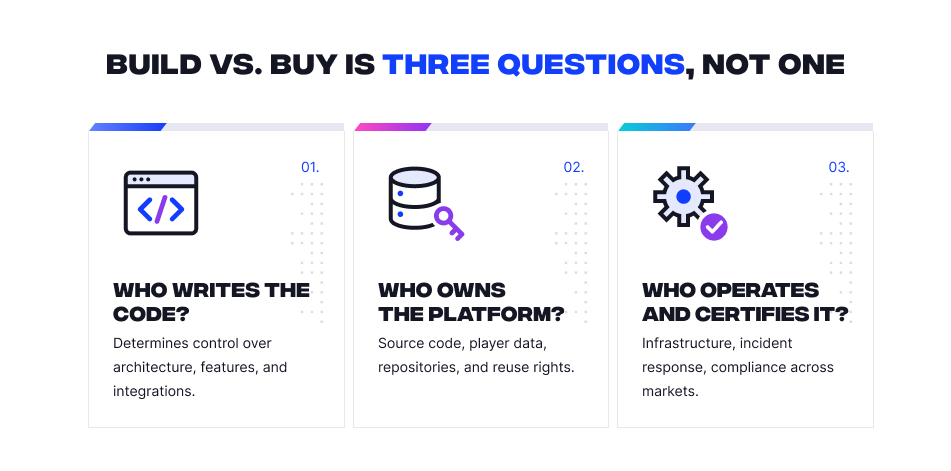
Build vs. Buy for an iGaming Platform Is Three Separate Questions Asked as One
When operators explore an iGaming platform, they usually start with one question: Who will build it? That matters, but it only answers part of the decision. The more useful framework separates three questions: who writes the code, who owns the intellectual property and player data, and who operates and certifies the platform once it goes live.
Who writes the code determines how the software is developed and how much control the operator has over its architecture, features, integrations, and development process. A bespoke build gives the operator more influence over these areas, while a platform supplied by a software company puts much of that work outside the company.
Who owns the platform is a separate issue. An operator can use custom software without owning the underlying source code, or receive source code without having the capability to maintain it. Source code ownership, player data, repositories, documentation, and the rights to modify and reuse the software must all be defined separately.
Furthermore, who operates and certifies the platform determines who carries responsibility once the system is running. This includes infrastructure, releases, incident response, compliance changes, testing, and certification across regulated markets. An operator may own its software while relying on an external team to handle these responsibilities, or keep them entirely in-house.
The build vs buy iGaming platform decision becomes more relevant at this point. Building answers the question of who develops the software, while buying a platform can place development, ownership, and operations largely in the provider’s hands. Separating these responsibilities creates more flexibility and opens a third route between the two.
The Four Commercial Models Behind Every Build vs. Buy iGaming Platform Comparison
The market uses several labels for iGaming platforms, but those labels can obscure important differences in ownership, control, and responsibility. White-label, turnkey, licensed or transferred source code, and bespoke in-house builds each give the operator a different position regarding cost, source code, roadmap control, and ongoing operations. The table below sets out those differences before we look at each model in more detail.
| Model | White Label | Turnkey | Licensed / Transferred Source Code | Bespoke In-House Build |
| Upfront Cost | Low | Medium | Higher | Highest |
| GGR-Share Exposure | Usually ongoing | May include platform fees or revenue share | Can avoid ongoing platform revenue share | No platform revenue share |
| License Holder | Vendor | Operator | Operator | Operator |
| Source-Code Rights | Limited or none | Usually limited | Granted or transferred under contract | Fully owned by operator |
| Roadmap Control | Vendor Dependent | Limited configuration | Full (Internal overhead) | Complete overhead |
| Exit Path | Dependent on the vendor | Dependent on the technology arrangement | Stronger, subject to maintainability | Strongest, provided the technology is maintainable |
The labels can still hide important differences. Turnkey, in particular, can describe two very different arrangements. In one, the operator rents a hosted platform and relies on the provider for much of the underlying technology. In another, the operator receives a technology stack that can be transferred and operated under its own control. The contract determines which structure applies.
White-Label
A white-label model provides a ready-made casino platform under the operator’s brand. The vendor supplies the technology, typically including the PAM, while the operator uses the vendor’s infrastructure and technology framework. Hence, white-label is one of the fastest ways to launch an online casino.
However, the trade-off is limited ownership and control. The operator generally does not own the wallet, player record, underlying source code, or product roadmap, and the commercial structure can include revenue sharing on bets. The iGaming PAM is therefore part of the vendor-controlled platform rather than an asset the operator can independently develop and evolve.
Turnkey
A turnkey platform gives the operator a more defined role in the commercial operation. The operator holds the gaming licence and controls the customer-facing business, while the software provider supplies and hosts the technology.
The important question is how much of that technology can actually be configured. Some turnkey platforms allow substantial changes to the interface, features, integrations, and workflows. Others provide a fixed architecture with limited configuration options, leaving the operator to share much of the same technology as other businesses on the platform.
This distinction matters because the operator may control the brand and commercial strategy without equivalent control over the underlying technology. Licensing decisions also remain separate from the technology arrangement, which is why operators need to review the top gambling licenses alongside the platform model.
Licensed or Transferred Source Code
With licensed or transferred source code, the operator receives access to a codebase under defined contractual rights. Depending on the agreement, this can provide substantially more control than a hosted platform long term.
Ownership alone does not remove the operational burden. The operator still needs to maintain the software, manage infrastructure, handle certification, apply regulatory changes, and keep the platform secure. Source-code delivery without documentation, automated tests, architecture records, and operational runbooks transfers responsibility without necessarily transferring the capability needed to maintain the system.
Bespoke In-House Build
A bespoke in-house build gives the operator control over the platform’s architecture, development priorities, integrations, and source code. The operator can develop its own software around the areas where differentiation matters, rather than adapting its business to the limits of an off-the-shelf casino platform.
The cost is responsibility. Development starts before the platform generates revenue, and the operator must fund the engineering teams, infrastructure, testing, security, maintenance, and certification required to keep the system running.
This model makes the most sense when owning and controlling specific parts of the technology creates a meaningful competitive advantage. That could include the player experience, engagement logic, or other areas where casino frontend customization directly supports the brand.
The Third Option: Owning the Platform Without Building the Organisation to Run It
Another way to structure an iGaming platform is the Build-Operate-Transfer (BOT) route. An external delivery partner builds the platform, while the operator retains ownership of the intellectual property. The partner then operates it for an agreed period before transferring operational responsibility to the operator.
Ownership does not have to mean immediate operational responsibility. The operator can own the source code, architecture, repositories, and other agreed technology assets while the external team handles deployment, maintenance, and production operations.
The transfer happens in stages. Documentation, processes, and operational knowledge move to the operator as its teams become ready to take over.
This approach rarely appears in standard platform comparisons because it falls outside the two commercial models most iGaming vendors sell. Traditional platform providers sell multi-tenant software licenses bound to a recurring revenue share. Pure software development agencies build custom code and hand over raw repositories without operational support. BOT sits between these incentives, providing a clear path to its software infrastructure without forcing a business to run a massive technical organization before launching its brand.
The Ownership Map: Which Layers of the Stack Are Worth Owning and Which Are Commodity
Owning an entire iGaming platform does not mean every component needs to be built from scratch. Some layers directly shape the player experience and give an operator a competitive advantage. Others are infrastructure or regulated services that can be sourced from specialist providers.
A useful way to decide is to score each layer on two questions:
- How much can this layer differentiate the business for online casino players?
- How much certification and regulatory work does it carry?
The answer points towards three approaches: own, rent, or co-build.
| Platform Layer | Player Differentiation Potential | Regulatory Burden | Recommended Approach |
| PAM and Wallet | Medium–High | High | Rent / Co-Build |
| Bonus & Gamification Engine | High | Medium | Own |
| Casino Aggregation | Low | Medium | Rent |
| Sportsbook and Trading Engine | High | High | Co-Build / Rent |
| Frontend & Native Apps | High | Medium | Own |
| Payment Orchestration | Low–Medium | High | Rent / Co-Build |
| CRM, BI & Data Warehouse | High | Low | Own / Co-build |
| Regulatory Reporting | Low | Very High | Co-build / Rent |
Own the Layers That Shape the Customer Experience
The frontend, bonus engine, gamification logic, and customer data can directly affect how an operator competes. These are areas where owning the software can support faster experimentation and a more distinctive product. For example, an operator may want its own iGaming gamification system rather than relying on the same engagement features available to competing brands.
Rent commodity infrastructure where ownership adds little value
Casino aggregation is a good example. Building and maintaining connections to a large number of slot games and mini games can consume significant engineering resources without providing much differentiation for the operator. The same principle can apply to specialist infrastructure and services, where established providers already handle complex technical or compliance requirements.
Co-Build the Layers Where Control and Complexity Meet
Some parts of the platform are too important to treat as mere commodities, but too complex to build entirely on one’s own. PAM, wallet infrastructure, payments, sportsbook technology, and regulatory reporting can fall into this category.
The right approach may be to retain control over the architecture, data, and integration points while using specialist software companies for specific components. For sportsbook operators, for example, sports betting development can involve highly specialised systems that require both technical expertise and an understanding of regulated markets.
Why the Cost of Building an iGaming Platform Is Quoted at the Wrong Number
The cost of building an iGaming platform is often presented as a launch figure. This can give operators a misleading view of the investment because the highest costs continue after the platform goes live.
A proprietary platform needs people to maintain the software, respond to incidents, manage infrastructure, and deliver new features. As a reference point, the US Bureau of Labor Statistics reports a median annual wage of $133,080 for software developers. Senior roles can cost considerably more, particularly in competitive technology markets.
Certification adds another ongoing cost in regulated markets. GLI-19 sets technical requirements for interactive gaming systems, but each jurisdiction can impose its own standards and testing requirements. Expanding into another market can therefore mean additional testing, certification, and engineering work rather than a one-time certification expense.
Additionally, the platform needs to keep up with regulatory expectations, licensing requirements, and third-party integrations. Payment providers, game aggregators, data feeds, and other services can change their APIs or technical requirements, creating additional development and integration testing work. Regulatory shifts in markets such as Canada, the US, the UK, and Europe also force internal engineering teams to divert sprint cycles toward updating deposit limits, self-exclusion registries, tax exports, and related tools.
Therefore, the cost of building an iGaming platform should be assessed over its operating life, not against the initial development quote alone. For an operator, the relevant figure is the total cost of ownership, including engineering, infrastructure, support, certification, compliance work, and ongoing development.
The Capability Test: Can You Operate a Platform, Not Just Fund One?
Having the budget to build your own online casino or sportsbook does not mean you have the organisation to operate it. Once the software goes live, someone needs to manage releases, respond to incidents, maintain infrastructure, handle compliance changes, and keep integrations working across regulated markets.
Before committing to a bespoke build, operators should assess whether they have the internal capability to support the platform after launch. A simple readiness check can help:
| Capability | What Should Be in Place |
| Release Management | A process for testing, approving, and deploying changes safely |
| Incident Response | On-call coverage and clear escalation procedures for production issues |
| Certification Ownership | People responsible for testing and maintaining approvals across jurisdictions |
| Compliance Engineering | Engineering capacity to implement regulatory and responsible-gambling changes |
| Documentation | Current architecture, configuration, runbooks, and system knowledge |
| Key-Person Risk | Enough knowledge spread across the team that critical systems do not depend on one or two engineers |
If several of these capabilities are missing, the question should not be whether the company can fund the build, but whether it can operate what it builds. That distinction should be settled before development starts.
What “You Own the Source Code” Has to Mean in the Development Contract
“Source code ownership” is frequently promised during software sales, but without specific contractual protections, operators often discover they have merely purchased an expensive perpetual license. The agreement should clearly state when intellectual property transfers and what the operator receives as part of that transfer.
At a minimum, the contract should address:
- IP assignment: The operator receives ownership of the custom code as agreed-upon payments are made.
- Source code access: The operator has full access to the repositories and codebase, without hidden runtime licence requirements.
- No technology revenue share: Ownership should not depend on an ongoing share of the operator’s gaming revenue unless explicitly agreed as part of the commercial model.
- Operator-controlled infrastructure: Cloud accounts, repositories, CI pipelines, and deployment environments should be accessible to and under the operator’s control.
- Documentation and runbooks: Architecture design, configuration management, deployment procedures, and operational documentation should be delivered with the code.
- Escrow where relevant: Where third-party components are involved, appropriate escrow arrangements can provide additional protection if the supplier becomes unavailable.
There is also a limit to what source code ownership covers. Games, odds feeds, payment services, KYC providers, and other third-party software remain subject to their own licences and commercial agreements. Owning the platform does not automatically mean owning every component connected to it.
This distinction becomes particularly important for KYC and AML in online gambling. Here, the operator must still meet applicable regulatory and compliance requirements regardless of who developed the underlying software.
Ownership and Valuation: Which Owned Layers a Buyer Actually Pays For
While owning an iGaming platform can strengthen a company’s position in a funding round or sale, ownership alone does not create value. Buyers and investors still need to establish what the technology does, who owns it, how maintainable it is, and what investment it will require after the transaction. Technology due diligence commonly examines architecture, software, infrastructure, security, development operations, and future investment requirements.
For an operator preparing for a raise or exit, the most valuable owned layers are usually those that support the business’s competitive position. Proprietary player data, engagement and bonus logic, a clear IP chain, and well-documented software can strengthen the technology asset. By contrast, owning a commodity component does not automatically make it valuable.
Source code also needs to be maintainable. A self-built PAM that only two departing engineers understand may create more diligence risk than value. Buyers will want to understand the architecture, dependencies, documentation, technical debt, and cost of future development before they can assess what the technology is actually worth.
The ownership decision should therefore be made with the eventual valuation story in mind. Own the layers that make the business more defensible, while avoiding the assumption that every line of code becomes an asset simply because the company paid to develop it.
When Each Answer Is Right: Matching the Build vs. Buy iGaming Platform Decision to the Trigger Moment
The right choice between building or buying an iGaming platform should not be driven by company size or raw revenue. Instead, the right architectural model depends on the specific operational catalyst that forced the question in the first place.
Evaluating options through a simple pros-and-cons list often fails because it weighs generic features equally. Operators should instead use a weighted decision scorecard tailored to their specific trigger moment,
Market Entry
When launching an online casino or sportsbook for the first time, speed to revenue and licence readiness usually matter most. A full custom build can tie up capital before the business has proven demand.
A rented platform or selected third-party components can reduce the initial scope. The key is to choose components that can be replaced or integrated with your software later, rather than creating unnecessary barriers to future ownership.
Replatforming an Established Brand
For an established operator, the main concern is usually platform migration risk. Moving player accounts, balances, transaction histories, integrations, and compliance configurations while keeping the existing business running leaves little room for a single, high-risk replacement project.
A layer-by-layer approach is often more practical. An operator can modernize selected parts of the platform while continuing to run the existing system, then move additional functions as they become ready. This also gives engineering teams time to test each integration and maintain operational continuity.
Multi-Jurisdiction Expansion
Expansion changes the calculation because every new jurisdiction can introduce additional licensing, certification, reporting, payment, and localisation requirements. The binding constraint may become regulatory work rather than product development.
In this situation, ownership should follow the areas where jurisdictional flexibility creates value. Commodity components can remain rented, while architecture, data, compliance workflows, and other strategic layers can be retained or co-built where greater control reduces future expansion work. Multi-jurisdiction platforms need to account for differences in licensing and compliance requirements rather than treating every new market as the same deployment.
Preparing for a Raise or an Exit
For an operator preparing for investment or a sale, the question changes again. The focus is on which technology assets the company actually owns and whether those assets can withstand technical due diligence.
Source code ownership, proprietary player data, documented architecture, maintainable software, and clear IP rights can strengthen the technology story. But owning software that is expensive to maintain or depends on a few key engineers can create a liability instead.
The best answer is therefore the one that fits the trigger moment. Build when control and differentiation justify the money, buy when speed and proven infrastructure matter more, and use a hybrid or BOT model when ownership is important but internal capability needs time to develop.
Conclusion: Treat Platform Ownership as an Allocation Decision, Not a Purchase
A build vs. buy iGaming platform decision is not a choice between two fixed packages. Operators can separate development, ownership, and operations, then decide how much control each part of the platform actually requires.
The right model depends on where ownership creates value. An operator may rent commodity infrastructure, co-build critical systems, and own the technology that supports its competitive advantage. For some businesses, Build-Operate-Transfer provides a practical path to ownership without requiring a complete engineering and operations organisation from day one.
Before choosing a model, assess the existing technology, business goals, regulatory requirements, and internal capabilities. A structured discovery and architecture assessment can then identify which parts of the platform should be built, bought, rented, or owned.
FAQ
How much does it cost to build an iGaming platform?
The cost depends on the platform’s scope, technology, integrations, regulatory requirements, and the extent of custom development. A custom platform can require significant upfront investment, followed by ongoing costs for engineering, infrastructure, certification, compliance, and maintenance.
How long does it take to build a casino or sportsbook platform?
A bespoke platform built from scratch generally takes 9 to 18 months from initial architecture design to production deployment and regulatory certification. However, operators can shorten this timeline to 3 to 6 months by co-building through a headless API approach or using a Build-Operate-Transfer (BOT) model.
Can you own an iGaming platform without an in-house development team?
Yes. A Build-Operate-Transfer model allows an external delivery partner to build and operate the platform while the operator retains ownership of the agreed intellectual property. Operational responsibilities can then transfer gradually as the operator develops its internal capabilities.
Does owning your platform technology increase company valuation?
Platform technology ownership can increase valuation when the company owns valuable intellectual property, proprietary player data, maintainable source code, and technology that supports a defensible competitive position. Yet, ownership alone does not guarantee a higher valuation, especially if the software is poorly documented, difficult to maintain, or heavily dependent on a small number of engineers.