- CrustLab /
- blog /
- Industry Insights and Regulations /
- Building a PvP Skill-Based iGaming Platform
Building a PvP Skill-Based iGaming Platform

- Skill vs. Chance: Predominance, Material Element, and Any-Chance Tests
- KYC, Geo-Compliance, Money Transmission, AML, and Responsible Gaming
- 1. Onboarding and Identity
- 2. Wallet, Payments, and Ledger
- 3. Game Integration Layer
- 4. Matchmaking and the Competitive Loop
- 5. Player-Facing Product and Gamification
- 6. Backoffice and Operations
Online casinos and sportsbooks are no longer the only routes into the iGaming industry. As demand shifts toward social experiences, PvP skill-based platforms are creating a new category that blends the excitement of real-money play with the appeal of esports and multiplayer gaming. In other words, players get a chance to win real money by beating other players, not the house.
As an investor, this is an opportunity to deliver high-stakes competitions and player excitement without the legal restrictions of traditional gambling. However, you must first solve two problems that determine whether players stay or leave: liquidity and integrity. This guide walks through the architecture, MVP strategy, monetization model, and engineering decisions needed to build a platform that scales from launch through long-term growth.
- Prioritize liquidity and integrity from the start, because fast matchmaking and trusted competition are the two factors that determine whether players stay and recommend your platform.
- Launch with proven skill-based games rather than building your own, so you can focus your budget on developing a scalable platform, a stronger brand, and a better player experience.
- Keep your MVP focused on the secure competitive loop by delivering onboarding, payments, matchmaking, settlement, and compliance before investing in advanced features and custom games.
- Scale in stages by first proving your business model, then expanding your platform with stronger retention features, a larger game portfolio, and eventually proprietary games and technology.
What Is a PvP Skill-Based iGaming Platform?
A PvP skill-based iGaming platform is a real-money platform where players compete against each other in skill-based games rather than against the house. Before a match starts, each player pays an entry fee into a shared prize pool. The winner takes the pot, while the platform earns revenue through a small commission, commonly called a rake.
Unlike traditional casino games, the platform doesn’t profit from players’ losses. Its success depends on attracting enough players and delivering a trusted experience that encourages players to return. To ensure fair matches and protect the ecosystem, most platforms use an ELO or similar rating system to match players with opponents of comparable skill.
Skill-Based PvP vs. Traditional iGaming and Gambling
The biggest difference between skill-based games and traditional gambling is the factor that determines the outcome. In a casino game, chance decides who wins. The outcome depends predominantly on the user’s ability and strategy, minimizing or standardizing elements of chance to ensure competitive fairness.
Legally, gambling is often assessed using three elements: prize, consideration, and chance. A player pays consideration (an entry fee) for a chance to win a prize. If chance is the deciding factor, the activity is generally treated as gambling. Remove the chance element, and the contest may instead be classified as a game of skill, depending on the jurisdiction.
This distinction is more than a legal technicality. It can determine where you can advertise, which partners you can work with, and whether your website or app can reach audiences that many gambling brands cannot. That makes preserving the integrity of skill-based games one of the most important design decisions you’ll make when building a PvP skill-based iGaming platform.
| Feature | Traditional iGaming | Skill-Based PvP Platforms |
| Legal Status | Heavily restricted, requires gambling licenses | Subject to a complex, region-specific legal patchwork |
| Core Mechanics | Outcome determined by chance | The outcome depends entirely on the user’s ability and strategy |
| Monetization | The operator profits from the player’s losses | The platform earns a rake |
| User Acquisition | Restricted ad networks, blocked from top app stores | Highly regulated, while easier to market than traditional casinos |
Why Skill-Based PvP Is the Next Frontier of iGaming
Player expectations are changing from chance to challenge. Many players no longer want to rely solely on luck. They want to compete, improve their skills, and earn every win. That’s why competitive skill-based games are attracting attention from both operators and investors.
The popularity of esports, multiplayer mobile games, fantasy leagues, and ranked tournaments has also created a generation of players who enjoy climbing leaderboards and beating opponents to earn rewards. A real-money PvP platform builds on these familiar experiences by adding cash prizes to the competitive loop.
For operators, the opportunity goes beyond gameplay. In many jurisdictions, a genuine skill-based product may have more marketing flexibility than traditional gambling, opening doors to advertising channels, partnerships, and sponsorship opportunities that are often unavailable to casino brands.
Popular Skill-Based PvP Game Formats
The best real-money skill-based games are fast and easy to understand. Short match times keep players moving through the platform, helping fill lobbies and reduce waiting times.
- Chess and checkers: These are deterministic games in which the outcome depends entirely on the players’ decisions. Since there are zero hidden variables or random drops, these formats provide the strongest possible foundation for an airtight legal argument. Short, high-tempo variants like bullet chess are ideal for real-money environments.
- Reaction and reflex games: These include tap-speed, aim, timing, or memory challenges where the highest score or fastest completion determines the winner. They create exciting, repeatable gameplay but require robust latency compensation because connection quality and device performance can affect results independently of player skill.
- Score-based competitions: Instead of direct head-to-head play, players attempt to achieve the highest scores within a set time. These formats work well for recurring competitions, leaderboard events, and asynchronous play while still offering real cash prizes.
It’s worth remembering that the games themselves are rarely the source of long-term advantage. Proven titles are widely available. The real competitive edge comes from building a platform with strong liquidity, trusted integrity, and features that keep players coming back.
The Business Case: Why Build a Skill-Based PvP Platform
This vertical offers a powerful commercial rationale. By combining the social pull of peer-to-peer competition with real-money rewards, operators can capture gambling-level engagement on a highly defensible platform.
From a business perspective, the biggest opportunity isn’t creating new games. It’s building a trusted platform where players can easily find opponents and compete for real cash prizes. Those advantages are much harder for competitors to copy than another chess or checkers game.
That is why the strongest businesses invest where defensibility lives. They use proven skill-based games, focus on building a loyal community, and allocate their budget to liquidity, integrity, and the player experience rather than rebuilding existing games.
Marketing Where Gambling Brands Cannot
One of the biggest advantages of a skill-based model is its ability to expand your marketing options. Where permitted by law, a platform built around skill-based games may be able to advertise through channels that restrict or prohibit traditional gambling brands. The exact rules vary by jurisdiction, so legal advice is essential before launching.
That flexibility can open the door to mobile app stores, influencer partnerships, sponsorships, content marketing, and paid advertising that would otherwise be difficult or impossible to access. It also helps position your website as a competitive gaming destination rather than a casino.
However, marketing alone won’t guarantee success. A strong launch depends on building demand before day one. A pre-warmed community and coordinated launch campaigns help ensure enough players join at the same time to keep matches running from the start.
Market Opportunity, Audience, and Scale Targets
The target audience consists of highly competitive players who want real stakes to validate their abilities. Many already play ranked multiplayer games, esports, fantasy sports, or online chess, and are motivated by competition, progression, and meaningful rewards.
When launching, the goal should be to attract a focused group of active users who can quickly find matches at any time of day. A smaller, engaged player base creates a better experience than a large audience spread across too many games.
Your platform should also be built with growth in mind. A successful launch might begin with a relatively small cohort before expanding toward hundreds of thousands of players over time. Designing for that scale from the start helps you avoid costly rewrites as your community grows.
The Two Problems That Make or Break a Skill-PvP Platform
Player liquidity and ecosystem integrity are two distinct operational challenges that determine whether a newly launched platform survives or collapses. Your launch capital should be heavily concentrated on these two pillars, as they are where your actual business defensibility lies.
Liquidity: The Silent Killer
An empty match lobby will destroy a digital platform faster than poor marketing. If players can’t find a fair opponent within seconds, they’ll leave. Once that happens repeatedly, attracting them back becomes much harder.
Some operators try to solve this by filling lobbies with bots or fake accounts. That may create the appearance of activity for a short time, but it’s a risky strategy. Players are told they’re competing against real people for real prizes. If they discover they’re actually playing against bots, it can become a consumer protection and transparency issue that damages the brand.
To build a thriving, honest ecosystem from day one, you must implement three reinforcing structural solutions.
Warm the Community From Day Zero
Liquidity begins before launch. Build a waitlist, grow your community, and coordinate your marketing so large numbers of players join at the same time. A concentrated launch creates active lobbies from day one and gives new users an immediate reason to stay.
Deliberately Limit the Number of Games at Launch
Resist the temptation to launch with dozens of games. Every additional title splits your player base, making it harder for players to find quick matches. Start with a handful of proven formats, then expand only after you’ve established healthy liquidity.
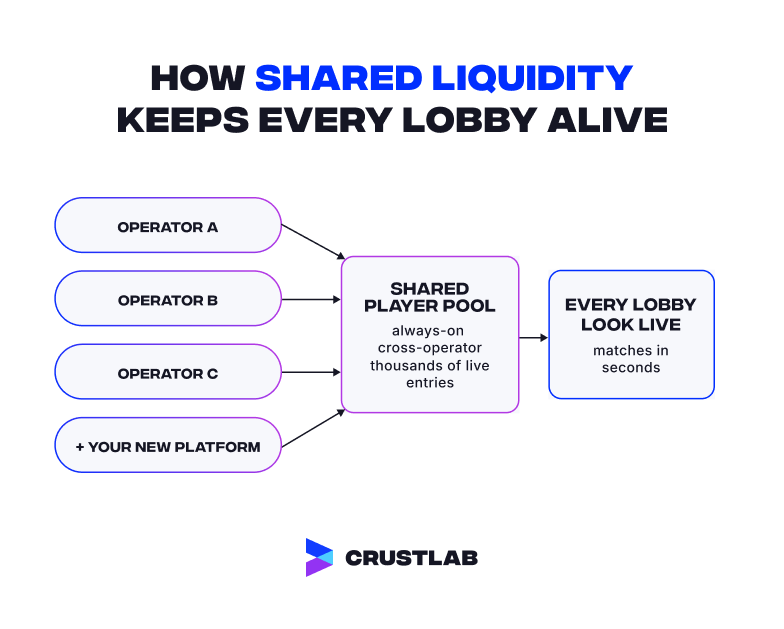
Use Shared, Cross-Operator Liquidity
Another way to overcome the cold-start problem is through shared liquidity. Some game providers pool players across multiple operator platforms, allowing new brands to benefit from a larger matchmaking network. While this approach is well established in online poker and casino networks, shared liquidity networks are also the primary industry standard for B2B skill-gaming SDKs, allowing new platforms to offer faster matches and more attractive prize pools without waiting to build a massive audience on their own.
Integrity: Your License to Operate
Liquidity attracts players, while integrity keeps them. The moment players believe someone is cheating, trust disappears, and so does your business.
There’s no single solution to this problem. Any popular skill-based game can eventually be scripted or manipulated. Real protection comes from combining multiple layers of security that detect and prevent suspicious activity.
Game-Engine Integrity on the Provider Side
Integrity starts with the game provider. Before integrating any title, make sure the provider can demonstrate that its game engine has been built with anti-fraud controls, secure result validation, and independent testing in mind. These protections should be contractual requirements, not optional features.
Behavioral and Timing Detection
Cheating often leaves patterns. Modern anti-cheat systems analyze mouse movements, touch input, reaction times, and other behavioral signals to identify non-human play or software-assisted decisions. Instead of relying on a single rule, the platform continuously monitors activity and flags suspicious accounts for review before they can harm other players.
Latency-Fairness Engineering (Beyond Anti-Cheat)
True system fairness requires dedicated engineering separate from standard anti-cheat protocols. Network latency and hardware differences can create an unfair advantage in reflex-based titles.
A good example is Checkmate’s fairness system, which adjusts each player’s displayed clock by up to 200 milliseconds based on measured network latency. This compensates for slower connections so timing differences don’t create an unfair advantage. Unlike anti-cheat measures, latency compensation focuses on creating equal playing conditions for every match.
Engine-Comparison Anti-Cheat
Turn-based games such as chess and checkers offer another powerful defense. Platforms can compare a player’s decisions against those recommended by an optimal game engine. If a player consistently makes engine-perfect moves at an unrealistic level, the account can be flagged for investigation.
Checkmate uses this approach as part of its anti-cheat system, with integrity research conducted alongside the Australian Artificial Intelligence Institute at the University of Technology Sydney (UTS). This demonstrates how engine analysis can strengthen trust in competitive play.
Collusion and Multi-Accounting Controls
Not all fraud involves malicious bots. Some users create multiple accounts or work together to move money between accounts by intentionally losing matches. To disrupt organized collusion rings, the platform must use its matchmaking engine as a fraud filter. By applying an ELO rating system, monitoring unexpected win streaks, and enforcing aggressive opponent shuffling, the core platform prevents bad actors from matching up to manipulate outcomes.
Legal Skill-Based Certification
Strong engineering should be backed by independent verification. Legal opinions, third-party audits, and formal skill-based certifications help demonstrate that outcomes depend on player skill rather than chance. This becomes especially important when expanding into the United States, where regulators and business partners often expect clear evidence that the platform operates as a game of skill.
Is Skill-Based Gaming Legal? Navigating Regulation
Whether a skill-based game is legal depends on where you operate. Many jurisdictions allow real-money skill-based games, but the rules differ from country to country and sometimes from state to state. While this overview does not constitute formal legal advice, understanding how governments evaluate these products will help your company target high-intent markets safely.
Skill vs. Chance: Predominance, Material Element, and Any-Chance Tests
Different jurisdictions use different legal tests to distinguish games of skill from gambling.
- Predominance test: The most common approach. A game is generally considered a game of skill if skill has a greater influence on the outcome than chance.
- Material element test: A game may still be classified as gambling if chance plays a meaningful role, even when skill is the dominant factor.
- Any-chance test: The strictest standard. Any meaningful element of chance can be enough for a game to be treated as gambling.
This is why deterministic games such as chess and checkers are attractive choices. Both players have access to the same information, and outcomes depend on their decisions rather than random events.
KYC, Geo-Compliance, Money Transmission, AML, and Responsible Gaming
Legal compliance extends well beyond whether a game is based on skill.
A real-money platform should include:
- Know Your Customer (KYC) checks before players can deposit significant funds or withdraw cash prizes.
- Geo-compliance enforced at the API level, allowing your website or app to restrict deposits, gameplay, or withdrawals based on a player’s location.
- Responsible gaming tools such as deposit limits, self-exclusion, cooling-off periods, and account monitoring.
- Anti-money laundering (AML) controls, transaction monitoring, sanctions screening, and record keeping.
- Money transmission compliance where required. If your platform accepts crypto deposits and pays out real cash or digital assets, you may also trigger money-transmitter and financial crime obligations that are separate from gambling law.
Platform Anatomy: The 4 Layers of a Skill-PvP Platform
A successful PvP skill-based iGaming site is much more than a collection of games. It combines multiple systems that work together to onboard players, run secure matches, process payments, and support day-to-day operations. At launch, the smartest approach is to rent proven games and invest your development budget in the layers that create long-term value.
1. Player-Facing Layer
The player-facing layer is where your brand comes to life. It includes the interface your players use to browse games, join matches, track their progress, and interact with the platform. This is also where gamification, leaderboards, rewards, notifications, and community features encourage players to keep coming back. Since many operators can offer the same games, the player experience is often what sets one platform apart from another.
2. Game Layer (Rented at Launch)
The game layer contains the competitive titles that power the platform. Rather than spending months or years building and certifying your own skill-based games, most founders are better off integrating a trusted provider. Established providers already offer tested game engines, matchmaking logic, anti-fraud controls, and legal skill certifications where available. Renting these games lets you launch faster while focusing your budget on areas that are harder to replicate.
3. Platform Core
The platform core is the engine that runs the business behind the scenes. It manages player wallets, crypto deposits and withdrawals, KYC, geo-compliance, matchmaking, and settlement after each match. It also handles communication between your website and the game provider, ensuring entry fees are locked before a match begins, and the winner is paid correctly once the result is verified. As your business grows, this layer becomes the foundation that supports scale and reliability.
4. Backoffice
The back office gives your operations team complete visibility and control over the platform. From a single dashboard, administrators can perform security verification, approve withdrawals, investigate disputes, monitor suspicious activity, and generate financial reports. An immutable audit log records every important action, making it easier to resolve disputes and demonstrate compliance. Although players never interact with this layer, it’s essential for running a secure and trustworthy real-money platform.
How to Build the MVP: The Secure Competitive Loop
When launching a PvP skill-based iGaming platform, scope discipline is your primary defense against budget burn. Your Minimum Viable Product (MVP) must focus entirely on executing a single, secure competitive loop: a player can create an account, complete basic identity checks, fund their wallet, enter an instant match, pay an entry fee, and receive a verified payout after a match ends. Everything else can come later.
1. Onboarding and Identity
The journey starts with a simple registration flow that quickly gets users onto the platform while meeting compliance requirements. Players should be able to create an account, authenticate securely, and manage their profile with ease. Before they can play for real cash prizes or make withdrawals, the platform should complete a light KYC process and enforce geo-compliance at the API level to limit access where required.
2. Wallet, Payments, and Ledger
For most MVPs, supporting a single cryptocurrency or stablecoin is the smartest approach. Many game providers settle in one digital asset, so matching your wallet to that asset reduces integration complexity and reconciliation errors. Behind the scenes, the ledger should separate a player’s available balance, funds locked in active matches, and pending withdrawals, while maintaining a complete transaction history for auditing and support.
3. Game Integration Layer
The game integration layer connects your platform to the provider’s game servers. Before a match begins, the system verifies the player’s balance and eligibility, locks the entry fee, and starts the game session. When the match ends, the provider returns a verified result that triggers settlement. Strong system-to-system authentication, replay protection, and detailed result logging help protect the integrity of every transaction.
4. Matchmaking and the Competitive Loop
This is the heart of the product. Players compete through a challenge lobby where they’re matched with opponents of similar skill. Once both players accept a match, the platform locks the entry fees and starts the game. It then tracks the match through every stage, from creation and funding to completion, cancellation, or dispute. After a verified result, the rake is deducted, the winner receives the remaining prize pool, and refunds are issued automatically when a match is canceled, ends in a draw, or cannot be completed.
5. Player-Facing Product and Gamification
Even the first release should give players a reason to return. A polished interface, clear branding, leaderboard, progression system, notifications, and simple social features create a stronger experience than gameplay alone. These elements turn individual matches into a longer-term journey that encourages engagement and repeat play.
6. Backoffice and Operations
Your administrators must be equipped with basic operational tools to manage the site safely from day one without touching the live database. The minimum backoffice dashboard requires a player search feature, a ledger transaction auditor, a KYC document reviewer, and a manual withdrawal approval queue. Additionally, include a basic dispute desk to resolve match conflicts, an immutable audit log for security, and real-time GGR and NGR financial reporting.
What to Deliberately Leave Out of the MVP?
One of the biggest mistakes founders make is trying to build everything before launch. Every additional feature increases development time and cost without necessarily improving the core experience. Your first goal is to prove that players will join, find matches, compete, and return.
Once that competitive loop is working, you can expand the platform with new capabilities. Features worth postponing include:
- Advanced financial tools: Multi-currency wallets, in-app crypto token swaps, automated loyalty ladders, and multi-period player rakeback programs.
- Complex retention loops: Daily reward chests, community chat rain systems, integrated affiliate networks, and streamer marketing tooling.
- Proprietary technology: Custom in-house game development, proprietary backend anti-cheat engines, and multi-tenant white-label platform architecture.
Build vs. Rent: How to Source Your Games
One of the most important decisions you’ll make is whether to build your own games or integrate existing ones. For most founders, renting proven skill-based games is the faster and lower-risk option. It lets you focus on the parts of the platform that create a lasting competitive advantage.
Building custom games from scratch can make sense later, but it’s rarely the best use of time or capital before you’ve proven demand.
Why Renting Proven Games De-Risks Launch
Established game providers have already invested in developing, testing, and refining their games. Many also include matchmaking, anti-cheat systems, fraud detection, and legal skill certifications where available. Instead of spending months recreating those capabilities, you can launch sooner with technology that’s already been tested in real-money environments.
Renting games also reduces technical risk. Your team can focus on building a polished website, secure wallet infrastructure, onboarding, and features that help attract and retain players. If a game doesn’t perform well, you can replace or expand your catalogue without fuss.
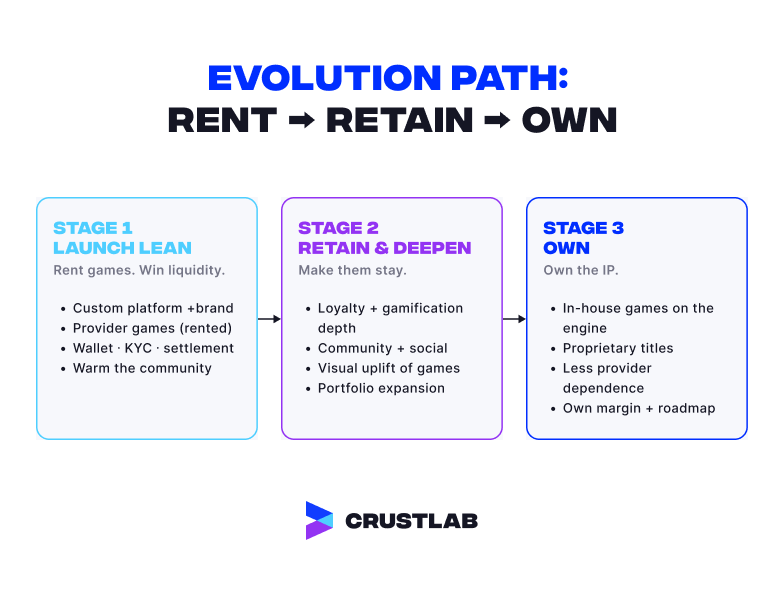
The Evolution Path: Rent → Retain → Own
The smartest growth strategy is to build ownership in stages rather than all at once.
- Stage 1: Launch Lean (Month 1 to 6): Launch with proven skill-based games, establish your brand, grow your community, and concentrate players into a small number of active matches. Your priority is proving liquidity and unit economics.
- Stage 2: Retain and Deepen (Month 6 to 18): Once the platform gains traction, invest in better gamification, richer social features, stronger rewards, and a more distinctive player experience. Expand your game catalogue only after your existing titles consistently attract enough players.
- Stage 3: Own (Month 18+): When your business has reached meaningful scale, begin developing proprietary games and technology. Owning your game portfolio gives you greater control over your roadmap, improves margins, and creates intellectual property that’s difficult for competitors to copy.
Monetization and Unit Economics
A PvP skill-based iGaming platform removes the volatile financial risks associated with traditional chance-based casinos. Since your site never takes a stake against players, you do not have to worry about a lucky high roller draining your operational capital. Instead, your business operates on a highly predictable, fee-based service model.
Rake, GGR, and NGR
The primary revenue source is the rake, a small percentage deducted from each prize pool before the winner receives the remaining cash prize. For example, if two players each contribute $10, the total prize pool is $20. A 10% rake leaves $18 for the winner, while the platform earns $2.
Operators typically track two financial metrics:
- Gross Gaming Revenue (GGR): The total value of all platform rakes collected over a specific timeframe.
- Net Gaming Revenue (NGR): Your GGR minus any direct player deductions, such as promotional match bonuses, payment processing charges, and external game provider fees.
These metrics should feed directly into the back-office reporting system, giving your team clear visibility into platform performance and profitability.
Scaling From a Launch Cohort to Mass Scale
The unit economics of a skill platform improve dramatically as your user base expands. In the initial phase, a small launch cohort requires highly localized matchmaking constraints to keep game rooms active. However, as traffic scales into six-figure player counts, your liquidity density hits a critical mass.
This increased density drastically shortens match waiting times, allowing users to play more consecutive matches per session. Denser player pools also allow your matchmaking engine to group users into more accurate ELO brackets, preventing novice-versus-expert matches.
This consistent level of fairness improves early retention metrics, lowering your player acquisition costs while driving up lifetime value (LTV). Once your unit economics are optimized, your growing cash flows can safely fund the development of your deferred features and custom games.
How to Choose a Skill-Based PvP Development Partner
Choosing the right development partner is one of the most important decisions you’ll make. Great games and a polished website won’t matter if the underlying platform can’t scale or protect players. Look for a team with proven experience in real-money gaming, including liquidity, security, KYC, payments, matchmaking, and compliance.
Review their technical track record as well. They should have experience building custom game engines, crypto settlement infrastructure, anti-cheat systems, and latency-fairness solutions—not just general software.
For example, CrustLab’s work on Checkmate demonstrates several capabilities that are directly relevant to a skill-PvP platform. These include custom game-engine development, engine-comparison anti-cheat developed alongside the Australian Artificial Intelligence Institute at the University of Technology Sydney (UTS), latency-fairness engineering, and crypto/Web3 settlement infrastructure. While Checkmate follows a different business model, it showcases the engineering expertise required to build secure, competitive real-money platforms.
Conclusion: Spend Where Defensibility Lives
If you are investing in a PvP skill-based iGaming platform, your first focus shouldn’t be on creating the next hit game. You should focus on creating a trusted platform where players can compete for real cash prizes and keep coming back.
The strongest businesses invest where it’s hardest to copy them. They launch with proven skill-based games, concentrate liquidity, build a loyal community, and treat integrity as a core product feature rather than an afterthought. As the player base grows, they expand their features, strengthen monetization, and gradually develop proprietary technology and games.
If you’re planning to enter this market, start by solving the fundamentals. Build a secure platform, rent proven games, and focus your resources on liquidity and player trust. That’s the fastest path to creating a business that can compete for the long term.
FAQ
Is a PvP skill-based game considered gambling?
It depends on the jurisdiction. If skill rather than chance determines the outcome, many jurisdictions treat skill-based games differently from traditional gambling.
How do you stop bots and cheating?
You can stop bots and cheating on a PvP skill-based platform by using layered security. This includes behavioral analysis, engine-comparison anti-cheat, collusion detection, and latency-fairness controls to protect players and maintain fair competition.
How long does it take to launch?
The timeline depends on the scope, but integrating proven games into a focused MVP is much faster than building custom games and infrastructure from scratch.
Should I build or rent the games?
Most founders should rent proven skill-based games first and focus on building the platform, growing liquidity, and attracting players.
How does the platform make money?
Most platforms earn revenue by taking a small rake from each prize pool. This creates a scalable monetization model as more players complete matches.