- CrustLab /
- blog /
- Industry Insights and Regulations /
- Sports Betting Industry & Market Trends for 2026
Sports Betting Industry & Market Trends for 2026

- 1. The Zero-Latency Tech Stack
- 2. The Rise of Micro-Betting and Same Game Parlays
- 3. Payments, Fintech, and Instant Payouts
- 4. AI, Data, and Personalization in Modern Sportsbooks
- 5. Regulation, Legalization, and Compliance
- 6. Responsible Gambling and Player Protection
- 7. The Creator Economy and Smarter Marketing
- 8. Media and Sportsbook Integration
- 9. Streaming, Interactivity, and Live In-Play Betting
- 10. Prediction Markets and Blockchain Betting
- 11. Consumer Behavior Shifts
- 12. Data Analytics and Trend Tracking
Driven by a digital revolution and exploding global demand, sports betting has transformed into a high-tech powerhouse. But according to experts, the real game-changer arrives as we approach 2026.
By fusing Artificial Intelligence with seamless fintech solutions, platforms are integrating advanced betting solutions, blurring the line between viewing and wagering. The future is here: instant withdrawals, bespoke betting markets, and a fully integrated ecosystem that makes the bettor the heartbeat of the live game.
This article unpacks the key sports betting trends shaping 2026. These include fintech and AI-powered personalization, evolving compliance standards, responsible gambling, and fan-centered innovation.
- 2026 will be a breakout year, as major events (FIFA World Cup, Super Bowl 60) and a wider U.S. legalization push handle, GGR, and overall sports betting market growth.
- Tech leads the shift. AI, automation, and low-latency data power live in-play betting, micro-markets, personalization, and smarter online gambling platforms.
- Open banking, instant payouts, and stricter KYC/AML improve trust, while responsible gambling tools move from policy to product.
- Media convergence accelerates as sportsbooks integrate with broadcasters and creators. Data dashboards and trend tracking turn fans into informed bettors.
Introduction: Why 2026 Marks a Pivotal Year for Sports Betting
The sports betting industry enters 2026 with unprecedented momentum. Since the U.S. accelerated legalization in 2018, the global market has not just expanded; it has matured into a high-tech powerhouse. We are moving past the experimental phase into an era where dynamic odds, safer play, and personalized journeys are the baseline expectation in sports betting development.
The 2026 FIFA World Cup in North America and Super Bowl 60 are two landmark events that will supercharge demand. Together, they will intensify live in-play betting and expand the online sports betting market. They will also push sportsbooks to improve payments and risk controls.
These catalysts, combined with AI and stricter compliance requirements, make 2026 the year when sports betting trends move from experiments to industry standards.
The Global Sports Betting Market Outlook for 2026
The financial trajectory for 2026 is staggering. The global sports betting market is on track to generate between $115 billion and $125 billion in Gross Gaming Revenue (GGR), driven by a compound annual growth rate of roughly 11% from 2024’s baseline. The United States has already established a dominant foothold, with online bettors expected to surpass 50 million by 2026.
The legal footprint is also widening. While 38 states, plus D.C. and Puerto Rico, were live in 2025, Missouri’s December 2025 launch effectively brings the operating count to 41+ jurisdictions heading into 2026. Hence, major operators are partnering with the best sportsbook software providers to fortify their tech stack.
As highlighted by insights from the esports betting market, the expansion of competitive gaming is also reshaping how operators diversify their portfolios. Meanwhile, Europe’s mature regulatory regime remains the benchmark for compliance and integrity, even as the U.S. closes the gap on scale and sophistication.
Key Sporting Events Driving Betting Volume in 2026
Major events will set the pace for betting volumes in 2026. The FIFA World Cup in North America is the primary catalyst, with its extended five-week schedule of 104 matches across multiple time zones. This will significantly increase in-play and pregame betting. Operators can expect spikes in new accounts and sustained engagement throughout the tournament.
Meanwhile, Super Bowl 60 remains the single biggest day for U.S. handle. Same-game parlays and instant markets will dominate, while promotions and bonus bets pull casual fans into higher-value betting activities. Leading sports leagues will also contribute across the calendar:
- March Madness drives daily wagering streaks and sustained engagement.
- The UEFA Champions League adds midweek surges in the football segment.
- The Indian Premier League concentrates evening traffic with high-frequency markets.
- The Winter Olympics (Milan–Cortina 2026) broadens the sports betting market with niche-sport micro-markets and daytime peaks.
- The Formula 1 season delivers weekly live betting windows and regional handle spikes.
Beyond headline tournaments, horse racing festivals, virtual sports, and global football fixtures ensure consistent liquidity for bookmakers.
Top Sports Betting Trends for 2026
The pace of change in the sports betting industry has never been faster. Consumer expectations, emerging technologies, and several other factors are influencing how sportsbooks operate and compete. In this section, we explore the top sports betting market trends for 2026.
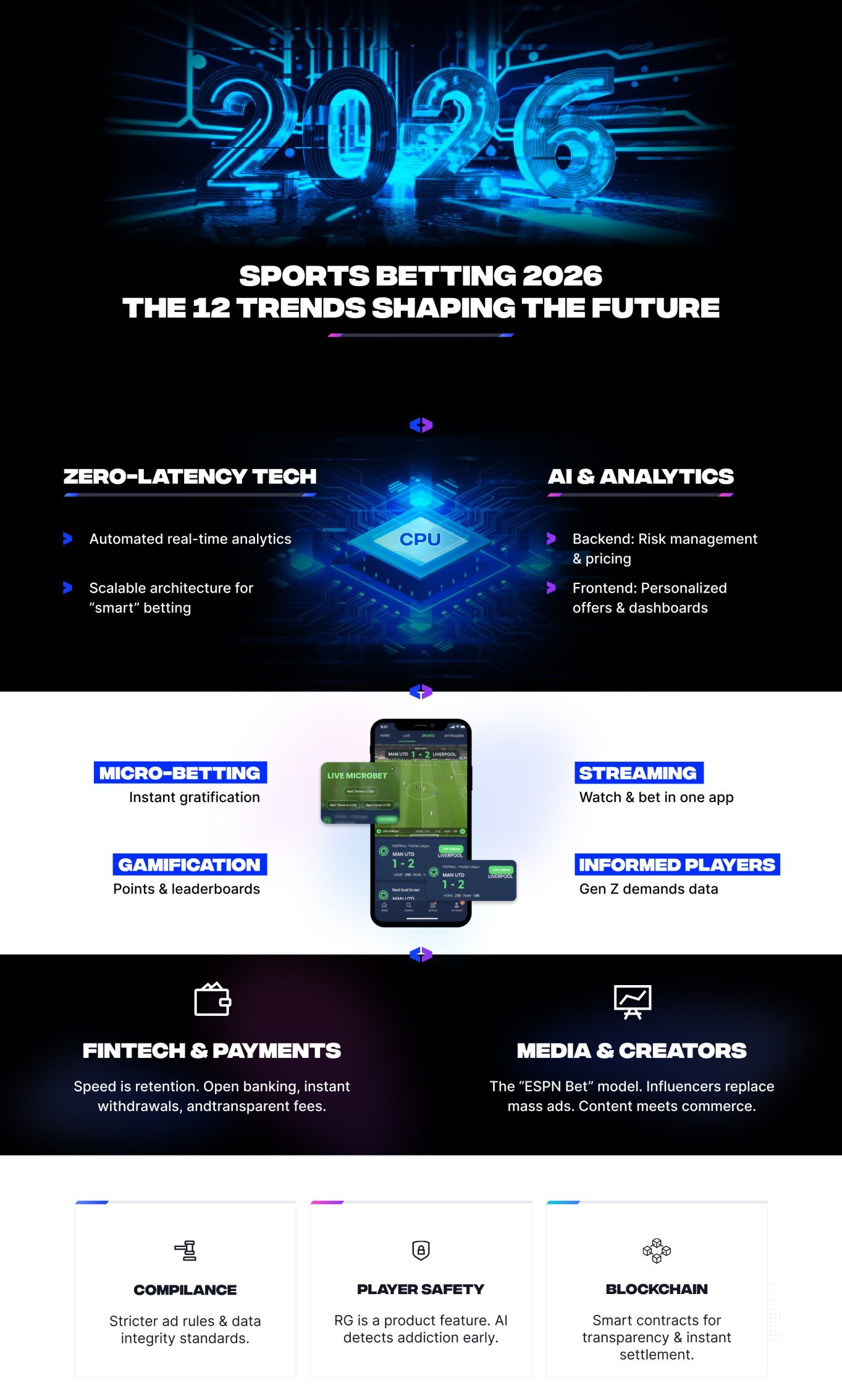
1. The Zero-Latency Tech Stack
Technology is the main driver behind how the sports betting industry will evolve in 2026. Operators are aggressively pivoting toward automation and real-time analytics to deliver the “smart” betting experiences users now demand. Advanced algorithms now handle odds management and market-making with greater precision to reduce latency and improve live data accuracy across betting platforms.
To survive 2026, brands are investing in scalable sports betting app architecture that can process thousands of data points per second without crashing, ensuring that the transition from a live play to a betting opportunity is seamless across web and mobile interfaces. Combined with improvements in user interface design and safe digital payment systems, these innovations make betting more seamless and immersive than ever before.
2. The Rise of Micro-Betting and Same Game Parlays
The modern bettor craves speed, and micro-betting is the answer. This segment is rapidly becoming the primary way younger audiences engage with the sports betting market, favoring immediate gratification over traditional full-game outcomes. Whether it is wagering on the next pitch, serve, or goal, these markets turn live games into continuous, interactive experiences that appeal especially to younger audiences who prefer instant feedback over traditional fixed odds wagering.
Simultaneously, same-game parlays (SGPs) have cemented themselves as the cornerstone of modern online betting. Powered by AI, platforms can now generate personalized parlay suggestions instantly, increasing average bet size and keeping users glued to the screen for the duration of the match.
Together, micro-markets and customizable betting slips represent the next evolution in the sports betting industry.
3. Payments, Fintech, and Instant Payouts
In the battle for retention, the speed of money wins. Payments have become the fiercest battleground in the global market’s online segment, with open banking and digital wallets becoming standard requirements rather than luxury features.
As players expect faster and more transparent transactions, operators are turning to fintech innovation to simplify every step of the betting process. Open banking and digital wallets are becoming the standard across online sportsbooks, offering instant deposits and near-instant withdrawals that keep bettors active and confident.
Behind the scenes, fintech integrations are improving how money moves. Real-time rails and automated verification systems reduce delays, while built-in KYC and AML checks maintain compliance across regulated markets. This results in smoother onboarding, fewer abandoned deposits, and higher player retention.
Trust matters just as much as speed. Operators are investing in secure digital payment systems that display clear fees, transaction limits, available bonuses, and transaction histories. These insights ensure that bettors always know where their money stands. For the global sports betting market, this combination of security and simplicity turns payments from a back-office process into a front-end experience that drives engagement and loyalty.
4. AI, Data, and Personalization in Modern Sportsbooks
Artificial Intelligence is rewriting the playbook of the sports betting industry for both the house and the player. On the backend, predictive models manage risk and adjust lines in milliseconds, giving operators a clear competitive advantage among numerous betting platforms.
But the front-end impact is where the magic happens. Machine learning now analyzes individual player behavior to curate bespoke betting markets, set custom limits, and offer promotions that actually feel relevant. This move toward hyper-personalization is critical for converting casual fans into long-term players, making AI essential for competitiveness rather than just a buzzword.
As AI capabilities expand, expect deeper integrations across apps and platforms. From smarter data dashboards to real-time decision support, AI in sports will be essential for competitiveness. Operators are also exploring AI gamification to make the betting experience more fun and rewarding.
5. Regulation, Legalization, and Compliance
Regulation will continue to impact the sports betting industry in 2026 as the US market adds newly regulated markets and aligns closer to the European sports betting market on integrity and consumer safeguards. Expect stricter ad rules, clearer bonus disclosures, and tighter controls on affiliate marketing to reduce misleading offers and protect vulnerable users.
Data integrity standards are becoming tougher, too. Leagues, data providers, regulators, and operators are formalizing official data pipelines and incident response to curb match-fixing and ensure fair live and fixed odds betting. On the compliance side, enhanced KYC/AML and affordability assessments will become baseline requirements across major jurisdictions.
For operators, the message is to build for compliance from day one. Transparent terms, responsible gambling tools, regular audits, and real-time monitoring are now competitive necessities. Those who adapt quickly will win regulators’ trust and long-term sports betting market share.
6. Responsible Gambling and Player Protection
Player safety is moving from policy to product. In 2026, leading operators will build responsible gambling into the core of online sportsbooks. Features like one-tap time-outs and seamless self-exclusion will function smoothly across online platforms and regulated markets.
Similarly, affordability checks and real-time monitoring are becoming standard. AI models flag early signs of gambling addiction so teams can intervene before serious harm is done. Teams can respond with tailored messages, cool-off prompts, or other appropriate solutions.
When it comes to transparency, platforms will display bonus terms in plain English and make all transaction details visible. Operators that prioritize transparency will experience higher retention rates and fewer complaints.
7. The Creator Economy and Smarter Marketing
The era of blanket mass-media advertising is fading. As rules tighten on gambling ads, operators are moving toward compliant campaigns with clearer bonus disclosures and safer messaging. In mature regions (notably Europe’s sports betting market), teams and sports leagues face tougher sponsorship limits that affect the competitive landscape for brand visibility and market share.
In the U.S., growth is shifting from mass media to creator-led content and high-quality affiliate partnerships. The playbook includes fewer risk-free claims, more education, value-led previews, and transparent offers. Influencers must meet disclosure and age-gating standards, while operators demand stronger tracking, KYC-aligned funnels, and responsible-play prompts. This will result in better conversion and longer-term user value across online betting channels.
8. Media and Sportsbook Integration
Sports media and sportsbooks are blending into one connected ecosystem. Broadcasters, publishers, and betting brands are forming partnerships to merge media content with betting insights.
A leading example is ESPN Bet’s integration strategy, which aligns its sports coverage with betting tools and personalized offers. Similar collaborations are emerging between streaming services and sports betting platforms.
These brands are using data-driven storytelling to attract both casual viewers and experienced bettors. As this model expands, content will evolve into an interactive layer of the sports betting industry, where information and entertainment coexist on a single platform.
9. Streaming, Interactivity, and Live In-Play Betting
Streaming is becoming the home field for live and in-play betting. Media platforms now overlay odds and real-time stats directly into streams, so fans can wager without leaving the stream or jumping between betting platforms. This reduces friction and turns every game into a marketable micro-event.
Low-latency tech makes it work. LL-HLS/DASH and WebRTC, paired with edge delivery, cut delay to a few seconds, keeping prices aligned with what viewers see. This sync enables sharper bet placements and more responsive cash-outs, critical for micro-markets and in-play bets.
Interactivity keeps viewers engaged longer. Polls, watch parties, predictive quizzes, and picture-in-picture bet slips turn passive watching into a two-way session. As latency falls and data rights improve, operators can offer more accurate pricing and faster settlement, making live betting feel seamless and controlled.
10. Prediction Markets and Blockchain Betting
Prediction markets and blockchain infrastructure are pushing the sports betting market toward greater transparency and automation. Decentralized systems built on smart contracts handle escrow, settlement, and audit trails, reducing human error and improving market integrity. These models also open up new opportunities for exchange betting and fixed-odds markets in regions where regulation allows for digital assets.
For operators, blockchain adoption is becoming more strategic than experimental. Many now use on-chain verification to enhance compliance and enable instant settlement through stablecoins or tokenized wallets. These innovations cut transaction costs and improve payout speed, particularly in emerging markets.
As hybrid platforms grow, they’re blending traditional UX with blockchain-backed transparency. This shift signals the early phase of decentralized betting ecosystems, where regulation and innovation evolve side by side. To see how this technology may shape the next wave of iGaming, explore our insights on the blockchain future.
11. Consumer Behavior Shifts
We are witnessing a shift from casual play to informed betting activities, as bettors get sharper. Gen Z and millennials compare odds, track performance, and use community tips before placing bets. This raises expectations for transparent pricing and smarter tools.
Formats are also changing. Platforms are using gamified experiences, such as leaderboards, points, streaks, and challenges, to keep users engaged between major sports events. Micro-markets, customizable slips, and bite-sized insights cater to mobile habits, while responsible-play nudges minimize friction without interrupting the session.
Additionally, platforms now need to provide players with data. Users want pregame previews for context, live trends for guidance, and post-match summaries to learn. Operators that meet these requirements will win significant market share in a crowded, competitive landscape.
12. Data Analytics and Trend Tracking
Data is now the backbone of the sports betting industry. Operators rely on real-time analytics to monitor odds movement and player activity. Modern dashboards visualize live data from leagues, markets, and transactions, helping teams make instant decisions on pricing, exposure, and promotions.
Advanced trend-tracking tools are also transforming the player experience. Bettors use public dashboards and predictive models to follow team form and key metrics like win probability or betting type distribution. For operators, this means sharper risk management and more personalized user journeys.
As analytics improve, sportsbooks are adopting automated competitive landscape tracking to benchmark their performance against rivals, identify profitable sports types, and detect shifts in player behavior before they go mainstream. In 2026, data will be a competitive edge, driving user loyalty and sustained revenue growth.
The Future Beyond 2026: Where Sports Betting Is Heading
Beyond 2026, the global sports betting market is expected to evolve through innovation, consolidation, standardization, and deeper integration with digital entertainment. Mergers between major betting platforms and technology firms will likely reshape the competitive landscape. They will create fewer but stronger operators with unified compliance frameworks and data ecosystems.
Regulatory alignment will continue, with cross-border standards in advertising, data integrity, and player protection becoming the norm. The esports betting segment and fantasy markets are projected to merge further with traditional sports. This will be powered by real-time data and streaming integration. Meanwhile, the online betting segment will keep expanding through voice-enabled devices and personalized betting assistants.
Additionally, new entrants will focus on building scalable ecosystems rather than standalone apps. Technologies such as open APIs, automation, and predictive analytics will help cut costs and boost transparency.
These changes signal a long-term shift toward intelligent, entertainment-driven betting experiences. If you are considering entering this dynamic space, you may check out our guide on how to start a sportsbook for a detailed roadmap.
Conclusion: Adapting to the Next Era of Sports Betting
The sports betting market is reaching a new stage of maturity, where innovation and responsibility must move hand in hand. By 2026, technology, regulation, and user behavior will redefine what success means for every operator. Operators that can adapt to this high-velocity environment will not only scale faster but will build the kind of deep, trust-based relationships that sustain long-term growth.
For those looking to build the infrastructure to compete in this next era, our software development company offers the blueprint for thriving in tomorrow’s digital betting ecosystem. To learn how to launch a sportsbook, see our detailed guide on how to make a betting website. It is a practical guide for thriving in tomorrow’s digital betting ecosystem.
Sources: