- CrustLab /
- blog /
- Industry Insights and Regulations /
- Full Report on Top iGaming Trends for 2026
Full Report on Top iGaming Trends for 2026

- 1. Marketing and Affiliate Strategies in 2026
- 2. Payment Innovation, Compliance, and Open Banking
- 3. AI, Data, and Personalization: The Core of iGaming Experiences
- 4. Product Design, UX, and Technological Infrastructure
- 5. Immersive Experiences, Live Content, and Social Play
- 6. Regulation, Responsible Gambling, and Global Policy Shifts
- 7. Competition, Growth Strategy, and Market Outlook
- 8. Measuring Success: Metrics That Define the Future
- 9. Opportunities and Risks for 2026
The iGaming industry is entering a more technologically mature phase, where the focus is shifting from rapid expansion to deeper personalization, regulatory alignment, and trust-building. As markets stabilize and competition intensifies, operators must evolve quickly to stay relevant.
In 2026, online gambling operators are prioritizing mobile-first design and seamless digital payments to keep players engaged. Emerging technologies like AI, Augmented Reality, and open banking are redefining how online casinos and sports betting platforms operate.
In this article, we explore the major trends shaping the iGaming industry in 2026.
- The iGaming industry is moving from rapid expansion to intelligent, data-driven growth that prioritizes profitability, compliance, and long-term player trust.
- AI and machine learning are reshaping how online casinos personalize gameplay, predict engagement, and ensure responsible experiences for every player.
- Global markets are tightening regulations, pushing iGaming operators to integrate transparency, safety, affordability checks, and responsible gambling tools directly into their platforms.
- AR/VR, live streaming, and mobile-first design are redefining the player experience, making gaming more social and accessible across devices.
iGaming Trends: What’s Shaping Online Gambling Now and Next
The iGaming sector continues to evolve as player expectations, global regulations, and technology converge. The coming year will be defined by compliance-driven marketing and the fusion of gaming and social interaction. As gambling platforms compete for attention, success now depends on adaptability and trust.
From AI-driven personalization to frictionless payments and safer gambling tools, every part of the online gambling market is being redesigned for long-term sustainability. To thrive in this environment, companies are investing in advanced iGaming development that prioritizes transparency, convenience, engagement, and responsible play.
The Evolution of iGaming: From Growth to Intelligent Maturity
After a decade of rapid expansion, the iGaming sector is shifting into a smarter, more sustainable phase. Projections for 2026 vary by methodology, but most analysts expect the global online gambling market to be roughly in the $120–130 billion range. This underscores continued growth even as top-line expansion moderates.
What’s changing is how growth happens. Operators are increasingly prioritizing sustainable profitability over pure scale. They are using first-party data to refine offers, reduce bonus waste, and boost player value. Compliance has also become a product requirement. It’s built directly into products, with systems that automatically handle KYC, AML, and affordability checks to enhance responsible gambling.
Similarly, personalization has evolved beyond targeted bonuses. It now involves adaptive lobbies and tailored content that match each player’s behavior. At the same time, companies are adopting modular, cloud-native tech frameworks and cloud systems to innovate faster and test ideas more efficiently.
Top iGaming Trends to Watch in 2026
As the iGaming market matures, the trends shaping 2026 and beyond reflect a clear balance between innovation and responsibility. Operators are refining existing products through better marketing, technology, and compliance. The following sections explore the iGaming trends setting new standards for the global online gambling market.
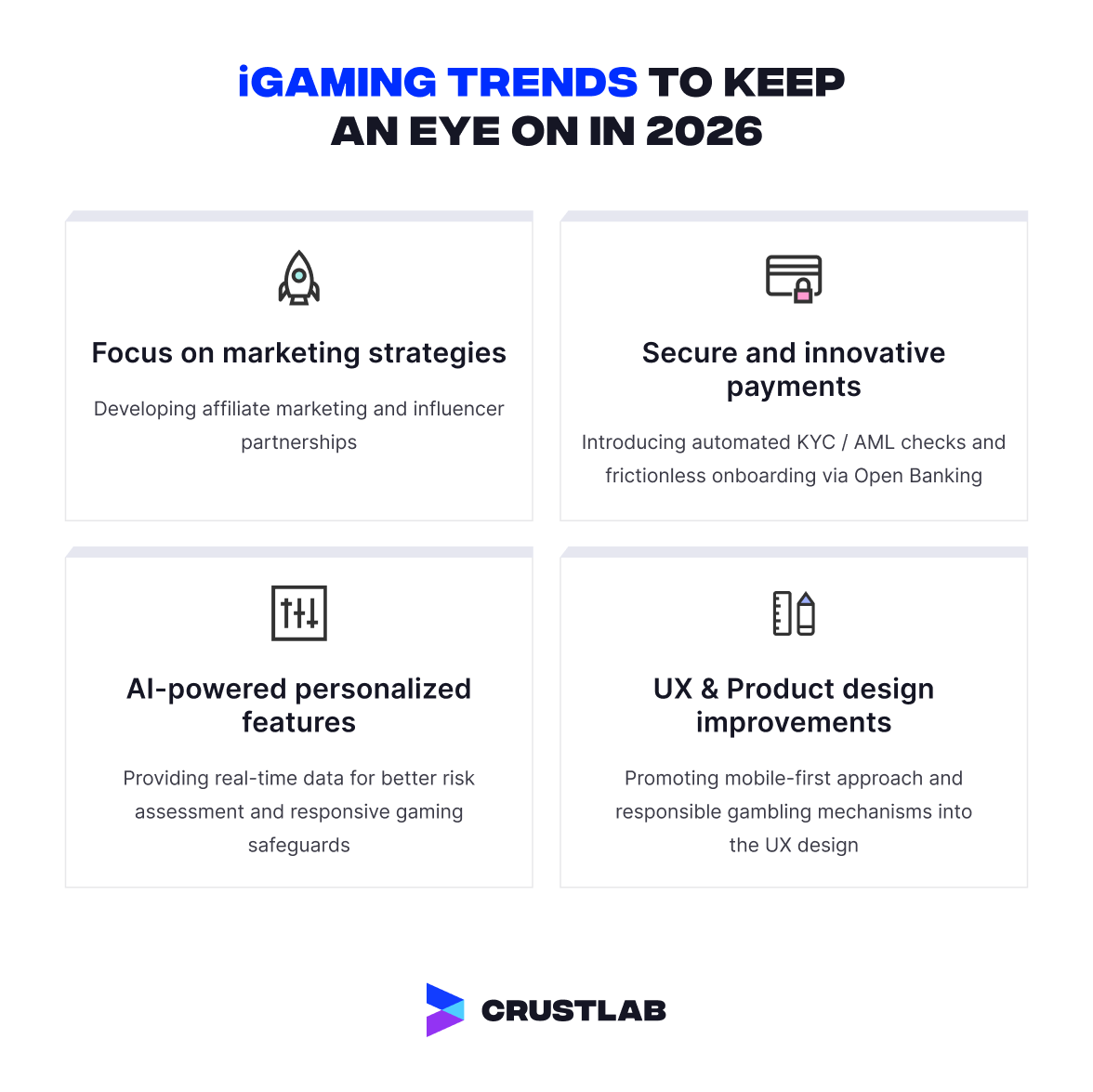
1. Marketing and Affiliate Strategies in 2026
Marketing in the iGaming sector is becoming more data-driven and compliant, with operators focusing on transparency and measurable impact. Traditional ads are being replaced by creator-led and hybrid affiliate models that connect better with modern players. In 2026, brands should balance creativity with responsibility to build trust and long-term engagement.
Creator and Influencer Partnerships
iGaming brands are partnering with creators and influencers to reach younger audiences. Streamers, YouTubers, and social media personalities now drive engagement by showcasing real gameplay and sharing authentic experiences. These collaborations help operators connect with younger players while maintaining credibility and fun.
However, compliance remains key. All content must promote responsible gambling and follow regional ad guidelines. In 2026, the most successful campaigns will blend community storytelling with transparency. Creators should be trusted advocates rather than mere promoters.
Affiliate Marketing and Attribution Advances
Affiliate marketing in iGaming is evolving fast, as operators adopt hybrid revenue models and advanced tracking systems to measure real impact. Multi-touch attribution now helps brands understand how players discover and participate across multiple platforms.
At the same time, new technologies are improving fraud prevention, ensuring fair payouts and transparent performance data. Affiliates who embrace automation and analytics will play a central role in sustaining long-term growth.
Responsible and Regulated Advertising
Advertising in the online gambling market is becoming more controlled as regulators tighten rules around player protection and transparency. In 2026, operators must navigate stricter limits on sponsorships and ad placement. This is particularly essential across Europe and U.S. states with evolving laws.
The focus is shifting toward compliant storytelling that promotes responsible gaming while maintaining brand visibility. To stay ahead, successful campaigns will combine data-driven insights and clear messaging built on trust.
2. Payment Innovation, Compliance, and Open Banking
The payment side of iGaming is becoming as important as gameplay itself. Players now expect fast and transparent transactions that also meet strict regulatory standards. This shift is being powered by tools like open banking API, tokenized payments, and real-time verification systems.
Frictionless Onboarding with Open Banking
Open banking is significantly streamlining how players register and transact in the online gaming industry. By allowing instant account verification and real-time fund transfers, it eliminates delays and manual checks that often slow down onboarding. This means lower fraud risk, better affordability insights, and higher conversion rates for operators.
For players, it offers faster payments and a more transparent gaming experience. In 2026, seamless onboarding powered by open banking will become a standard feature across regulated online casinos and sports betting platforms.
KYC, AML, and Affordability Checks
Automation and AI are streamlining how online gambling operators handle player verification and compliance. Modern systems now perform Know Your Customer (KYC) and Anti-Money Laundering (AML) checks instantly, reducing onboarding time while meeting strict global standards.
Additionally, real-time affordability tools help operators identify risky behavior early. This makes it easier to support responsible gambling and protect player well-being. In 2026, these automated checks will be essential for maintaining trust and ensuring that innovation never compromises security.
Security and Responsible Payments
Security is now a defining part of the iGaming industry, with operators adopting advanced tools like biometrics, passkeys, tokenized payments, and device-based authentication to safeguard transactions. These technologies protect sensitive data while ensuring every payment supports responsible gaming standards.
In 2026, the strongest online gambling platforms will view payment security as more than compliance. It will be a trust signal that enhances player confidence and long-term loyalty.
3. AI, Data, and Personalization: The Core of iGaming Experiences
Artificial intelligence and data-driven design are revolutionizing the way players experience online gaming. From dynamic lobbies to real-time predictions, AI now powers personalization that keeps players engaged responsibly. In 2026, the most competitive iGaming companies will use AI gamification to deliver more rewarding experiences.
Hyper-Personalized Offers and Lobbies
AI-driven personalization is improving player engagement in online casinos, esports betting, and sports wagering platforms. Modern algorithms analyze real-time behavior to deliver tailored game recommendations, custom bonuses, and adaptive interfaces that evolve with each session.
Players now enjoy data-informed experiences, from dynamic jackpots to segmented tournaments. Personalization is going beyond marketing. It is becoming the foundation of every successful iGaming operator’s strategy.
Real-Time Data and Predictive Engagement
Real-time analytics now power how iGaming operators understand and engage their players. By tracking live events, such as in-play bets and esports statistics, AI can predict engagement or risk patterns and trigger calibrated, personalized responses.
These systems help keep players active and support responsible gaming by identifying risky behavior. Predictive engagement will continue to define how data turns into action, ensuring that growth and player well-being stay aligned.
Ethical Personalization and Responsible Gambling
As personalization becomes more advanced, ethics and transparency are taking centre stage in the online gambling industry. Operators must now ensure algorithms don’t exploit risky behavior and follow privacy laws across all regions.
In 2026, explainable AI and built-in safeguards will help strike a balance between engagement and responsible gambling to foster trust between players and platforms. The future of personalization lies not just in prediction, but also in protection.
4. Product Design, UX, and Technological Infrastructure
User experience will be one of the strongest differentiators in the iGaming industry. Players expect instant, low-latency gameplay on any device. Operators are investing in advanced casino software development to meet these needs.
Mobile-First and App-Like Experiences
Mobile-first design delivers app-like navigation and instant gameplay on any device. Progressive Web Apps (PWAs) and responsive interfaces provide offline support, quick loading, and intuitive gestures, all of which enhance usability. These improvements boost conversion rates and retention across mobile gaming and sports bookmaking platforms. In 2026, mobile-first gaming will remain the standard for accessibility and player satisfaction.
Core Web Vitals and Performance Optimization
Performance has become a key factor in ranking and retention for digital platforms. Metrics like Largest Contentful Paint (LCP), Interaction to Next Paint (INP), and Cumulative Layout Shift (CLS) play a crucial role in influencing SEO performance and user engagement.
Leading iGaming platforms are turning to Core Web Vitals to measure speed, stability, and responsiveness. This process ensures that every page loads quickly and performs flawlessly on all mobile devices. A smooth and reliable site experience is now as critical as online casino games themselves.
Trust-by-Design and Responsible UX
Trust is now designed directly into every part of the online gaming experience. Modern iGaming operators are integrating responsible gambling tools, such as spending limits, reality checks, time reminders, and self-exclusion options into their intuitive user interfaces.
These features promote transparency and empower players to stay in control without disrupting gameplay. In 2026, successful casino operators will view responsible UX not as a regulatory requirement to follow, but as a core part of ensuring safety — a trust-by-design and safety-by-design approach.
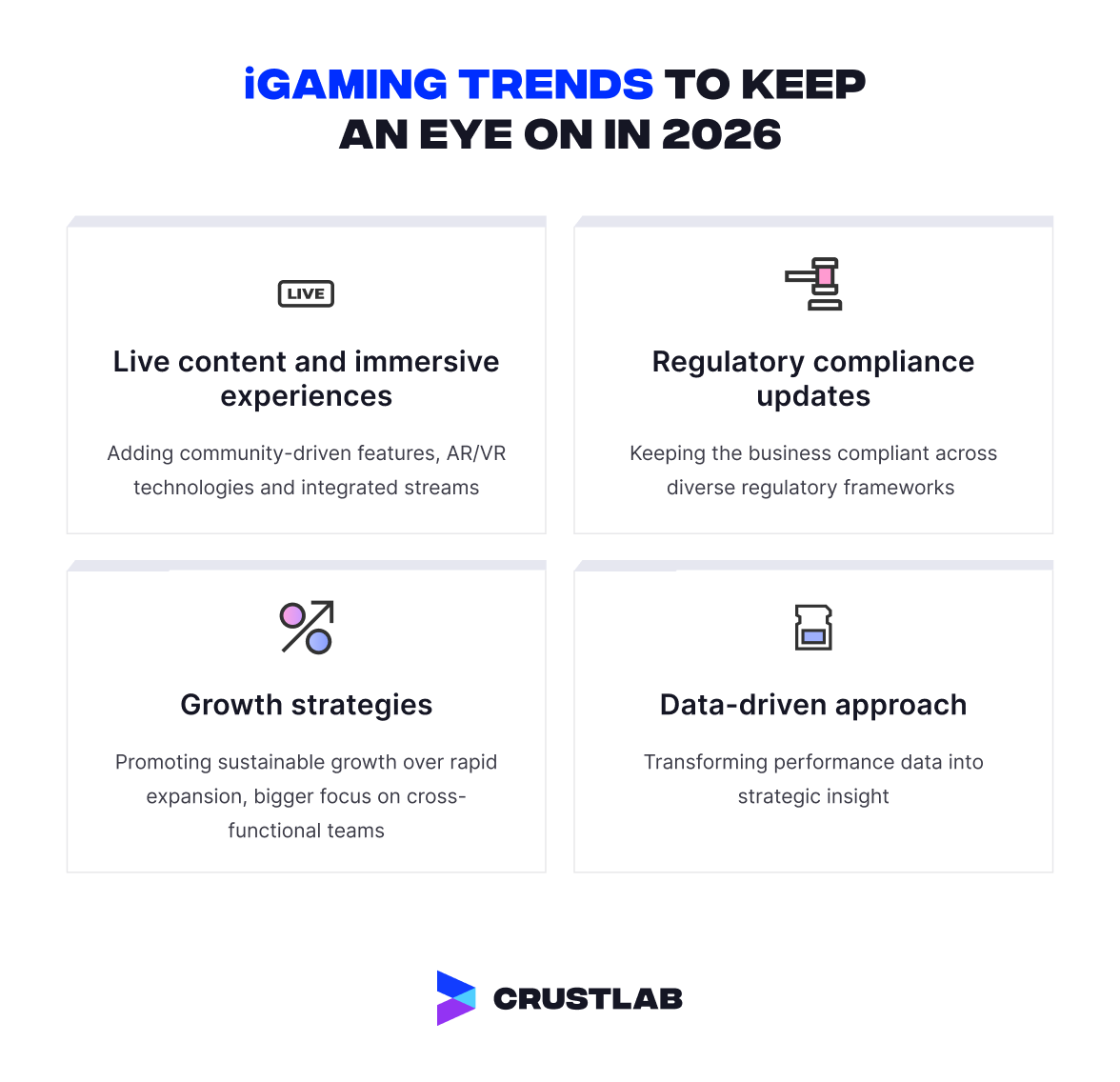
5. Immersive Experiences, Live Content, and Social Play
The next stage of iGaming is all about immersion and connection. With advances in live streaming, AR/VR, and community-driven features, the line between gaming and social interaction is disappearing fast. As a result, forward-thinking iGaming operators are focused on creating interactive experiences that blend entertainment and authenticity.
AR/VR and 3D Interaction
Virtual reality (VR) and augmented reality (AR) technologies are elevating the realism of online gambling experiences. Players can now enter 3D casinos and interact with dealers and friends in real time for a truly immersive gaming experience.
By combining innovations such as Web3 and metaverse gamification, operators are building virtual spaces that blend entertainment and community. In 2026, AR and VR will continue shifting from experimental to strategically valuable for early adopters, defining how players connect and engage across the iGaming sector.
Live Casino and Stream-Integrated Betting
A live casino business combines real-time excitement with social interaction. Features like live dealer games, interactive chat, and watch-party betting let players experience authentic gameplay from anywhere.
In 2026 and beyond, deeper live casino integration will connect players, influencers, and hosts in shared sessions. This fusion of entertainment and social features will make live experiences one of the most engaging segments in the online gaming community.
Social Betting and Community Features
Social layers are boosting retention by turning solo play into shared experiences. Friend leaderboards, co-betting, squads, and tournaments keep players engaged while giving brands organic reach through community challenges.
Operators also blend social mechanics with responsible gaming features like nudges and fair-play rules to keep competition healthy. As seen in sweepstakes casinos vs social casinos, these community-driven models are driving stronger engagement and retention across the iGaming market.
6. Regulation, Responsible Gambling, and Global Policy Shifts
Global regulations are tightening as governments work to ensure player protection and fair competition in the online gambling industry. In 2026, new licensing models and restrictions on gambling ads could alter how operators operate. Compliance will be a key factor in building trust and long-term sustainability.
U.S. State-by-State Legalization Outlook
The U.S. regulatory environment remains a state-by-state patchwork. Some states are expanding online betting and iGaming, while others stall over tax rates, RG controls, and tribal compacts. Expect ongoing debates in large markets like New York, California, and Virginia about whether to permit or broaden online casinos or sports-only models.
Operators are preparing modular tech stacks and geofencing that they can switch on by state once rules are finalized. Success will hinge on localization, as tax compliance, marketing limits, and responsible gambling frameworks must be tailored to each jurisdiction.
European and UK Compliance Evolution
Europe and the UK continue to set the global standard for responsible gaming and regulatory enforcement. Stricter affordability checks, financial-risk thresholds, and identity controls are defining how gambling operators design their products and promotions.
The UK Gambling Commission and EU regulators are also tightening ad rules, requiring more transparency around data use and player safety. In 2026, compliance will evolve from a checklist into a full design philosophy, where every feature supports fair and secure.
Emerging Markets: Brazil and Africa
Brazil and several African nations are becoming high-priority hotspots as regulatory frameworks mature and mobile phone usage surges. Federal rules are activating and regulating the gambling market in Brazil, drawing iGaming operators that localize content and payment tools for players on mobile devices.
Across Africa, strong mobile gaming habits and widespread mobile money are opening up significant new possibilities. For both regions, the winning strategy combines localization, low-bandwidth user experience, and clear safeguards to convert first-time users into long-term, high-trust customers.
7. Competition, Growth Strategy, and Market Outlook
Competition within the iGaming industry is prompting operators to prioritize retention-first strategies over expansion. Success now requires localization, technology investment, smart recruitment, and strong leadership. Insights from the social casino market highlight how community engagement and responsible innovation are shaping the next wave of global growth.
Sustainable Growth Over Expansion
Operators are now prioritizing player lifetime value (LTV), profitability, and localized engagement over rapid market entry. By refining offers and improving the user experience, the best-performing iGaming companies are proving that steady growth can outperform unchecked expansion. Sustainable scaling will define long-term success across the global iGaming industry in 2026 and beyond.
Regional Hotspots and Growth Priorities
Emerging regions like Brazil, Kenya, South Africa, and Nigeria are becoming vital engines for iGaming market expansion. These countries have youthful demographics and improving regulatory frameworks that facilitate growth. Several U.S. states, like New York, Virginia, and California, are also considering opening up to more gambling activities.
At the same time, mature regions such as the UK and Europe are focusing on technological innovation and retention to sustain long-term value. Operators that combine localized strategies with compliance and tech-driven engagement will capture the strongest growth momentum worldwide.
Talent, Culture, and Leadership Trends
Leaders are hiring cross-functional squads to deliver faster cycles while embedding compliance into every release. These teams typically comprise product, data science, risk, and marketing experts. Clear KPIs and continuous training on AI and gambling regulations also help iGaming operators out-execute their rivals.
In 2026, forward-leaning companies will invest in upskilling for mobile-first design and reward outcomes over output. The best leaders will build their work cultures on collaboration, ethics, and continuous learning.
8. Measuring Success: Metrics That Define the Future
The iGaming industry is becoming an increasingly data-centric space, where growth is defined by sustainability. Operators now rely on precise KPIs to measure compliance efficiency, personalization accuracy, and player retention. As explained in software development KPIs, the right metrics help transform performance data into strategic insight.
Core Metrics for 2026
The most successful iGaming operators will focus on KPIs that reflect both performance and responsibility. These metrics will define profitability, trust, engagement, and long-term sustainability:
- Customer Acquisition Cost (CAC): Measures how much it costs to attract a new player. Lower CAC through optimized marketing and affiliate tracking means more efficient growth.
- Lifetime Value (LTV): Reflects the total revenue generated by a player over time. High LTV signals strong retention and loyalty.
- Approval and Conversion Rates: Show how many verified users complete registration and deposit successfully. They are an indicator of onboarding efficiency and payment system reliability.
- Retention and Session Duration: Reveal how long players stay active and how often they return. They help operators refine online casino games and loyalty programs.
- Personalization Accuracy: Tracks how precisely AI-driven systems recommend games and bonuses that match player preferences without crossing ethical limits.
- Responsible Gambling Interventions: Monitors early detection, affordability alerts, and self-exclusion triggers. They show how well the platform protects at-risk players.
- Compliance Efficiency: Measures how quickly the system adapts to new gambling and data privacy rules. It is essential for staying competitive in regulated markets.
From Data to Actionable Insight
By 2026, data will be the lifeblood of decision-making across the iGaming sector. Modern operators are investing in advanced analytics stacks, including feature stores, real-time dashboards, and AI models, to transform raw information into actionable business strategies.
Predictive analytics helps forecast player behavior and optimize promotions to prevent churn before it happens, while compliance data ensures every action aligns with responsible gambling policies. The goal is no longer just to collect data but to convert it into meaningful, real-time insights that improve platforms.
9. Opportunities and Risks for 2026
The year 2026 presents a turning point for the iGaming industry, offering vast potential alongside growing complexity. Emerging technologies, new markets, and creator-led growth open powerful opportunities for innovation and expansion. Yet, rising regulatory pressure, fraud, tech debt, and compliance risks mean that only adaptable iGaming operators will thrive in this evolving landscape.
Key Opportunities for Operators and Suppliers
Opportunity in the online gambling market lies in innovation that enhances both player experience and trust. Creator-led marketing, open banking integrations, and immersive virtual reality (VR) environments are giving forward-thinking brands a competitive edge.
Operators can diversify revenue and reduce risk by expanding into emerging markets and refining retention in mature regions. For software suppliers, the demand for compliant and scalable platforms is surging. This creates new space for partnerships that power sustainable growth across the global iGaming sector.
Top Risks and How to Mitigate Them
The iGaming industry faces increasing risks tied to regulation and technology. Stricter advertising laws and evolving compliance requirements can quickly disrupt operations if not managed proactively. Technical challenges such as outdated infrastructure, cybersecurity threats, and data misuse also threaten player trust and platform stability.
To stay resilient, iGaming operators must invest in scalable tech, transparent data policies, and strong responsible gaming frameworks. Building flexibility and ethical governance into every process is the best safeguard against volatility in 2026.
Conclusion: Preparing for the Next Era of iGaming
The defining gambling industry trends for 2026 centre on intelligent growth. AI and machine learning are driving personalization, while compliance and security are now built directly into products and payments.
iGaming operators that balance innovation with responsible gambling and localize for fast-moving regulatory landscapes will enjoy the most success. Instead of blitz-scale expansion, retention, transparency, compliance, and trust will separate leaders from the pack.
To move faster, partner with a software development company that understands the iGaming industry requirements end-to-end. CrustLab has the expertise you need across all iGaming verticals.