- CrustLab /
- blog /
- Explainers /
- Provably Fair Gambling: Understanding How Provably Fair Works in Casinos
Provably Fair Gambling: Understanding How Provably Fair Works in Casinos

Gone are the days when players have to trust the results of casino games blindly. The growing demand for transparency in online gambling has led to the introduction of provably fair games.
Provably fair casinos enable users to verify how each game outcome is generated, rather than relying solely on licenses or audits. This article explores how provably fair gambling works, and why it’s becoming a key part of casino software development.
- Provably fair gambling is redefining trust in online casinos by allowing players to verify every game result. It ensures complete transparency and eliminates doubts about manipulation.
- The system works through a combination of server seeds, client seeds, and nonces, which together create a unique and verifiable random result for each round.
- Compared with traditional online casinos that rely on external audits, provably fair casinos have a more open and reliable process. They also appeal to cryptocurrency enthusiasts.
- As blockchain technology and cryptographic innovations evolve, provably fair systems are expected to become the standard for secure and transparent online gambling across modern platforms.
What Is Provably Fair?
Provably fair is a modern verification method that lets players confirm whether a game outcome in online casinos was generated honestly. Instead of relying solely on licenses or random number generators tested by auditors, a provably fair system utilizes cryptographic tools that enable both the player and the casino to contribute to the final result.
This creates a process where no one can pre-determine or change what happens once the game begins. It also removes the need to simply “trust” the operator, as every round can be checked afterward using public data. As a result, provably fair gambling has become a cornerstone for crypto casinos and many new online games that prioritize transparency and fairness.
Why Provably Fair in Gambling Matters?
Trust has always been the biggest problem in online gambling. For years, players had no way to know whether online casinos generated each result fairly or if the system favored the house more than advertised. Traditional online casinos relied on third-party audits, sealed random number generators, and licensing bodies to prove fairness. While helpful, these methods created a system where players had to accept the results without seeing how they were produced. Everything happened behind closed doors, and users simply hoped the operator followed the rules.
Provably fair gambling changes this dynamic by giving players a direct way to confirm what happened during each round. Instead of depending on opaque systems, the player and the operator contribute to the final result through seeds and cryptographic proofs. Since these processes are open and independently verifiable, manipulation becomes significantly harder. Players also gain real control. This type of system solves one of the oldest trust issues in the iGaming industry. It offers a clearer, more transparent alternative to traditional models and helps ensure that games are played fairly.
Is Provably Fair the Same as RNG?
Provably fair and traditional random number generators may look similar on the surface, but they differ fundamentally in transparency. Provably Fair is actually a specific type of Random Number Generator (RNG) where the inputs are public.
In a traditional setup, an RNG produces a random number behind the scenes, and players must trust that the casino configured it correctly and that auditors tested it properly. The system can be safe, but players cannot see how each outcome was created.
A provably fair system takes a more transparent approach. In this system, the user and the casino add inputs through a server seed, a client seed, and a nonce. These values interact to form a final result that can be checked at the end of the round. Since the casino reveals its hashed seed before the game starts and discloses the unhashed server seed after the result, players can verify the fairness themselves using an online tool or open-source script.
How Provably Fair Works?
Before we break down seeds, nonces, and algorithms, it helps to understand the core idea behind a provably fair system. Each game round is created through a shared process where the casino and the player both contribute random values. Cryptographic proofs then lock these values in place so they can’t be altered.
After the round ends, players can retrace the steps and confirm the final result themselves. This structure is what makes provably fair gambling more transparent than traditional online casinos, where the randomness stays hidden.
The Cryptography Behind Provably Fair Systems
Provably fair technology relies on cryptographic algorithms that make it impossible for a casino to alter a result without being detected. The most common tools are SHA-256 and HMAC hash functions, which turn any input into a one-way encrypted key. Since the hash cannot be reversed back into its original value, casinos can publish a hashed server seed before a game begins without exposing the secret data behind it. This commitment ensures the operator cannot change the seed later to influence the result.
During the game round, the system combines the server seed, the client seed, and the nonce to produce a genuinely random string that determines the final result. Once the round ends, the casino reveals the unhashed server seed. Players can then use the hash, both seeds, and the nonce to verify the fairness of the outcome with an online tool. If the hash matches, it proves mathematically that the result was created honestly.
This cryptographic foundation is the reason provably fair casinos have gained traction in crypto gambling and online games where trust and transparency matter most.
Understanding Server Seeds, Client Seeds, and Nonces
A provably fair algorithm depends on three core elements that work together to create a secure and verifiable game outcome. Each piece adds its own layer of randomness, and none of them can be reused or altered without breaking the system.
- Server Seed: This value is generated by the casino before the game starts. To prevent tampering, the operator shares only the hashed version and keeps the actual server seed secret until the round ends. When the casino later reveals the unhashed server seed, players can check whether it matches the original hash and confirm that nothing was changed.
- Client Seed: This value comes from the player or from their device. It ensures that the player and the casino influence the final result. Because the client seed can be adjusted or manually chosen, it adds visible randomness to every round and increases player involvement.
- Nonce: The nonce acts as a counter that increments each time a game begins. It prevents repeated combinations of the same seeds from generating identical results. With every new bet or round, the nonce changes to produce a unique outcome that can be verified afterward.
The Verification Process Step by Step
Once a game round ends, players can retrace how the result was created and confirm that the system worked exactly as promised. The steps are straightforward and can be checked with any trusted online tool or open-source script:
- Compare the hash: Check that the hashed server seed shown before the game matches the hash of the unhashed server seed revealed afterward. A perfect match proves the casino didn’t change anything.
- Combine the values: Enter the server seed, client seed, and nonce into a verification tool. These three values generate the same random number that the casino used during the game.
- Reproduce the final result: Use the generated number to recreate the final result of the round. If it matches what you saw in the game, the outcome was produced honestly.
- Check for reuse: Make sure the nonce increased correctly for every new bet or round. Reused seeds or counters can indicate poor implementation.
- Confirm full transparency: If all values line up, it means the game is fair.
Examples of Provably Fair Games
Provably fair casinos use the same core system across many different casino games, but each genre applies the algorithm in its own way. Some titles rely on simple number generation, while others mix seeds with more complex rules to shape the final result. Below is a quick look at the most common pf games you’ll find in crypto casinos and modern iGaming development platforms.
Dice
Dice games are the most common example of provably fair games because their rules are simple and the outcome is easy to verify. The system generates a random number between 0 and 99.99, then compares it to the player’s chosen threshold to determine the final outcome. Since the entire result can be recreated using a virtual tool, dice games give users a clear view of how provably fair technology works and why it offers stronger transparency than traditional casinos.
Crash
Crash is a timing game. The multiplier climbs from 1.00× until a provably fair algorithm triggers a “crash,” and you must cash out before it happens. Unlike dice games (a single roll), the outcome here depends on the game mode.
In multiplayer crash, the results are derived from a pre-generated “reverse hash chain” to ensure all players see the same result. In single-player versions, the result is uniquely derived from the server seed, your client seed, and the round’s nonce.
Coin Flip
Coin Flip uses the provably fair algorithm in one of the most straightforward ways. The system generates a single random value and maps it to heads or tails. Since the game only has two possible outcomes, it’s easy for players to check that the result wasn’t influenced by the casino. Many players use Coin Flip to practice how provable fairness works before exploring more complex casino games.
Blackjack
Blackjack adapts provable fairness to a multi-step game, where each card draw must be generated in a transparent way. Instead of revealing the entire shoe upfront, the system uses cryptographic hashing to lock in the order of cards before the game begins.
As the hand plays out, each card drawn comes from that pre-committed sequence. This allows players to verify that the dealer’s actions and their own cards followed a predetermined but unaltered order. This approach keeps the familiar feel of classic casino games while adding the transparency expected in modern online casinos.
Slots
Some slot games use a provably fair system to lock in the random string that decides the reel positions before the spin starts. While not every slot title supports this model, provably fair slots appeal to players who want the fast pace of reels with the added confidence of verifiable fairness. They are popular in crypto casinos where trust is a key part of the experience. BGaming’s Fire Lightning and Aztec Magic Deluxe are two good examples.
Provably Fair Gambling vs. Traditional RNG Casinos
Provably fair gambling introduces a level of transparency that traditional online casinos simply can’t match. In a standard setup, players rely on third-party auditors and hidden RNGs to ensure that casino games run fairly. These systems can work well, but they leave users with no direct way to check how a result was produced.
A provably fair system changes that dynamic by letting both the player and the operator contribute to the randomness and verify every result to confirm that nothing was altered behind the scenes. This shift has become especially important in instant win casino games, crash gambling, and other fast-paced formats where trust and clarity matter.
Below is a simple chart showing how the two models differ:
| Feature | Provably Fair Gambling | Traditional RNG Casinos |
| Transparency | Players can verify the fairness of each result using seeds and nonces. | Results rely on hidden RNGs tested by external auditors. |
| Player Involvement | Players contribute a client seed and can reproduce the result. | No player involvement. Results are fully generated server-side. |
| Tamper Resistance | Hash commitments prevent the casino from changing outcomes. | Players must trust that RNG systems and audits are accurate. |
| Verification | Anyone can use a digital tool to confirm the outcome after a game round. | Verification depends on licensing authorities and certifications. |
| Typical Use Cases | Dice, crash, coin flip, some slots, crypto casinos. | Live casino games, online roulette, poker, and most traditional casino games. |
Benefits of Provably Fair Gambling
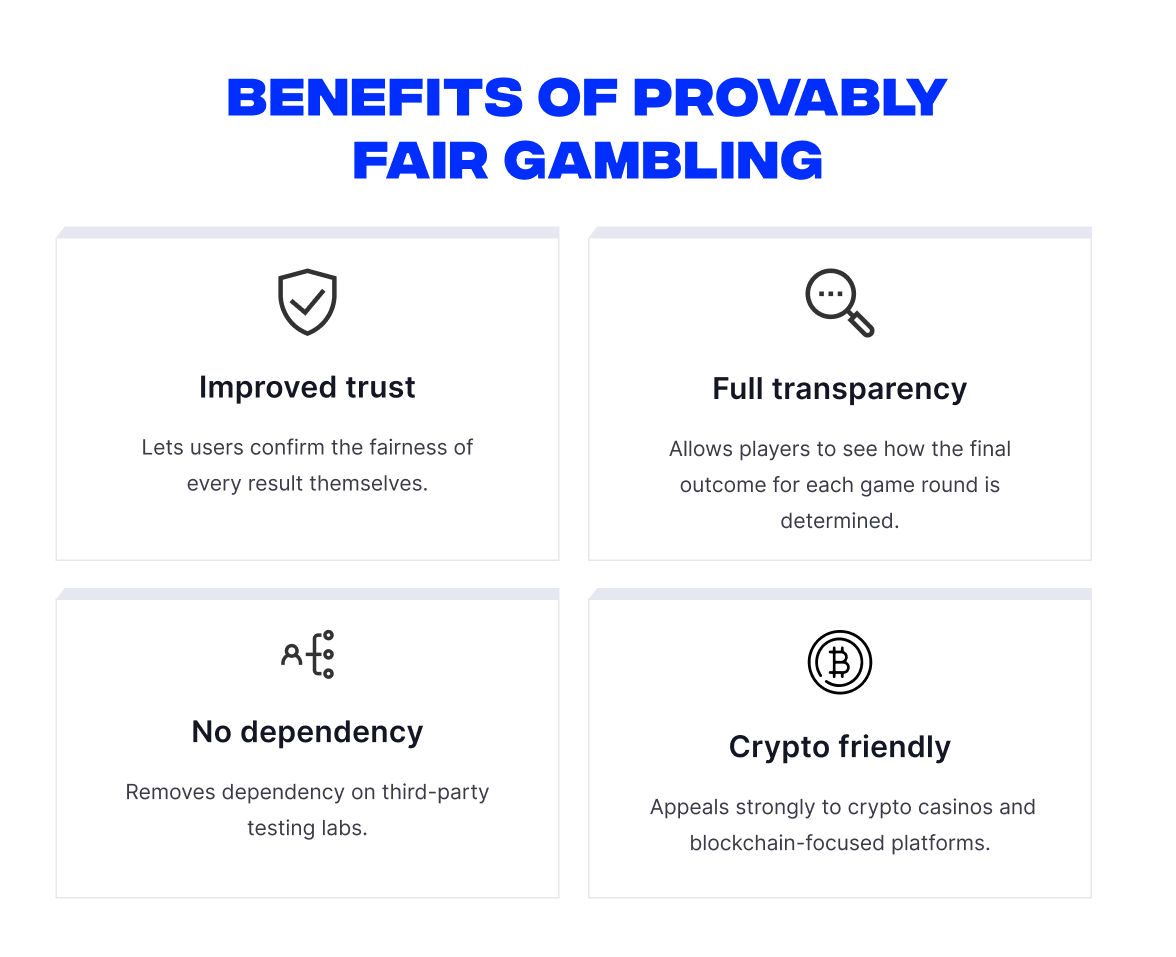
Provably fair gambling gives players more control over how results are generated and checked. Below are some of the key benefits it offers:
- Improved trust: It increases player trust by letting users confirm the fairness of every result themselves.
- Full transparency: It allows players to see how the server seed, client seed, and nonce are combined to determine the final outcome for each game round.
- No dependency: It removes dependency on third-party testing labs. This gives casinos and players a math-based method to prove fairness.
- Crypto friendly: It appeals strongly to crypto casinos and blockchain-focused platforms where provably fair technology aligns with the demand for open, tamper-resistant systems.
Security and Technical Integrity
Provably fair technology is built around cryptographic methods that protect both the player and the casino from manipulation. The strength of the system comes from the secrecy of the server seed, the openness of the client seed, and the one-way nature of hashing algorithms. When implemented correctly, these elements work together to guarantee that every game outcome is generated from a tamper-proof sequence.
But even with its strengths, players should still pay attention to how a platform handles randomness. Weak randomness sources, reused seeds, or poorly implemented cryptographic algorithms can undermine the entire system. A reliable casino will rotate seeds regularly and allow players to inspect the unhashed server seed after each round. By understanding these basics, users can spot bad implementations early and choose platforms that take security seriously.
Industry Adoption and Use Cases
Provably fair technology has moved from a niche feature to a core standard across many modern gambling platforms. Its transparency and alignment with blockchain game development make it particularly valuable in environments where trust is difficult to establish. Today, you’ll find provably fair systems in crypto casinos, decentralized apps, instant games, and a growing number of iGaming platforms that want to offer verifiable fairness.
Application in Crypto Casinos
Crypto casinos were among the first platforms to adopt provably fair technology, as it aligns perfectly with their users’ expectations. These casinos often support multiple cryptocurrencies and utilize provably fair systems to demonstrate the exact process by which each game outcome is generated. As a result, provably fair crypto casinos have become a major entry point for players exploring blockchain-driven gambling platforms.
DApps
Decentralized apps take the idea of provable fairness even further by removing the traditional casino structure entirely. Rather than relying on a central operator, DApps run game logic on smart contracts and make every action visible on the blockchain. This setup appeals to players who want casino games that cannot be manipulated by any platform. Because every outcome is tied to on-chain data, users can confirm the fairness instantly and trust that the rules stay consistent for everyone
Use in Dice Games and Other Instant Wins
Dice games remain one of the strongest use cases for provably fair technology because the rules are simple and the outcomes are easy to reproduce. Each roll comes from a unique server seed, a player seed, and the nonce tied to that specific round. This clarity makes dice titles ideal for players who want the highest level of fairness and transparency. The same provably fair principles are also applied across other instant win games like Limbo, Plinko, and Mines.
iGaming Platforms
Many iGaming platforms now integrate provably fair systems to improve transparency. This approach fosters trust across a wide range of casino games, from dice to slots, and supports operators who want to offer transparent mechanics without compromising speed or variety. As provable fairness becomes more prevalent, top game providers are increasingly combining it with virtual currencies, bonus systems, VIP programs, and broader platform features to appeal to a wider range of users.
How to Verify a Provably Fair Casino Yourself
Checking a casino’s provably fair system is straightforward once you know the essential elements involved. Most platforms provide all the data needed to verify each game outcome with a digital tool or their own built-in checker. Here’s how to do it:
- Find the Hashed Server Seed: Look for the hashed server seed displayed before the game starts. This locks the casino’s seed in place, so it can’t be changed later.
- Check Your Client Seed: Open your game settings and locate the client seed. Some casinos allow you to set it manually, while others generate it automatically.
- Confirm the Nonce: Make sure the nonce increases with every new round or bet. A repeating nonce may indicate a flawed or weak implementation.
- Use an Online Tool: Enter the revealed server seed (after the round ends), your client seed, and the nonce into a trusted online tool to regenerate the random string.
- Compare the Result: Match the regenerated outcome with what you saw in the game. If they align perfectly, the round was produced and played fairly.
Future of Provably Fair Gambling
Provably fair gambling is evolving beyond simple seed checks and entering an era defined by blockchain technology, smart contracts, and more advanced cryptographic tools. As online casinos mature, operators are exploring hybrid systems that combine traditional random number generators with provably fair algorithms to offer stronger transparency without compromising gameplay speed. These improvements aim to simplify verification, reduce reliance on centralized systems, and expand the types of casino games that can support provable fairness.
Looking ahead, decentralized game logic may become standard in crypto casinos and DApps. This allows players to see every action (bet, random number, or result) recorded on-chain. There’s also growing interest in AI-supported RNG models that still allow players to verify the fairness mathematically. As regulators begin to recognize the value of provably fair systems, we may see clearer rules and wider adoption across global gambling markets.
Final Thoughts
Provably fair gambling represents a major step toward transparency and accountability in online gaming. By allowing players to verify outcomes through cryptographic proofs, it replaces blind trust with verifiable fairness. This shift is especially important for crypto casinos and platforms built on blockchain technology, where transparency and control matter just as much as gameplay.
To build or expand similar systems, schedule a consultation to learn how a software development company like CrustLab can assist you. You can also explore our guide on how to start a crypto casino to understand the technical foundation behind these platforms.
FAQ
Provably fair gambling utilizes cryptographic algorithms to enable players to verify that each game outcome is genuinely random and untampered with.
Cracking the cryptographic algorithms (like SHA-256) is mathematically impossible with current technology. However, a system can be compromised if the casino implements it poorly (e.g., reusing seeds), so verification is still important.
Since the server seed is hidden until the round ends, no one can predict or alter the result before the game is completed.