- CrustLab /
- blog /
- Comparisons /
- Sports Trading vs Sports Betting: Explanation, Features, and Main Differences
Sports Trading vs Sports Betting: Explanation, Features, and Main Differences

- Counterparty & Market Structure
- How Profit Is Generated
- Complexity & Learning Curve
- Time Horizon, Flexibility & Control
- Skill vs Luck: Where the Real Edge Comes From
- Risk, Variance & Money Exposure
- Psychological Differences Between Betting and Trading
- How Sports Betting Is Regulated
- How Sports Trading on Exchanges Is Regulated
- Sports Event Contracts & Prediction Markets
- Value Betting & Closing Line Value
- Line Shopping & Comparing Sportsbooks
- Bankroll Management for Bettors
- Pre-Match Trading Strategies
- In-Play Trading Approaches
- Scalping & Swing Trading
- Hedging, Greening Up & Risk Control
In recent years, millions of people have been making money legally through sports. More than just watching sports for entertainment, many now engage in sports betting or sports trading to make extra cash on the side. Both terms sound similar and involve wagering on the outcome of sports events.
However, they differ in terms of features, strategy, and profit potential. Anyone looking to enter sports trading or sports betting software development must understand the key differences between these two options. This sports trading vs sports betting guide explains how they work, their main features, and differences.
- Sports betting and sports trading both involve wagering on sporting events to make a profit.
- Betting is outcome-based, with bookmakers providing multiple markets on a single game for punters to bet on.
- Trading focuses on buying and selling betting positions to profit from odds movements. This is done on a peer-to-peer order system similar to a traditional stock exchange platform.
- In sports betting, bookmakers set the odds and earn profit through built-in margins, whereas sports trading operates on peer-to-peer exchanges where prices are driven by supply, demand, and market liquidity.
What Is Sports Betting?
Sports betting, or gambling, is the process of predicting and wagering on the outcome of sports events. In simple terms, you guess the result of a sports game and bet money on your guess being correct.
Platforms that receive player bets and pay them for correct predictions are known as sportsbooks or bookmakers (also commonly called bookies). These platforms offer odds on a variety of betting markets (sports and leagues from all over the world). At every event, users can bet on a variety of future game results.
The most straightforward option is to bet on either team to win. This is known as a moneyline bet. There’s also the point spread option (also known as handicap), where you bet that the favorite team wins by more than a specified number of points or the underdog loses by less than that number.
Sports bettors can bet that the total number of points (or goals) is above (over) or below (under) a specific point set by the sportsbook. Bets can also be placed on the probability of a specific event or individual statistics happening within a game. Bets are typically placed before a match begins, but many platforms now offer in-play betting as well, with odds updated based on live events during the match.
How Sports Betting Works
Sports betting works on a bookmaker-driven market, meaning the sports betting platform providers (sportsbooks) determine the available markets in each game and the odds for every outcome. They use sophisticated statistical models combining past results, team form, news reports, and public sentiment. Based on these stats, the model calculates the probability of an outcome occurring.
Odds are structured to attract bets on both sides of the line. Sportsbook operators make money on the “vig,” which refers to the cut of all bets they accept on their platform. Vigs vary from one bookmaker to another but always depend on the odds they provide. This built-in mathematical advantage that ensures sportsbooks receive more than their payout is known as the margin or overround.
For bookmakers, the ultimate goal is to balance the books. This is achieved by adjusting the odds to attract bets on all possible outcomes. If betting is perfectly balanced, the bookmaker makes a profit regardless of the actual event result. However, they might end up with an outcome-dependent profit, as the books are not perfectly balanced.
Types of Sports Betting Markets
There are several ways to place bets with a bookmaker. Each bet type has unique use cases and risk profiles. Here’s a breakdown of the most common bet categories or wagering methods.
- Straight bets: These involve wagering on the direct outcome of a sporting event. You either pick a winner (moneyline bet) or bet that a team will win or lose despite a handicap of points (point spreads). Straight bets have polar outcomes, although some sportsbooks also allow players to bet on a draw. This is why it is often considered the lowest risk (and fairest) betting option.
- Totals: Also known as over/under totals, these involve betting on the total number of goals/points scored by both teams. The bookmaker sets specific odds for each goal outcome, and you wager on whether the final score will be above or below that level. Unlike straight bets, it doesn’t matter who wins the game in a totals bet.
- Props: Also known as side bets, these are wagers placed on the possibility of specific occurrences within a game. These occurrences can relate to specific player performance (player props) or unique aspects of the game (game props). Player prop bets don’t necessarily affect sports outcomes (who wins or loses). They only require that the predicted event occurs.
- Futures bet: This involves placing bets on the eventual outcome of a sports event or season. Examples include the winner of a World Series, the grand-slam champion, or the number of wins a team will achieve by season’s end.
- Parlays and same-game parlays: Most sportsbooks allow multiple bets to be combined on the same ticket. This is known as a parlay bet. When a player does this, all outcomes on the parlay ticket must be correct to win. Parlays can be created for just one game (predicting multiple outcomes within one match) or for several games.
Bookmakers may also introduce new or temporary bet types based on current sports betting trends. For instance, some platforms allow bets on early goals, 1Up, goal scorer duos, and other options.
What Is Sports Trading?
Sports trading is a method of making money on sporting events by buying and selling contracts. Sports trading is done on an exchange platform. The main goal is to profit from changes in odds, similar to trading stocks. Sports traders don’t really care who wins or loses a match. All that matters is entering the market at the right time (when the odds are good) and exiting when the odds are not. Similar to the stock market, profit comes from price movement based on key factors rather than the match outcome. The goal is to buy low and sell high, with the difference in prices being the player’s profit.
How Sports Trading Works
Sports trading provides an alternative way to make money on popular sports events, more akin to traditional stock trading or selling shares. In sports trading, you buy and sell event contracts based on specific yes/no outcomes in real-life sporting events. The price of each yes or no outcome depends on the probability (or odds) of that outcome occurring. It’s called a “back bet” when you bet on an outcome occurring and a “lay bet” when you bet against it.
An event trading exchange sets the initial contract price for both sides of the outcome based on probabilities. Unlike sports betting platforms, where the bookmaker sets odds, the compilation of current bids (back odds) and asks (lay odds) is stored in an order book.
As the probability of each outcome changes (based on team news, injuries, or in-play events), prices shift up or down. This possibility of changing odds presents an opportunity for players to sell their position for profit or buy a new position hoping the price will rise. This back-and-forth trading continues until the event concludes.
Users who bought the correct side get the full value of the event contract, while those who bought the incorrect side get nothing. Their loss is the price they paid to buy the outcome contract. Players apply different strategies to sports trading, such as greening up (or hedging) their risk by spreading their profit between both outcomes. Trading can occur pre-match or live during play, with in-play trading being more volatile and high risk.
Exchanges, Markets & Price Dynamics
Users can access sports trading through mobile apps and traditional brokerage platforms. These platforms facilitate peer-to-peer (P2P) buying and selling of match contracts. The system is similar to modern financial stock exchange markets.
Unlike sportsbooks, where the bookmaker bets against your prediction, a sports exchange acts only as a middleman. They take information from sporting events to set the odds (and initial price) for each outcome.
The information is displayed in the order book, showing available back bets and lay bets. The order book engine thrives on liquidity – the availability of back bets matched with lay bets in any market. Popular events like the World Cup or Super Bowl typically have high liquidity, while fringe events or niche sports have low liquidity. The sports exchange takes a commission on all winning bets. For instance, Betfair, the largest betting exchange in the world (founded in 2000), takes a commission on all winning bets, with the lowest rate being 2%, depending on the user’s country.
Sports Trading vs Sports Betting: Key Differences Explained
There’s major overlap between sports trading and sports betting. In fact, it is entirely possible to wager on the same match on a traditional sportsbook and a sports trading exchange. However, there are notable differences between these two gambling options, highlighted below:
| Feature | Sports Betting | Sports Trading |
| Market Structure | Against a Bookmaker (House Edge) | Peer-to-Peer (Supply & Demand) |
| Profit Source | Final Outcome (Fixed Odds) | Price Movements (Entry/Exit Price) |
| Learning Curve | Low (Simple Prediction) | High (Technical & Financial Analysis) |
| Flexibility | Fixed (Locked until outcome) | High (Ability to exit/hedge anytime) |
| Risk Profile | Binary (All or Nothing) | Variable (Controlled exposure) |
| Time Horizon | Long-term wait for result | Active, intra-match management |
Counterparty & Market Structure
A bet placed with a traditional bookmaker is almost always a back bet. This means you’re predicting that an outcome will happen while the bookmaker bets against you (predicting the outcome will not happen). Sports trading takes a different direction. It runs on a peer-to-peer system, meaning one person places the back bet while someone else (not the platform) places the lay bet at the current market price.
This significantly impacts pricing and house edge. In traditional bets, the bookmaker bears the bet’s risk. To ensure profit, a house edge is built into each odd. Pricing in a sports exchange is primarily based on demand and supply. In the long term, the trader takes on fewer risks than a traditional gambler due to this market structure.
How Profit Is Generated
Traditional betting runs on an outcome-based model. Once bets are locked in, players wait for the final outcome to determine if they have won or lost. The odds are fixed at the moment of purchase, and a player’s profit or loss isn’t affected by changing odds.
Trading, on the other hand, depends on price movement. The outcome matters little to the sports trader. Their primary goal is to determine how the perceived probability (and thus the price) changes during the match. Profit is generated based on the difference between the player’s “entry” price and “exit” price.
For example, a player enters a Manchester City vs. Manchester United match at odds of 2.00 with $100 in favor of a Manchester City win. On a sportsbook, the player gets $200 at the end of the match if Manchester City wins. It doesn’t matter if the odds changed during play. A trader doesn’t wait for the outcome. If City scores in the 10th minute and the odds crash from 2.00 down to 1.25, the price goes up (since City is more likely to win), and you can sell your contract immediately to make a profit.
Complexity & Learning Curve
Sports betting has a very low barrier to entry. Most sports markets are easy to understand, and even the more complex ones are relatively straightforward compared to trading. Trading requires players to transition from a simple “fan” mindset to a “technical trader” mindset. This transition from simple prediction to active market management has a steep learning curve. Success lies in a player’s technical and financial analysis. Sports traders may also use sophisticated tools and data to make smarter choices.
Time Horizon, Flexibility & Control
Sports betting is based on a single decision for every market. You simply choose an option and wait for the outcome. Sports trading requires players to track their bets, watch the odds, and decide the perfect time to enter or exit trades. They can do this (enter and exit trades) multiple times within one game, making profit off each trade.
Sports trading is also more flexible compared to betting. Your bets are final, and the odds are fixed at the point of placing the bet. Even if you change your mind and use the cash-out option (available on some sportsbooks), you may likely lose money. Sports trading allows ongoing risk adjustments based on changing match statistics and other factors.
Skill vs Luck: Where the Real Edge Comes From
Since both trading and betting involve predicting uncertain outcomes, you need some element of luck to win. But luck isn’t the only factor. Successful betting depends on your understanding of the sports, knowledge of the playing teams, and overall dynamics of the competition. This can help you identify strong teams and underdogs in any matchup and make informed decisions. Success often depends on your understanding of how bookies set odds and your ability to combine this statistical probability with real-world data.
Sports trading requires even deeper quantitative analysis. Traders use historical data to build models that predict how odds are likely to move when a goal is scored or a player is sent off. Trading also requires a disciplined approach. Like stock trading, you need to know when to take profit or hold your position without giving in to sentiment or emotion. A good trader knows that skills, strategies, and everything else don’t guarantee profit. Discipline will keep you from chasing losses or making bad decisions due to overconfidence.
Risk, Variance & Money Exposure
Betting is an all-or-nothing affair. Every bet you place is a “cliff-edge” event, meaning you can either win the calculated payout or lose all of your stake. There’s no middle ground to this. Sports trading has a more variable risk spectrum. The odds change over time and are rarely ever fully locked in.
Traders have the option of exiting a position at any time. This provides an out with every bet, ensuring that you never lose 100% of your stake even if the odds move against you. Sports betting is often about big moves, leading to either high reward or losses.
The risk of betting is higher due to the binary outcome of every bet, but players have the option of placing smaller unit bets compared to trading, where a substantial investment is needed to get tangible profit. Trading involves small, frequent moves, with each move giving you marginal profit. While traders often use larger stakes, their liability is smaller since their investment is never fully locked in. Experienced sports traders can scale their profits into four- or five-figure monthly returns, depending on their skill and bankroll management.
Psychological Differences Between Betting and Trading
The psychological impact of sports betting and trading depends on whether you find uncertainty or constant decision-making more stressful. The long wait between placing a bet and getting an outcome in sports betting leads to emotional buildup and psychological tension. A win or loss in this case feels like substantial returns.
Sports trading is based on nearly instantaneous feedback. Players watch the match (and odds) for changes in order to make trading decisions. Each session is a series of mini wins or losses, which can be stressful in its own way. Psychological reactions such as tilts, overconfidence, and loss-chasing all exist in both worlds but are exhibited in different ways.
Legal & Regulatory Landscape
Sports betting and trading are classified differently under the law. While sports betting is considered a form of gambling, trading platforms are classified as financial exchanges. This difference in classification means they’re governed by different regulatory bodies and subject to varying laws.
How Sports Betting Is Regulated
As a form of gambling, sports gambling is governed by state gambling laws and is under the control of the State Gaming Commissions. Currently, 25 US states have a legal and thriving sports betting industry. Regulators treat legal sportsbooks as gambling entities, which means they’re expected to obtain a license and comply with player protection, minimum age verification, and responsible gambling requirements.
How Sports Trading on Exchanges Is Regulated
Sports trading platforms enjoy more legal freedom compared to legal sportsbooks because they’re classified as financial exchanges rather than gambling sites. As a result, their operation is controlled by federal oversight by the Commodity Futures Trading Commission (CFTC). While there are regional access limitations to certain sites, some platforms, such as Crypto.com and Kalshi, are accessible nationwide.
Sports Event Contracts & Prediction Markets
The legal designation of betting platforms and sports event contracts is still a controversial market. While traders are technically betting on the outcome of real-world events, sports event contracts are legally classified as financial derivatives. This places them under the jurisdiction of the Commodity Futures Trading Commission (CFTC) rather than a state gambling board. However, regulators in certain jurisdictions (like Nevada, New Jersey, and Massachusetts) and groups like the American Gaming Association (AGA) argue that a “bet” is still a bet regardless of what name it is called.
Sports Betting Strategies
People who are successful at sports wagering don’t just bet on a whim or rely on gut feelings alone. Instead, they apply practical strategies to find the best bet value and mitigate risk. Some of the most notable strategies include:
Value Betting & Closing Line Value
Value betting is based on the idea that the odds provided by the sportsbook aren’t always an accurate reflection of an outcome’s probability. A player can look at a matchup and determine (based on their own analysis) that the odds provided by the bookmaker are higher than the actual probability of an outcome. For instance, the sportsbook might give high odds to a team they consider an underdog, but your analysis might show that the team has a decent chance of winning. This is called a value bet. Looking out for bets like this can boost your winning chances and get you the most value from your bets.
A similar concept to this is the idea of closing line value. This is based on the idea that the first odds published by the bookmaker aren’t always the most accurate ones. Instead, the closing odds (the odds at the exact moment the match starts) are the most accurate reflection of a win probability. At this point, all the bets are in, team news is out, and even minuscule factors like the weather conditions and fan attendance have been confirmed. Beating this closing line increases your probability of turning a profit, especially for long-term betting.
Line Shopping & Comparing Sportsbooks
As a punter, you might discover that the exact same event and betting market is being offered at different odds across various sportsbooks. Line shopping is all about checking multiple platforms to find the one with the best possible odds for the specific event and market you’re targeting. Getting the best odds reduces the built-in house margin and improves your winning chances ever so slightly.
Bankroll Management for Bettors
Managing your bankroll is an essential skill every punter must learn. Even with the best strategy, not all predictions will go your way. If you do not learn to manage your money wisely, a string of bad luck can wipe out your entire bankroll.
A simple strategy that works effectively is to set a fixed percentage of your total bankroll (usually 1% to 2%) as the unit bet and apply a flat staking strategy. This means you only bet this exact unit on every match, no matter how confident you are in the outcome. This helps you avoid emotional betting that may lead to huge losses.
Expert sports bettors who are skilled at finding odds may also apply the Kelly Criterion to set their bankroll. This is a formula that can be used to determine the optimal bet size based on your edge. If you feel the bookies’ odds are high based on your analysis, then you can increase your bet size. Conversely, you reduce your bet size if the bookie’s bet seems lower than the win probability.
Sports Trading Techniques
In sports trading, players try to profit from price movements on a sports exchange. This requires even more technical skills and strategies compared to traditional betting. Some of the most important aspects of trading and techniques used by sport traders are highlighted below:
Pre-Match Trading Strategies
As the name suggests, pre-match trading is all about anticipating changes in the odds even before the match begins. Traders who use this strategy rely on early odd movements in response to team news, public sentiments, and other match-related factors that may change in the days or hours before a match. It’s all about turning information into a winning strategy over extended periods.
Another approach to pre-match trading is to rely solely on anticipating market conditions. In trading, odds may change in response to how the liquidity swings. If more people back an outcome, the price will likely drop. A trader may choose to back a team days before the match with the hope that more people will throw their money in that direction and drive the price down, allowing them to exit for a profit before the match begins.
In-Play Trading Approaches
Players who prefer faster-paced action may opt for in-play trading instead of trading days. This is more complex as it requires real-time data and split-second decision-making based on live events happening during the match.
During matches, in-game events such as goals, points won, red cards, or player injury can cause the odds to shift. Experienced traders watch out for odd changes and trade the market based on these. For instance, if an underdog scores in a match, causing the odds to shift in their favor, a player may choose to exploit this depending on their initial position.
In some cases, simply waiting for time to elapse can cause odds to change even when no major shock event has occurred. Strategic in-play trading is all about timing and your ability to judge the impact of in-match events on odds.
Scalping & Swing Trading
In sports trading, a trader can either try to capture small odd changes (scalping) or go for larger trend-based swings. Scalping is more practical in markets with high liquidity, where odds are relatively stable but still fluctuate slightly between two points. The goal is to enter and exit trades quickly to capture the small margin. On the other hand, swing trading is more common in volatile markets where a trader expects a specific team to dominate a portion of the game.
Hedging, Greening Up & Risk Control
In trading, players can apply different techniques to control risk and minimize losses. The most common strategy is to spread your profit across all possible outcomes. This is known as greening. This strategy ensures that you walk away with a win regardless of the outcome or odd changes during the match. A similar strategy to this is hedging, which involves placing a “Lay” bet against your original “Back” bet (or vice versa). The goal is to reduce your total liability. Players also have the option of setting a predetermined point to automatically exit a losing trade in order to preserve their capital. This is known as the stop-loss, and it is an efficient risk-control measure.
Tools, Platforms & Data Sources
The sports betting industry is highly tech-reliant. The same is true for trading platforms. Modern bookmakers in the sports betting space and sports trading platforms use sophisticated stacks of low-latency data feeds to instantly deliver odds to players across various betting markets. These odds are presented to players and updated in real-time based on the live match events.
Most platforms rely on turnkey solutions from third-party providers to deliver odds, handle risk management, and other aspects of their services. The best sportsbook software providers also provide features like bet builders and automated cash-out functions built into them to help players manage their gambling activities.
More serious traders use even more sophisticated software and tools to place and manage their trades. Some platforms allow users to connect third-party software via API to their exchange. These professional tools change how odds are displayed to players and allow them to execute trades easily in a single click.
Traders may also use bots to run automated strategies like scalping or set triggers for buy and sell action. Trading calculators may also be used when applying strategies like hedging to equalize your profit across multiple outcomes.
Another set of tools that is important to those trading on an exchange or betting on a sports betting app is the data providers. These data platforms provide punters and traders with useful data to help them create a clear plan. Examples of the data types they provide include historical data, live in-play data, weight of money (the ratio of back orders vs. lay orders), economic indicators, and general match data like weather forecasts, injury reports, and travel distances. Using these trading software can provide a significant advantage by allowing faster access to market data and quicker bet placement.
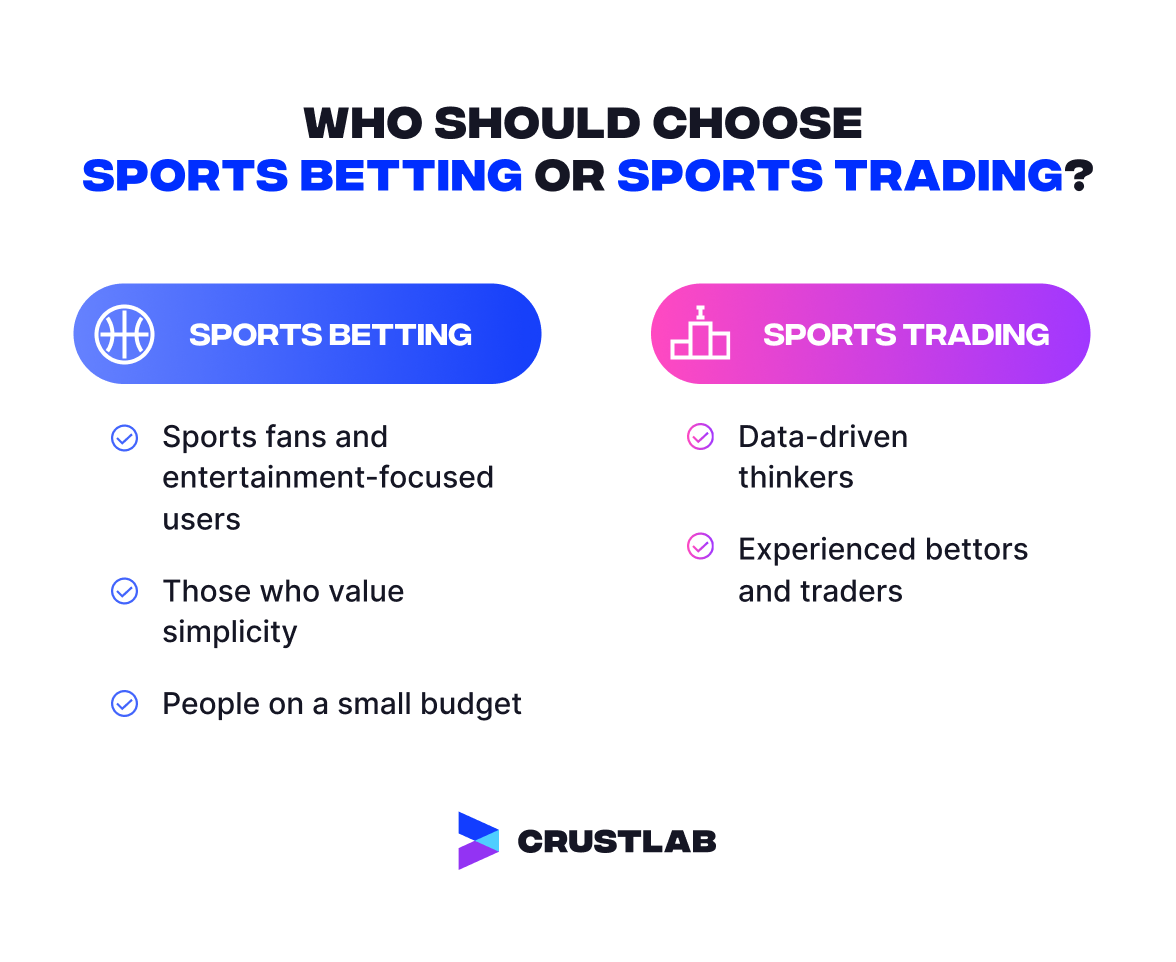
Who Should Choose Sports Betting (and Why)
- Sports fans and entertainment-focused users: Sports gambling is best for both casual and serious sports fans. Many punters don’t just bet for profit. They have a deep understanding of the game and enjoy exploring the numerous sports betting offers available.
- Those who value simplicity: Sports betting may be better for beginners seeking a simple, entertaining experience with potential for immediate large payouts. It is also great for those who prefer to invest minimal time or effort in gambling. Unlike trading, sports gambling isn’t time-consuming. You don’t need to watch changing odds or change positions multiple times. You simply place your bet and wait for the match outcome.
- People on a small budget: Betting platforms allow punters to place relatively low unit bets. Sportsbooks may also offer bonuses and promotions that increase initial betting power for people with a small budget.
Who Should Choose Sports Trading (and Why)
- Data-driven thinkers: Sports trading requires more research and data analysis than betting. You have to have an eye for data and technical analysis to truly enjoy and profit from trading. Such people are also more likely to be familiar with the technical interfaces of trading platforms.
- Experienced bettors and traders: Sports trading is similar to traditional stock or financial markets trading, where you buy and sell positions to profit from market movements. Given this similarity, sports trading is generally more beneficial for experienced investors seeking control and a long-term, skill-based approach. Some of the principles used on conventional exchange platforms can be applied to stock trading.
Which Is Better: Sports Trading or Sports Betting?
Sports betting is the more traditional option, offering players numerous betting markets. It is also more popular and requires less capital compared to trading. Sports gambling is easy to understand, so pretty much anyone with a basic understanding of sports can get in on it.
Sports trading is a lot more technical. It is similar to stock market trading, meaning participants have to actively trade positions based on their prediction of price movements. More than simply predicting outcomes, traders have to analyze technical data and make strategic decisions to get great results.
Either of these markets holds lucrative opportunities for platform providers looking to venture into the industry. You can partner with our software development company to create your own platform with betting or trading options for punters. You can also get in touch with us if you have questions about how to make a betting website or how to start a sportsbook.
FAQ
No. Sports trading isn’t the same as sports betting. Sports gambling involves predicting the outcome of matches and earning profits based on correct predictions. Trading, on the other hand, involves buying and selling betting positions, with the goal of making profits from the differences in buying and selling prices.
Yes. In many jurisdictions, it is considered an investment option rather than a form of gambling, which is why it enjoys a favorable legal position.
It is not recommended that a person tries to make a living consistently from sports betting or trading. This can lead to addiction, debt, and other problem gambling issues.
Sports trading is generally safer than sports betting. Unlike sports betting, where outcomes are polar, sports trading rarely leads to absolute losses. You just need to know when to enter/exit trades and put measures in place for risk control, such as stop losses.