- CrustLab /
- blog /
- Comparisons /
- Lottery vs Gambling Explained. Is the Lottery Considered Gambling?
Lottery vs Gambling Explained. Is the Lottery Considered Gambling?
The debate over lottery vs gambling has long sparked curiosity among players and policymakers. While both involve risk and reward, their structures and intents differ greatly.
Lotteries are often government-run fundraising tools, whereas gambling games are primarily profit-driven entertainment ventures. Anyone looking to invest in lottery software development should read this guide to understand this distinction. It will also help players make informed choices about how they spend their money and manage risk.
- Both lottery and gambling involve chance and reward. Players pay money for an uncertain outcome, but lotteries are state-run while most gambling is privately operated.
- The lottery is legally a form of gambling, yet it’s viewed differently because it raises public revenue for education, health, and infrastructure rather than private profit.
- Odds and frequency set them apart. Lottery draws are rare with extremely low chances of winning, while casino and betting games offer faster play, smaller wins, and higher addiction risk.
- Responsible play is essential. Players should study the odds, set spending limits, manage expectations, and recognize signs of problem gambling to protect both their finances and mental health.
What Is Gambling?
Gambling is the act of risking money or something of value on an uncertain outcome with the hope of winning a prize. It always involves three key elements, which are consideration, chance, and prize. Consideration means the player pays or wagers something to participate, while chance refers to the random or unpredictable result that determines whether a person wins or loses. The prize is what the player stands to gain, often in cash or other rewards.
Across the world, gambling games appear in many forms, including online and offline casinos and sports betting. Some games, like blackjack or sports betting, mix skill with chance, while others depend entirely on luck. Despite the variety, all gambling relies on players accepting risk in exchange for a possible reward.
What Is the Lottery?
A lottery is a form of game in which participants pay a small fee to purchase tickets, giving them a chance to win a significantly larger prize. Every ticket represents an equal opportunity, and winners are chosen through a random draw. The system is simple: players purchase a ticket and claim their winning ticket if their numbers match during the draw. This structure makes lotteries one of the most popular forms of organized gaming in the world.
Most lotteries are state and provincial lotteries, regulated and run by governments rather than private operators. Their main goal is to raise revenue for public projects, such as education, healthcare, infrastructure, and social services. This purpose sets lotteries apart from casino or betting operations, which exist mainly for profit.
Although most lotteries meet the legal definition of gambling because they involve chance and reward, they’re often seen as socially acceptable. Governments market them as harmless entertainment and a way to support good causes while dreaming of life-changing lottery winnings. To learn more about the mechanics, see how lotteries work, or explore the broader lottery market.
Is the Lottery Gambling?
By definition, the lottery is considered a form of gambling. It involves all three core elements of a gambling game: players pay for a chance to win, the outcome is determined by luck, and there’s a prize or payout for the winner. This makes every lottery draw a legal form of gambling, even if it feels more harmless or routine than a night at the casino.
However, what separates lotteries from other forms of gambling is their purpose and perception. Most are operated by state governments or licensed bodies to raise public funds, while traditional gambling is run for private profit. Hence, many people view lotteries as a civic activity rather than as risky play.
Cultural and religious views also shape opinions. For instance, India allows lotteries only in certain states while banning most other gambling activities. Each participating state lottery is government-run and regulated separately. Similarly, almost all gambling is illegal in Thailand, yet the state lottery operates as a lawful national enterprise under tight government control. Meanwhile, countries like the United Kingdom and Canada run lotteries through official bodies and treat them differently from casinos or online gambling.
Key Differences Between Lottery and Other Types of Gambling
While the lottery shares a similar foundation with gambling, it operates very differently in practice. The contrast lies not in the mechanics of luck, but in how each system is run and experienced. The table below highlights their most important distinctions.
| Aspect | Lottery | Other Forms of Gambling |
| Regulation | Operated and supervised by state or provincial lotteries. | Often run by private casinos or online platforms under commercial licenses. |
| Purpose | Designed to raise revenue for public programs. | Focused on profit generation for operators. |
| Odds and Expected Value | Extremely long odds (e.g., 1 in 292 million for Powerball) and low expected value. | Typically better odds, especially in skill-based games. |
| Frequency | Draws occur weekly or bi-weekly. | Bets and spins happen continuously. |
| Skill Element | Pure chance. Players have no control over outcomes. | Games like poker and sports betting require skill and strategy. |
| Accessibility | Sold widely at stores and online. Promoted as safe entertainment. | Access is often restricted to licensed venues or age-verified platforms. |
| Payout Structure | Large jackpots, smaller prize tiers, lump sum or annuity options. | Instant payouts per round or event. |
| Taxation | Lottery winnings are taxed by the state government. Requires reporting. | Gambling winnings are taxed similarly, though rules vary by activity. |
| Revenue Destination | Funds are directed to public causes. | Profits go to private operators or shareholders. |
1. Regulation and Legality
Regulation is one of the clearest dividing lines between the lottery and other forms of gambling. Most lotteries are created and managed by state or provincial lotteries, operating under strict government control. Their legal frameworks ensure transparency in ticket sales, draws, prize distribution, and the use of funds. This tight regulation builds public trust and helps maintain the lottery’s image as a legitimate form of entertainment.
By contrast, casinos and online gambling platforms are typically owned by private companies that operate under separate commercial licenses. These operators must follow gambling laws but have greater freedom in marketing and payouts. For example, the United States does not have a national lottery. Each state decides whether to run its own, while laws governing casinos and sports betting differ widely.
2. Purpose and Ownership
Lotteries exist to raise revenue for the public. They’re owned or mandated by the state government, with lottery sales channelling funds to various projects. Rules often require clear reporting and public audits so lottery players can see where the money goes.
Casinos and most other forms of gambling are run by private operators for profit. While licensed, their goal is shareholder return, not public funding. Players pay into products designed for margin. Payouts and cadence are set to maximize engagement. They don’t fund community projects.
3. Odds and Expected Value
The typical state lottery offers extremely low chances of winning. For example, the Powerball jackpot’s lottery odds are about 1 in 292 million, while the Mega Millions top prize sits around 1 in 302 million. In contrast, a single bet on roulette has roughly 1 in 38 odds of success. Skilled players in poker or blackjack can further influence their results.
This difference leads to a lower expected value for lottery tickets, i.e., the mathematical average return per play. For instance, spending one dollar on a ticket might statistically yield only a few cents over time. That’s because most lottery winnings fund jackpots, administrative costs, and public programs rather than returning value to players.
While still favouring the house, casinos and sportsbooks generally offer higher return rates and more frequent wins. This means lotteries provide massive jackpots but extremely poor odds, while gambling games offer smaller, more consistent chances of success.
4. Frequency and Player Behavior
The lottery runs on long cycles. Major draws like Powerball or state lottery games usually happen once or twice a week, giving players time between tickets and results. This slow pace limits impulsive play, but it also builds anticipation around the next jackpot or winning ticket.
On the other hand, gambling games like casino tables and online slots run continuously. Players can place new bets within seconds, so the experience is faster and more immersive. This constant availability increases the risk of losing money quickly and can contribute to problem gambling if not managed responsibly.
5. Skill vs. Pure Chance
All types of lottery are entirely based on chance. Every ticket has equal odds, and no strategy or experience can improve the outcome. Whether someone buys a single ticket or a hundred, the numbers drawn are random and unaffected by player behaviour. This makes the lottery a pure game of luck. It is exciting but completely unpredictable.
Meanwhile, many gambling games blend skill and strategy with probability. Card games and sports betting reward knowledge, calculation, and emotional control. Skilled players can slightly tilt the odds in their favour, even though luck still plays a role.
6. Accessibility and Marketing
Lotteries are among the most accessible forms of play. Lottery tickets are sold at convenience stores, supermarkets, and authorized kiosks, often alongside everyday purchases such as snacks or fuel. This easy access, paired with friendly branding and slogans such as “Play for a good cause,” frames the lottery as light entertainment.
In contrast, casinos and betting platforms typically require age verification, KYC, membership, or travel to licensed venues. Their marketing targets defined gambling audiences through digital ads, loyalty programs, or live events.
This accessibility gap impacts public behaviour. Many people buy tickets impulsively, especially when the jackpot or top prize climbs into the millions. Meanwhile, gambling operators use more aggressive promotions to acquire and retain players. Governments carefully regulate both, but AI lottery software and lottery sales are often held to softer advertising standards.
7. Payouts and Prize Structures
Lottery payout options are tiered. Most games feature a single top prize or jackpot, followed by smaller cash rewards. Winners usually choose between a lump sum payment and an annuity spread over several years. Although the lump sum option gives instant access to wealth, it comes with higher income tax obligations and long-term financial decisions.
In comparison, gambling games such as roulette or slot machines pay out instantly. Winnings depend on each bet, and players can win or lose multiple times in one session. Casinos distribute prizes continuously to create faster gratification and reinforce play.
8. Taxation and Reporting
Both lottery winnings and gambling profits are considered taxable income in many countries. In the United States, for instance, operators are required to issue a W-2G form for prizes exceeding a specified amount. Federal income tax is typically withheld from the player’s payout before it is received. Depending on the state lottery, additional state taxes may also apply.
Players who choose the lump sum option often face higher upfront taxes, while annuity payments spread the liability over time. The same principle applies to casinos and betting platforms. Any significant win must be reported, and losses can sometimes offset taxable gains if properly documented.
Additionally, tax policies vary internationally. In the United Kingdom, lottery players keep their full prize untaxed, while operators pay taxes on lottery sales and revenue instead. Because laws differ by region, it’s always wise for lottery winners and gamblers to consult a qualified tax professional before claiming large sums.
9. Government Revenue and “Good Causes”
One of the strongest distinctions in the lottery versus gambling debate lies in where the money goes. Most state and provincial lotteries allocate a portion of their sales to public causes, such as education and health services. For example, U.S. states like California and Georgia allocate billions from lottery revenue each year to school funding. Similarly, in the U.K., the National Lottery contributes significant funds to arts, sports, and heritage programs.
However, private casinos and betting companies keep their profits after taxes and licensing fees. While these funds may still benefit the state government through taxation, they’re not directly tied to social programs.
Despite their good intentions, lottery proceeds often come from lower-income groups who spend a higher share of their earnings on tickets. Supporters counter that most lotteries provide transparent reporting and voluntary participation. So, they are a fair way to raise revenue for the public good.
10. History
Lotteries have existed for centuries as a way to raise revenue for public works. Early civic draws in Renaissance Italy and the Dutch Republic funded walls, canals, and charity. In colonial America, lottery tickets financed roads and universities, but a 19th-century backlash led many regions to ban most forms of gambling.
The modern revival began in the mid-20th century as governments searched for non-tax funding. New Hampshire launched the first contemporary state lottery in 1964, and many U.S. states followed. In 1994, the UK introduced the National Lottery to establish a model where players pay small sums for a chance at a large jackpot, with proceeds supporting public causes.
Meanwhile, commercial gambling evolved separately. Nevada’s casinos in the 1930s, Atlantic City in the 1970s, riverboats and tribal casinos thereafter, and, more recently, online betting. Across the world, provincial lotteries (e.g., in Canada) and state lotteries operate alongside private casinos, each with distinct rules, odds, and oversight.
Lottery vs Casino Games
Lotteries and casino games both involve chance, but they differ in pace, odds, payout cadence, and expected value (EV). Lotteries offer rare, life-changing jackpots; casinos offer frequent, smaller wins with generally better odds per play.
| Factor | Lottery Games | Casino Games |
| Odds | Extremely long (e.g., ~1 in 292m for Powerball top prize) | Shorter (e.g., roulette single number 1 in 37/38) |
| EV (Return) | Low EV | Higher EV |
| Payout Frequency | Infrequent draws; delayed claims | Instant per hand/spin; immediate cash payouts |
| Prize Structure | Tiered prizes; lump sum or annuity | Per-round payouts; no annuity |
| Skill Element | None (Pure chance) | Varies (blackjack/poker need strategy) |
Lottery vs Sports Betting
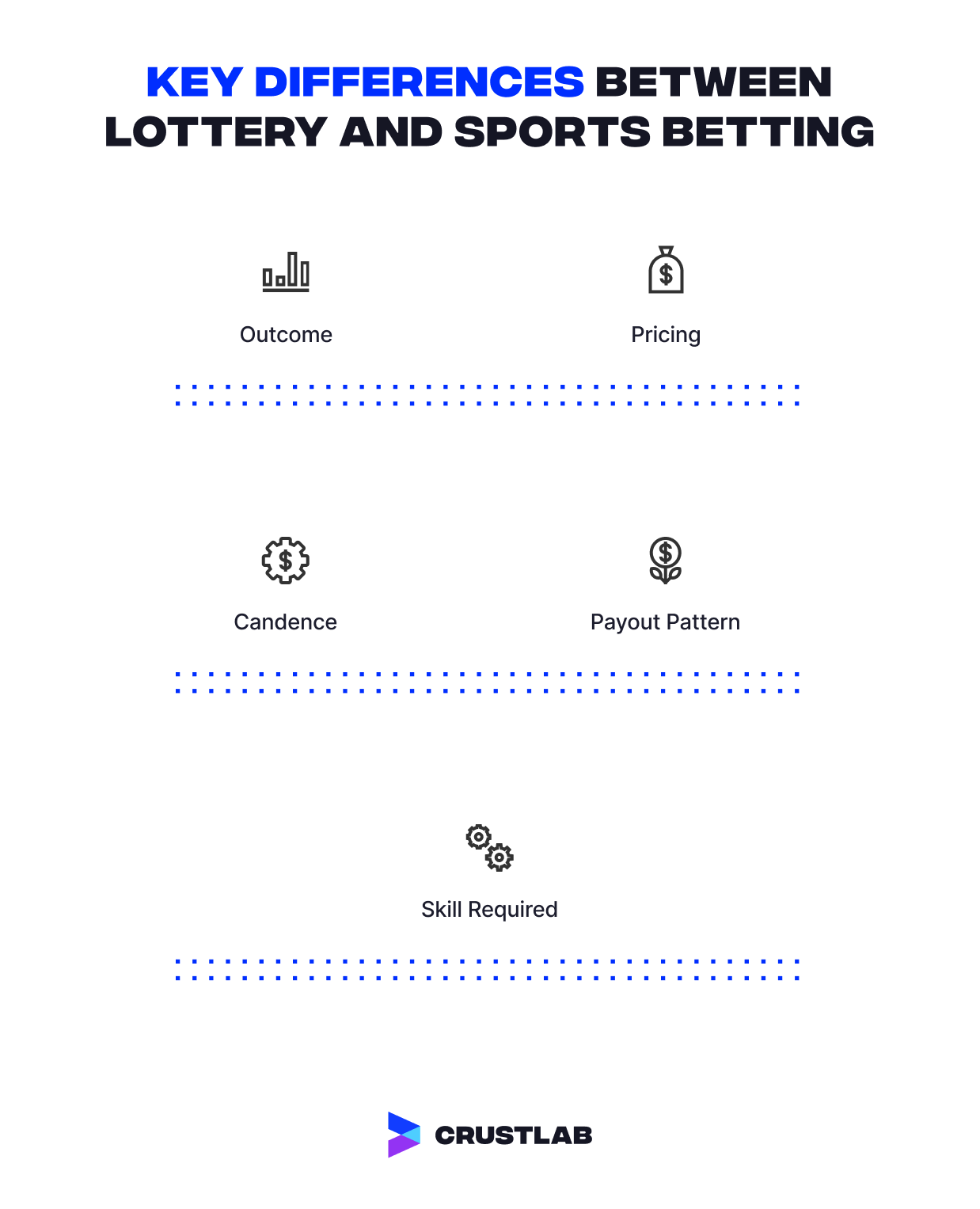
Sports betting prices outcomes (odds/lines) and can reward analysis. On the other hand, the lottery is random with fixed-price tickets and fixed odds. See how they compare below:
| Factor | Lottery | Sports Betting |
| Outcome | None; random draw | Some informational edge (head-to-head, form, injuries, models) |
| Pricing | Fixed ticket price; fixed probability | Dynamic odds; markets move based on statistics |
| Candence | Draws weekly/bi-weekly | Continuous (daily matches, in-play) |
| Payout Pattern | Big jackpot, small tiers | Frequent smaller wins/losses; settlement after events |
| Skill | Not applicable | Matters (model building, bankroll rules) |
Skill-Based Games vs Lottery
In skill-based games like poker and fantasy leagues, a player’s decisions can genuinely influence the result. By contrast, the lottery leaves everything to chance.
| Factor | Lottery | Skill-Based Games |
| Determinants | Random number draws | Choices, psychology, math, variance management |
| Learning Curve | None | Steep; strategy affects outcomes |
| Variance | Extreme; most players pay and lose | High but reducible with edge and discipline |
| Winnings | Rare, outsized jackpot or prize tiers | Smaller, repeatable winnings are possible |
| Addiction Risk | Lower event frequency; high “dream” appeal | Faster cycles can heighten risk without controls |
| Anonymity | Some winners may remain anonymous (jurisdiction-dependent) | Typically private; no public disclosure |
Comparing the Risks: Lottery vs Gambling Addiction
The risk of addiction increases with event speed, frequency, and reward patterns. Lotteries run on slow cycles (weekly or bi-weekly draws), which lowers the intensity of play. Casinos and online betting allow rapid, repeated bets that can escalate financial loss.
From a social psychology perspective, both trigger similar biases: the near-miss effect (“I almost won”), loss chasing, and the illusion of control. In skill-framed products like poker and blackjack, players may overestimate their edge. Rollovers and huge jackpot headlines can also inflate perceived chances despite long odds in lottery games.
Event cadence matters when it comes to problems with gambling. Continuous games deliver variable-ratio rewards, as wins arrive unpredictably and quickly. This is a pattern strongly linked to compulsive behaviour and poorer mental health outcomes. Lotteries use the same reward schedule but at a much slower tempo. So, cravings and impulses have more time to fade between draws.
Accessibility also shifts risk. Lottery tickets are sold in everyday retail settings. This encourages impulse purchases, especially when the top prize surges. Private gambling products rely on always-on access and promotions, increasing gambling participation and the temptation to play longer than planned.
Vulnerability isn’t evenly distributed. Lower-income groups spend a higher share on tickets, hoping for life-changing winnings. The combination of unrealistic win expectations and limited disposable income can deepen financial stress across both lottery and gambling contexts.
Bottom line: lotteries tend to carry slower risk, while continuous gambling carries faster, higher-intensity risk. In both, players need to stay safe by setting limits and recognising early warning signs.
Who Plays the Lottery Most Often?
Lottery players cut across age and region, but participation is consistently higher among lower-income households. Numerous economic studies and gambling studies show that people with less disposable income buy lottery tickets more frequently. They allocate a larger share of money spent on draws, hoping for transformational winnings.
Age patterns vary by market, but play typically peaks in mid-adulthood and tapers in older groups. In jurisdictions with state and provincial lotteries, participation rises when the jackpot surges. Huge jackpots pull in occasional players who otherwise rarely participate.
Additionally, urban areas with more retailers sell more tickets, while communities with limited access to casinos may lean more on the state lottery for gaming entertainment. Marketing around “good causes” can also broaden appeal beyond typical gambling audiences.
Surveys (e.g., national budget and census bureau-style spending studies) repeatedly find that the majority of players make small, routine purchases, while a smaller segment accounts for a disproportionate share of lottery sales. This concentration means policy and responsible-play messaging should focus on heavy players and at-risk groups.
Ethics and Morality: Is Playing the Lottery Wrong?
Views on the morality of lottery versus gambling vary widely. Some religious traditions oppose all gambling, including the lottery. They argue that it encourages greed, distracts from work, and costs families money they can’t afford. Others see lottery tickets as voluntary entertainment, no different from paying for a night out.
Regressivity is a common ethical critique. Lower-income players spend a larger share of their money chasing a jackpot, while benefits like schools and parks are enjoyed by the broader community. Critics say this shifts revenue from those with the least wealth. Supporters counter that players pay by choice and most lotteries disclose where funds go.
Practical ethics often comes down to intent and impact. Buying an occasional ticket for fun is different from using rent or food dollars to chase a prize. Ethical play means setting limits and treating any winnings as windfalls, rather than a plan for escaping poverty.
Responsible Gambling and Safe Play Practices
Responsible play means enjoying the lottery or other gambling games within clear limits. Both are designed for entertainment, rather than generating income. Set a budget before you play, stick to it, and never use money meant for bills or essentials. You should also treat lottery tickets as a small indulgence. Don’t see them as investments.
Additionally, it is essential to recognize the warning signs of problem gambling. They include borrowing to play, chasing losses, spending more time or money than intended, or feeling anxious when you can’t participate. If you notice these habits, take a break or reach out for support.
Help is available everywhere. In the U.S., contact the National Problem Gambling Helpline (1-800-522-4700). In the U.K., call GamCare (0808 8020 133) or visit BeGambleAware.org for free guidance.
Responsible play protects both finances and mental health. Know your odds and pace yourself. Remember that the real win is keeping control.
Conclusion on Lottery vs Gambling
In the end, both lottery and gambling revolve around the same core idea, i.e., spending money for a chance to win a prize. However, they differ in their structure and regulation. The lottery is state-run, slower-paced, and framed as civic entertainment, while casinos and betting markets operate for profit and encourage frequent play.
Players can stay safe by understanding the odds, knowing the rules, setting limits, and managing expectations. Whether you’re drawn by the dream of a jackpot or the thrill of strategy, it’s vital to play within limits and recognise that luck determines most outcomes.
To explore the business side further, read our guide on how to start a lottery business. We are also the best software development company for anyone looking to build scalable lottery systems.
FAQ
The lottery is a form of gambling because it involves payment, risk, and a prize.
Casino games offer far better odds; lottery jackpots are extremely unlikely to win.
They are usually taxed the same way, but rules differ by country. You should always confirm with a local authority or tax advisor.
State lotteries are government-run and marketed as a means of funding public good causes, not private profit.