Full Guide on Live Casino Integration: Add Live Dealer Games to Your Online Casino Business

- Direct Integration with a Single Provider
- Multi-provider Aggregator Platforms
- Turnkey White-label Solution
- Table Limit Configurations
- Jurisdictional Controls
- Performance Analytics
- Player Management Tools
- Promotional Features
- Maintaining Latency Targets
- Global Content Delivery Networks (CDNs)
- Rigorous Testing
- Real-time Monitoring
- Handling of Multiple Fiat Currencies
- Support for Cryptocurrencies
- Chargeback Prevention
- How Bonus States and Eligibility Flags Are Communicated Through the Game API
- Sandbox Testing Phase
- Regulatory Certification Procedures
- Quality Assurance and Staged Rollout
- Post-Launch Monitoring and Continuous Improvement
A huge percentage of online casino users are attracted to live casino games. These games offer real human interaction and replicate the feeling of playing in land-based casinos. Live games provide a more immersive experience compared to RNG-based online casino content. Even the most innovative video slots aren’t as immersive as live dealer casino games.
As a casino operator, adding this category to your portfolio allows you to fill a vital gap and attract more users to your gambling platform. This article is a comprehensive guide to live casino integration. You’ll learn the benefits of live casino software integration and the steps to follow to implement this integration.
- Live casino integration is the process of connecting your casino solution to a gaming server provided by a live dealer games provider.
- Online casinos with an API integration to live providers can offer classic table games like roulette, baccarat, and blackjack games streamed in real-time from partner game studios.
- Developers offer live dealer games via an API Gateway connected to a single provider or an aggregator platform.
- Core components of a live casino integration architecture include the player session management module, payment processing, and reporting mechanisms.
Introduction to Live Casino Integration
Live dealer casino games integration refers to the process of connecting your casino platform to live dealer providers. This is achieved through a direct API that connects you to a provider or through aggregator platforms that provide access to multiple live dealer game providers.
A live casino API integration allows you to offer live card games hosted by professional dealers, such as live roulette, live blackjack, live poker, live baccarat, and other high-quality games to players on your platform in real time. Doing this enables your online casino platform to meet growing player demands for immersive live dealer experiences.
A live casino integration is an essential step in casino software development. It allows you to offer a full suite of games and capture an important segment of the market (players interested in immersive gaming experiences). You also get to generate more revenue for your live casino business through this integration.
What is API integration?
API stands for Application Programming Interface. In software development, this is a bridge designed to connect two different software systems, allowing them to share data and other information. In the context of live casino software, an API integration refers to the process of setting up a connection from your gambling platform to a third-party provider.
A successful integration process allows you to seamlessly offer live dealer casino games on your gambling platform without building casino software from scratch. A live gaming experience can be offered as a standalone service or alongside other virtual games like slot games, virtual sports, crash games, and other casino classics.
How Live Casino Integration Works: From API to Player Table
Live dealer casino games integration is a seamless process that requires a bit of technical complexity. After setting up the gambling platform (the operator’s website), developers connect to the live casino software (managed by the game provider or aggregator service) via an API Gateway to gain access to live dealer online casino games.
Each time a player initiates a session on the casino operator’s website, a request is sent to the game provider’s server via the API endpoint that has been established. This request communicates the player ID, session token (for security), the player’s currency, language, and other essential data.
The API Gateway validates this request and sets up a live session for the user. This means the player’s browser will now connect directly to the game provider’s game streaming server so they can see and play games. A wallet API, which is a part of the connection, also creates a bridge between the player’s funds held by the casino’s platform and the game server.
After the game is loaded, all of the players’ actions and outcomes are transmitted in real time between both software systems through continuous API calls. For instance, when a player places a bet, the game server sends an API call to the casino solution to check the player’s balance and debit the funds for the bet they just placed. Similarly, the outcome of a bet is communicated back to the user from the gaming platform.
Note that this entire process is completed within a fraction of a second. This low-latency, sub-second response is essential in API integrations as it prevents lags or delays that would disrupt the live gaming experience. Every API call is also secured by encryption technology to protect sensitive player data.
Benefits of Integrating Live Casino Games with Online Casinos
A top-tier live casino experience will distinguish a gaming platform from others that only offer RNG table games, slots games, or sports betting software. This is a game-changer in the highly saturated iGaming industry, where several operators are trying to attract and retain users. The following are some of the benefits of integrating live casino games into your online casino:
- Increased player engagement leading to longer gaming sessions and higher Average Revenue Per User (ARPU).
- Live dealer games often have high betting limits, which allows them to attract VIP and high-roller players.
- Live dealer games attract new player segments (those who prefer land-based gambling experiences). This increases your user base and provides new opportunities to cross-sell to newly acquired players.
- API integration is a cost-effective and scalable solution.
Integration Models: Direct API, Casino Game Aggregator, or White-Label Solutions
Online gaming platform operators looking to integrate live gaming experiences on their platform have three main options to choose from. They can integrate with a single provider, an aggregator platform, or use a turnkey white-label solution. The details for each of these models are summarized below.
Direct Integration with a Single Provider
Individual live casino software providers such as Evolution Gaming, Playtech, or Pragmatic Play often offer direct API integration. For each provider the operator integrates, they only gain access to the company’s range of live games. This can be sufficient in some cases, since most of the big live casino software providers offer a broad and diverse portfolio of live dealer games that includes all the classic live games that players love and enjoy. Focusing on one platform at a time can also help an operator differentiate themselves in a crowded market.
Multi-provider Aggregator Platforms
For operators looking to offer more to players in terms of variety of game selection, integrating with a multi-provider aggregator platform might be a better idea. As the name suggests, an aggregator has games from multiple brands on a single API. This saves you the trouble of having to integrate multiple APIs from various providers. Some aggregators may even offer RNG games as part of a comprehensive suite, so operators get all they need in one place.
Turnkey White-label Solution
A turnkey white-label solution offers operators in the online casino industry a pre-built solution with all the games and API integration already in place. This plug-and-play solution allows them to save time and reduce development costs, so they can run their iGaming business quickly and efficiently. However, a white-label solution typically offers limited customization compared to the other two alternatives.
| Feature | Single provider | Aggregator | White label |
| Control | Operators get to pick the specific live casino software provider and games they want on their platform | Less control compared to a single provider, but operators can select their preferred aggregator platform and the kinds of games they want. | Limited control and customization |
| Cost | A single operator integration is cheap, but the cost may add up when you start integrating multiple APIs | Saves cost by integrating multiple providers at once | More expensive, but it allows the operator to save development costs |
| Time to market | Fast for a single operator integration, but more time might be needed for multiple integrations | Fast; only one integration required | Helps operators launch their platform quickly and effectively |
| Content breadth | Less content compared to aggregator platforms | Provides access to content from multiple operators at once | More content depending on how the solution was built |
Core Components of a Live Casino Integration Architecture
Live casino gaming is a highly technical niche. In addition to the technical requirements for setting up the game itself (like multiple camera angles, OCR technology, and so on), integrating a casino platform with a live game server also requires some technical building blocks. The core components needed for a seamless integration in a typical live casino architecture are listed below:
- Frontend game client: This refers to the operator’s own website, where the live game lobby will be accessed by users. It is typically built with modern web design standards such as HTML5, ensuring that the site’s interface is responsive across various platforms, especially mobile devices.
- Player session management: A live casino API has a game management system for handling player sign-ins and monitoring their gaming activity. A single sign-on system allows players to use their secure login credentials to access games on the provider’s server. The session also generates a secure token for each session, which authorizes and maintains the player’s active session. All of the players’ activities are also tracked for security and compliance purposes.
- Wallet models: The wallet module handles all financial transactions between the operator and the provider’s network. To play live games, the player may need to transfer funds from the gambling account to a separate wallet. A more common approach is for the provider’s system to send API calls to the gambling platform for every bet deduction and every win credit.
- API Endpoints: The API has multiple endpoints that handle communication between the gaming server and the casino solution. While the authentication endpoint is responsible for verifying user identity, a game launch endpoint handles how games are displayed to players. There are also endpoints to handle wallet transactions and manage session disconnections.
- Reporting mechanisms: A live gaming API has components that collect data in real time as players interact with the system. This includes systems for instantaneous data feeds, end-of-period reporting, aggregated data reporting, and logs for errors to track and report errors on both ends.
Ensuring Seamless Wallet and Account Management
A live casino API goes beyond making games available for players. It also handles betting transactions, identity management, and other tasks necessary for seamless account management.
As mentioned above, the player session management module is responsible for handling player sign-ins. This system is configured in a way that allows players to access games on the third-party provider’s server using their credentials on the gambling platform without a separate registration. Once signed in, the two platforms exchange time-limited tokens, which allow them to securely authorize an active session and keep it open.
Live casino APIs also handle the transfer of the player’s balance between both platforms to fund a gaming session. This is done through either of two wallet systems. The transfer wallet model is the older of these two models. With this approach, the player has to transfer funds from the main wallet to a separate temporary wallet. This is largely manual, which means it doesn’t require significant API resources.
Alternatively, the system can be set up in such a way that the provider’s system sends API calls to get funds from the player’s gambling wallet each time they place a bet or win some money. This approach requires a high-performance, synchronous Wallet API Endpoint on the casino side.
Practical Considerations For Minimizing Wallet Delays And Player Friction
To achieve a truly seamless playing experience, operators must prioritize performance in setting up APIs. Here are a few practical considerations:
- Keeping betting and payout systems synchronous, while non-critical data like logging player chat or statistical updates can be handled asynchronously.
- Optimize API response time to prevent delays and a poor player experience.
- The system must be designed to gracefully handle failures.
- Hosting servers and API endpoints should be closer to the player base or the game provider’s servers to reduce network latency.
Compliance and Regulatory Requirements in Live Casino Integration
Compliance with regulatory requirements is a vital step in creating a secure, legitimate, and scalable live gambling business. Like other forms of online gambling, operators of a live casino need to obtain appropriate jurisdictional licenses from recognized regulatory authorities. These certifications are only granted to operators that meet strict KYC, AML, and responsible gaming regulations.
Third-party Audits
Before a game can go live in a regulated market, both the casino API integration and the game provider’s software should be certified by an independent testing agency such as GLI and eCOGRA.
KYC and AML
Regulators typically require live gambling platforms to enforce KYC and AML procedures. Verifying the age and contact information of players prevents underage or banned individuals from accessing casino games. The data collected also makes it easier to monitor users for illegal activities. Online casinos must implement continuous monitoring measures that track the volume and frequency of player bets and report potential red flags that may indicate money laundering and other illegal activities.
Security and Data Protection
Live casino platforms must commit to player safety by implementing standard encryption and security features across their platform. These guarantee that the player’s personal and financial data are fully protected by the casino. Live gambling platforms must also follow data protection standards such as GDPR and CCPA in how they manage, use, and share player data with third parties.
Responsible Gambling
Live gambling platforms are expected to enforce responsible gaming limits in line with a player’s preferences and the standards indicated by regulatory authorities. The extent of a casino’s responsibility depends on the specific laws that guide the gambling license obtained by the platform provider.
Connecting to Leading Live Dealer Game Providers
Live dealer game providers are at the very core of live gaming experiences. Connecting to a top-tier live casino provider has to be a top priority for any platform operator looking to offer live games to its customers. Some of the best casino software providers in this niche of the online gambling industry include:
- Evolution Gaming
- Pragmatic Play Live
- Playtech
- Vivo Gaming
- Ezugi
Each of these platforms offers APIs that platform operators can integrate directly into their platform. They also partner with aggregator platforms that unify various studios into a single API feed. This enables operators to seamlessly access games from multiple top-tier providers with just one API integration.
Gaming studios differ in terms of their streaming quality, interactive features, number, and variety of games that they offer players. This is a primary reason why many online casinos prefer to integrate content from multiple studios. They get to offer more in terms of game variety, table limits, and content diversity. Integrating multiple platform providers at once also promotes resilience, protecting the platform from technical or compliance issues.
Back Office Tools and Operator Controls
In addition to the games and interactive frontend interface, a live casino also has a complex back office system. This is the system that ensures the seamless operation of the gambling platform, handling important tasks such as table limit configurations, jurisdictional controls, performance analytics, and player management. Here’s an overview of the core functions of a live casino’s back office system.
Table Limit Configurations
The back office system has a comprehensive interface for managing the diverse casino games on the platform. From here, operators can set and adjust the minimum and maximum betting limits for each game, table, and even specific player segments.
Jurisdictional Controls
This refers to the function related to the platform’s compliance and regulatory standards. From the dashboard, the operator can activate or deactivate tables based on local licensing requirements in the player’s geographic location.
Performance Analytics
A typical back office system has sophisticated algorithms for processing data collected as users play games on the platform. This allows the operator to gain insight into the performance of each game, player behavior, financial trends, and so on. They can then use these insights to make important operational decisions for the live casino.
Player Management Tools
This refers to the tools that the operator uses to manage player accounts. They allow the site’s administrator to deactivate, suspend, or block user accounts when they break rules or exhibit potentially problematic behavior.
Promotional Features
The back office facilitates the execution of bonus features and other ongoing promotions within the live dealer environment. This includes tools to set up and track various bonus mechanics, manage tournaments, VIP, jackpots, and private tables.
Performance, Reliability, and Streaming Quality
Connecting players directly to live games in real time comes with significant technical challenges. Maintaining consistent performance and ultra-low latency for live streams and APIs is a major challenge that a live dealer operator must master to succeed in this competitive market.
The ultimate goal is to ensure that the video feed showing the dealer’s action and the API that gives players the ability to bet are fully in sync. Operators can achieve this through the following steps.
Maintaining Latency Targets
Ultra-low latency is the industry standard for a seamless, interactive live dealer experience in the live casino sector. Operators must aim for sub-second delivery (under 1,000 milliseconds) for both the video stream and the API transaction response. Many top online casino game providers target less than 300 milliseconds for betting API calls.
Global Content Delivery Networks (CDNs)
Live casino providers leverage extensive global CDNs to maintain stable and reliable streaming quality. This system allows them to cache and deliver the video stream from the closest possible edge server to the player. This minimizes the physical distance the video data has to travel to reach its target users, significantly reducing latency.
Rigorous Testing
After integrating the API, the operator needs to test the entire system to ensure everything works as it should. Tests should simulate a typical day’s maximum concurrent player volume to ensure the system performs within acceptable latency targets. QA developers can also perform stress tests that push the system well beyond its limits to find its breaking point and identify potential bottlenecks.
Real-time Monitoring
Testing and monitoring are the operator’s final defense against performance degradation and failures. Live casino operators must install sophisticated monitoring software on their platform to continuously track key performance indicators (Service Level Indicators) across the entire system. The system must also have automated systems that can detect bottlenecks and trigger immediate alerts when any metric exceeds a defined threshold.
This section discusses the importance of maintaining consistent performance for live streams and APIs. It explains latency targets, use of global CDNs, redundancy planning, uptime SLAs, and real-time monitoring tools. This topic should include guidance on testing under peak traffic conditions.
Security and Fraud Prevention in Live Casino Environments
Like other forms of gambling, live casino gaming is prone to various kinds of fraud, from simple promo abuse to full-blown identity theft, collusion, and fraudulent payments. Securing your gambling platform is an essential step in operating a live casino business. In this section, we cover some of the measures used to prevent fraud in live casino environments.
Encryption
Live online casinos must implement standard encryption to protect data stored at rest on the platform. Examples of at-rest data that must be protected include anonymized transaction logs, financial records, and session history. Data transmitted between the casino platform and the game provider’s server, such as video streams and API calls, must be encrypted using Transport Layer Security. This creates a secure tunnel protected from eavesdropping and data tampering.
Authentication
To keep your gambling platform secure, you must pay attention to the authentication component of the casino’s setup. The casino API integration should create secure session tokens for each user to verify their identity and grant access to only authenticated users. The API connection itself should also be protected with unique keys and secrets. These should be stored securely and changed regularly.
Anti-collusion Measures
Since human dealers are involved in live casino gaming, the risk of collusion is significantly higher compared to RNG casino games. Anti-collusion measures must be put in place to create a fair gaming environment and reduce the risk of players collaborating with each other or with the dealer. This includes rigorous surveillance of game studios, tracking everyone’s actions, and implementing advanced algorithms that monitor real-time gameplay patterns to detect suspicious activities.
Compliance With Player Privacy Standards
A live casino operation often involves multiple entities that need to share data, such as affiliate networks, payment providers, operators, aggregator platforms, and many more. Data sharing among these entities should still comply with player protection and privacy standards. Users must be aware of all the data that the operator collects about them, how they use the data, and who they share it with.
Payments, Multi-Currency, and Cryptocurrency Support
Handling payments is an essential part of the live gaming experience. The live gaming server must interact with the gambling platform to deduct bets and credit winnings to the player’s account. How this process is handled depends on the currencies supported by the casino and other important considerations.
Handling of Multiple Fiat Currencies
A casino platform will typically maintain a player’s account in a single currency base. This can be USD, EUR, AUD, or any other currency preferred by the player from a list of available options. If the player makes a payment in any currency different from this designated currency, the wallet API has to carry out a real-time conversion. This process is either handled directly by the casino or by a third-party payment processor.
Support for Cryptocurrencies
Live online casinos offering support for crypto deposits and withdrawals must integrate a crypto payment gateway or specialized wallet that can handle crypto payments. On most sites, crypto deposits are converted to the casino’s fiat base currency. This way, all transactions in the casino environment itself are carried out in fiat form.
Chargeback Prevention
This is one of the most common payment processing frauds that online casinos have to deal with. This happens when a user disputes the charge on their credit or debit card after making payments and betting on a casino. While merchants can always dispute a chargeback, the success rate is extremely low. Online casinos can mitigate this risk through adequate KYC, keeping detailed transaction logs, and ensuring that the casino’s name appears clearly and recognizably on the player’s bank statement.
How Bonus States and Eligibility Flags Are Communicated Through the Game API
Bonuses are managed on the casino’s back office system. But the bonus status must be communicated to the live game environment for synchronization. A player’s session request to the game provider’s API should include specific data fields that show that they have an active bonus. The casino game server will use this data to display the bonus balance, deduct bets from the balance, and enforce wagering rules.
Testing, Certification, and Launch Process
Before launching your live casino to the general public, it needs to go through a pre-launch validation or testing phase where you confirm that the integration works as intended and is in compliance with regulatory requirements. Below are some of the steps involved in a live casino’s pre-launch testing and certification process:
Sandbox Testing Phase
This involves testing the API integration in a staging environment designed to mirror the live version of the gaming system. In this environment, the team can carry out functional tests to confirm that the integration works as intended. These tests verify the mechanism for the wallet API, session management tools, game launch features, error handling, and other components of the live gaming API.
Regulatory Certification Procedures
After verifying that the integration meets your internal operational standards, you can then subject the system to a regulatory certification check. At this phase, third-party auditors check the API integration for security, performance, and regulatory compliance. Regulators like the Malta Gaming Authority have their own criteria for testing and certifying your online casino API integration.
Quality Assurance and Staged Rollout
Once the integration has been verified and certified by regulators, it can then move to the live production environment. Operators typically follow a staged rollout strategy to mitigate the risk of a full-scale failure. This involves deploying the casino game to a small, controlled segment of the market or a subset of players to see how it performs in the real world before deploying fully.
Post-Launch Monitoring and Continuous Improvement
Testing and platform optimization don’t end at launch. Operators typically implement advanced data analytics and monitoring systems to track the platform’s performance and monitor key metrics 24/7 so they can fix any issues and improve the platform’s performance over time.
Localization, User Interface, and Mobile Optimization
The success of a live casino platform isn’t just about the number or quality of casino games from top game providers that you manage to integrate. An operator must also pay attention to some basic user interface and experience considerations to ensure users get an enjoyable live gaming experience. Some of the things to pay attention to include:
Localization
Your gambling platform should be localized to ensure the experience feels native to the players in your target region. This is achieved by offering live sessions that align with their daytime time zones, providing local language options, and offering support for local currencies.
Mobile Compatibility
Mobile responsiveness is an important UX consideration since the majority of iGaming traffic comes from mobile. Your live casino interface must be designed with cross-platform compatibility in mind. The interface should adjust fluidly to the orientation and size of different devices. Your mobile-first site should also be lightweight to minimize loading speed and optimize performance.
Accessibility Standards
Your gambling platform should be designed to comply with accessibility standards. This ensures that your gambling platform can be used by all players, including those with disabilities such as visual impairments or color blindness.
Implementation Timeline and Best Practices for Live Casino API Integration
Live casino API implementation is a complex process carried out in phases over a period of several weeks or months. Below is an overview of the recommended timeline and steps for a live dealer casino games integration:
- Planning and design phase (2 to 4 weeks) – this phase involves defining the site’s requirements, due diligence, and designing the platform’s core architecture.
- Integration and development (4 to 6 weeks) – the next phase involves actual iGaming development, which includes building the platform UI, implementing API integration, and back office tools.
- Testing, QA, and Certification (2 to 4 weeks) – this phase begins with internal testing and quality assurance to ensure the casino is set for public rollout. The integrated system is then submitted to an accredited testing laboratory and regulatory body for certification.
- Launch & Post-Launch Optimization (2 weeks to ongoing) – after receiving certification, you can proceed to soft launch the platform to a small subset of the live player base. Once the system proves stable, the full rollout can then be implemented. Measures must also be put in place to continuously monitor API response times, error logs, and fraud alerts throughout the lifecycle of the platform.
Best Practices for Live Casino API Integration
- Choose a reputable casino game provider or aggregator platform.
- Pay attention to latency, as delays will directly impact the player’s ability to bet.
- Prioritize site security and player protection.
- Establish a single point of contact between the operator and vendor to ensure seamless API integration.
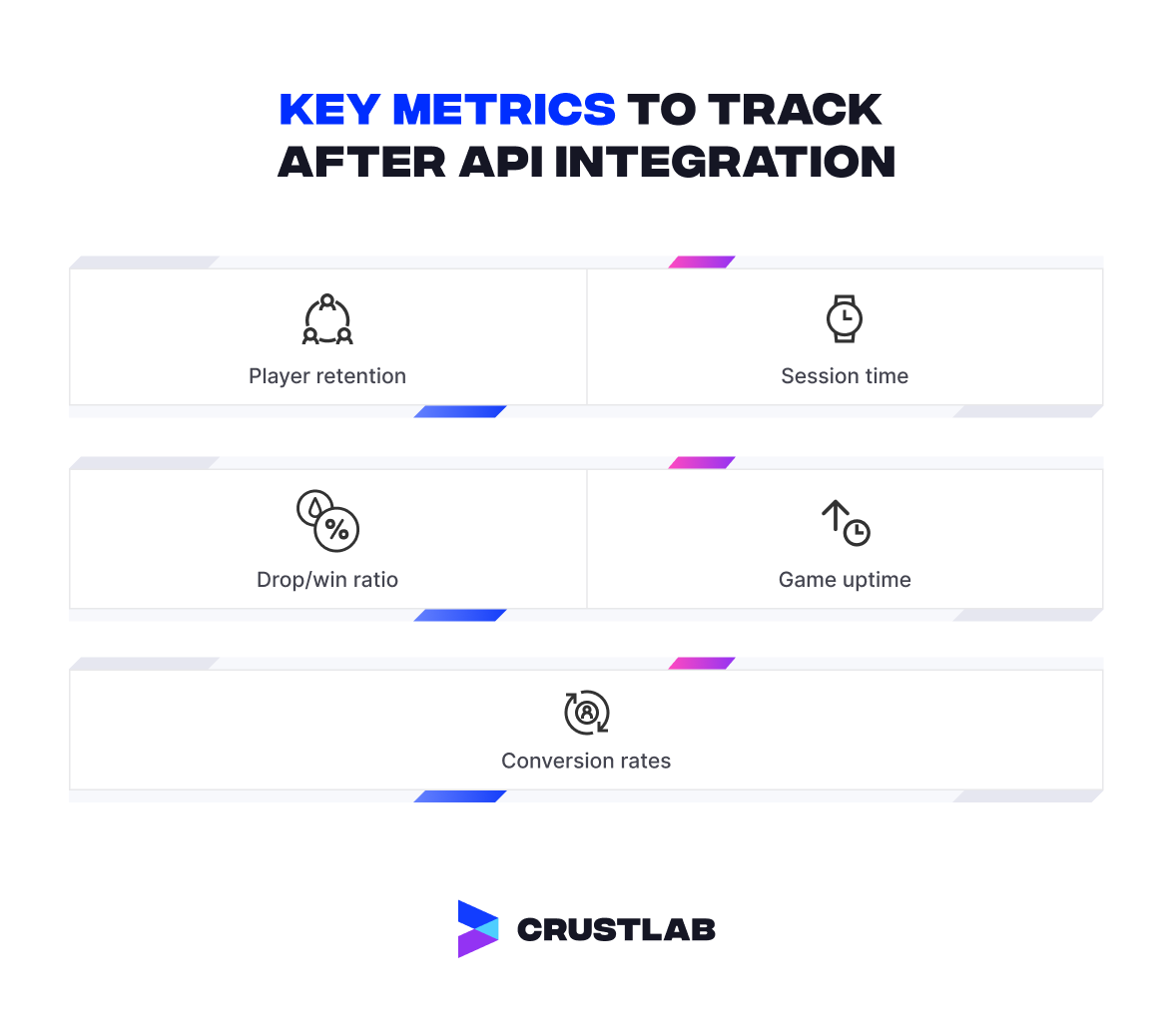
Key Metrics to Track After API Integration
After launching your live casino integration, it is important to monitor metrics that allow you to make targeted decisions to optimize your platform and increase ROI. Some of the important KPIs for operators to monitor post-launch include:
- Player retention: The player retention rate measures the percentage of players who return to the casino after their first visit. This metric demonstrates player satisfaction with their gaming experience on the platform.
- Session time: This is the average duration a player spends playing in the live casino lobby. Longer sessions indicate that the site has high engagement, leading to more revenue and profit in the long run.
- Drop/win ratio: This is the ratio of total money wagered by users to the amount paid out by the online casino as winnings. A significant deviation from this ratio is a potential indicator of fraud or technical issues with the platform.
- Game uptime: The game uptime is a technical metric that shows the percentage of time the integrated live casino games are available and functional. Monitoring downtime is important to rectify it early to prevent lost revenues.
- Conversion rates: The conversion rate shows how fast a live casino platform is gaining new players. This metric measures the effectiveness of your marketing efforts.
Building a Scalable, Compliant, and Engaging Live Casino Ecosystem with CrustLab
A successful live dealer casino doesn’t just offer players a collection of online casino games. It is a unified ecosystem with multiple components working together to handle payments, security, analytics, and several other operations. A successful live casino API integration also complies with regulatory standards and delivers an optimized user experience.
Building this level of technical excellence and navigating the regulatory landscape requires specialized expertise in iGaming development. By partnering with an experienced software development company like CrustLab, you ensure your integration is built to the highest industry standards. Get in touch with us today to get started.