Mastering Best Strategies for iGaming Payment Risk Management

- Transaction Fraud and Account Takeovers
- Multi-Accounting and Bonus Abuse
- Friendly Fraud and Chargebacks
- Anti-Money Laundering and Regulatory Risks
- Identity Verification and KYC/KYB Controls
- Device Fingerprinting and Behavioral Analytics
- AI/Machine Learning and Risk Scoring
- 3-D Secure, MFA, and Step-Up Authentication
- Chargeback Management and Representment Strategies
- Integrating Alternative Payment Methods (APMs) and Open Banking
- Managing Withdrawals and Instant Payouts Securely
- High-Risk Processing and Rolling Reserves
- Cryptocurrency and Digital Asset Payments
- AI, Automation, and the Future of Payment Security
Operators in the iGaming industry handle financial transactions worth billions of dollars annually. An industry that moves so much money is always a prime target for hackers, fraudsters, and other malicious actors. This is why payment risk management must be a top priority for anyone venturing into the iGaming business. Securing your payment systems is an essential step in iGaming development.
In this article, we will take a deep dive into how online casino businesses can manage payment risks. We’ll cover the most common payment risks faced by operators and the best strategies or standard practices for mitigating them.
- iGaming payment risk management refers to the measures that operators implement to identify, assess, and neutralize risks.
- iGaming industry payment processing risks are multifaceted. They include operational, financial, security, and compliance risks.
- A resilient iGaming risk management framework uses a multi-layer defense strategy.
- There’s a significant overlap between payment risk management and established compliance frameworks and industry-standard protocols.
Understanding the Core of iGaming Payment Risk Management
In iGaming, payment risk management refers to measures put in place to identify, assess, and neutralize factors that may contribute to financial stress on an iGaming platform. This includes everything from handling high-stakes payouts and flagging fraudulent transactions to keeping the casino’s revenue stream consistent.
Payment risk management is an important step in maintaining an online casino’s bottom line. Securing your payment systems prevents losses that may arise due to payment fraud, adverse betting patterns, or poor cash flow issues. It is also essential for compliance and responsible gambling purposes. Regulators expect gambling platforms to secure and monitor transactions and flag suspicious activities such as money laundering and terrorism financing.
For any operator venturing into casino software development, they must figure out the delicate balance between fraud prevention and maintaining smooth payment systems free from technical failures and service disruptions. The goal is to stop fraud without slowing players down or interfering with the gaming experience.
Types of iGaming Risks
The table below summarizes the most common types of payment risks faced by online gambling platforms.
| iGaming Risks | Definition |
| Financial risks | Risks that occur as a result of monetary exposure and fluctuations in liquidity |
| Operational risks | Reputational risks caused by disruptions in the casino’s daily operations due to bottlenecks or technical failures. |
| Security risks | Risks associated with site and transaction security. Mitigating this risk involves adequate fraud prevention and fortifying the casino against cyberattacks. |
| Compliance risks | This involves ensuring the casino’s compliance with regulatory requirements and responsible gaming laws. |
The Payment Risk Landscape in the iGaming Industry
Operators take on significant risk when they venture into the iGaming industry. The financial risks they face far exceed those encountered by many traditional businesses.
Casinos handle several transactions daily. The frequency of these transactions raises fraud risks significantly. Malicious actors have sufficient motivation to attack iGaming platforms due to the potential for huge rewards if successful.
The biggest platforms also have customers spread all over the world, which introduces complexities in transaction monitoring and compliance. Due to these risk factors, payment service providers often classify iGaming businesses as high risk. The following are some of the risks operators face when they venture into the iGaming business.
Transaction Fraud and Account Takeovers
Fraud and stolen identities are among the biggest risks faced by iGaming businesses. Malicious actors may take over other people’s bank accounts or use stolen credit cards to deposit funds on a gambling site. Fraudsters may also create fake identities to manipulate the payment system. In addition to the financial losses that the casino may incur, these fraudulent transactions can also damage the site’s reputation.
Multi-Accounting and Bonus Abuse
Online gambling sites use bonuses to attract new users and retain existing ones. However, a significant portion of the money spent on these marketing campaigns is lost to bonus abuse and fraud by fake accounts. A single individual could create multiple accounts using different email addresses and stolen identities. They may also use IP-masking tools or proxies to avoid detection. Instead of attracting unique users, the casino ends up wasting efforts and resources on bonuses, resulting in poor returns on investment.
Friendly Fraud and Chargebacks
iGaming operators get hit with chargebacks frequently. This happens when dissatisfied players dispute a transaction with their bank or card provider. In many cases, the customer ends up getting their money back even though it was a legitimate transaction. The loss of revenue isn’t the only reason casinos have to worry about chargebacks. When a player disputes a transaction, the payment provider still charges the casino for the transaction. They may also impose heavy fines or terminate the casino’s account entirely if the chargeback ratios exceed card network thresholds.
Anti-Money Laundering and Regulatory Risks
Casinos are typically subject to strict regulations, many of which relate to how they process transactions. Regulators try to prevent crimes, protect players, and ensure the integrity of the gambling industry in their jurisdictions by enforcing anti-money laundering (AML) and terrorism financing laws. Operators have the legal responsibility to enforce KYC, monitor transactions, and report suspicious activities. Regulatory non-compliance can lead to fines or even total bans from operating in a jurisdiction.
Building a Resilient iGaming Risk Management Framework
Given the high-risk nature of the gaming industry, operators employ a multi-layer defense strategy to combat financial risks and secure their platforms. Securing an online casino isn’t just about integrating a robust mobile payment gateway. This is just one step among several requirements. iGaming operators can build a resilient risk management system by combining various fraud detection tools with compliance workflows and data-driven decision-making.
Identity Verification and KYC/KYB Controls
Verification is a vital step in securing an iGaming platform. Regulatory authorities mandate online casinos to carry out ID, age, and address checks for all registered players on their platform. Casinos also prioritize this due diligence check because it helps them collect important data about the people who use their platform. While KYC applies to everyday users, KYB (Know Your Business) is just as important. It helps casinos verify the businesses they partner with in providing gambling services to players, such as software providers, processors, affiliates, and aggregator platforms.
Device Fingerprinting and Behavioral Analytics
Device fingerprinting involves creating a unique identifier for every device based on its characteristics, such as operating system, browser, time zones, IP address, or hardware configuration. This is essential for capturing the unique identity of individual users, even if they try to mask their IP with a VPN or use a proxy service. By establishing a distinct identity for each user through their device fingerprint, operators can tie user behavior data to specific users and analyze it effectively to spot patterns and generate insights.
AI/Machine Learning and Risk Scoring
AI and machine learning algorithms are already helping casinos build payment risk management systems that provide real-time monitoring and can proactively predict risks. These advanced systems use extensive financial data to analyze player profiles, betting trends, past transactions, and real-time payment information. These data points create a rule-based scoring system that can assess the legitimacy of transactions and flag unusual betting patterns or high-risk deposits/withdrawals for further investigation. These tools have proven effective for mitigating fraud, stopping money laundering, cyber threats, and other types of fraudulent transactions at scale. The system is adaptable, allowing operators to tailor thresholds based on their target audience and risk appetite.
3-D Secure, MFA, and Step-Up Authentication
On many casino sites and sportsbooks, players are prompted to set up multi-factor authentication to secure their accounts from illegal access. Individual transactions are further secured with security protocols like 3D Secure, which requires users to re-authenticate with a one-time password (OTP) during transactions.
While it might appear cumbersome, each extra layer of authentication makes things difficult for hackers. However, implementing multiple authentication methods can also affect the user experience if not done properly. Operators must make the authentication process as frictionless as possible. Helpful strategies include exempting low-risk transactions, providing multiple authentication options, and whitelisting trusted devices.
Chargeback Management and Representment Strategies
To avoid losing money due to chargebacks, operators must implement effective post-transaction defense measures for payment disputes. It is important to set up automated dispute alerts that instantly notify you when the acquiring bank contacts you to dispute a chargeback. You also need solid representation workflows with evidence of transaction history showing customer authorization. These mechanisms significantly improve your chargeback win rates.
Payment Orchestration and Fraud-Resistant Payment Flows
Payment orchestration refers to the process of connecting multiple payment providers into one streamlined solution for your gambling platform. This is important for online casinos since most iGaming businesses partner with multiple providers to process player deposits and withdrawals.
Operators need to intelligently manage, unify, and optimize the entire payment flow, which helps boost conversion while protecting the platform from fraud. They use dynamic routing algorithms to analyze transactions in real time and direct them to the most suitable payment service provider.
This mechanism is also beneficial from a fraud prevention point of view because the system routes transactions away from providers experiencing technical issues, poor security, or authentication challenges, boosting the chances of a successful payment.
The payment orchestration system also uses smart retries and other fallback strategies to mitigate failure by redirecting the transaction to a new provider if the primary PSP or acquirer declines the transaction due to a transient error or other factors.
Integrating Alternative Payment Methods (APMs) and Open Banking
Online casinos should aim for a well-orchestrated payment system that offers as much payment diversity as possible. Offering multiple payment methods (such as cards, wallets, and open banking) not only makes your platform more appealing to users but also significantly impacts authorization success and fraud rates.
Each payment method has unique benefits and downsides. While debit/credit cards are the most preferred method for many players, they carry a higher risk of chargebacks and fraud. Integrating alternatives like open banking provides users with stronger authentication and transaction security while reducing chargebacks for operators.
Managing Withdrawals and Instant Payouts Securely
Secure payment orchestration for online gambling platforms is a two-way system. In addition to facilitating secure deposits, operators must also pay attention to withdrawals. While everyone prioritizes speed, it must be balanced with regulatory and fraud control to avoid abuse or fraudulent transactions.
Sending money to the wrong account or inadvertently facilitating money laundering are among the biggest payment-related risks casinos face. Operators must ensure every payout is sent to a verified account, preferably in the account holder’s name. Every withdrawal must also undergo stringent AML checks before approval. Casino wagering rules and transaction limits can also reduce the risk of fraud.
Compliance, Licensing, and Global Regulatory Expectations
There’s a significant overlap between payment risk management and compliance frameworks established by regulators. Global regulatory standards, such as anti-money laundering (AML) laws and the Payment Card Industry Data Security Standard (PCI DSS), include directives on how operators should build their gambling platforms and handle payments.
Gambling licensing requirements from regulators like the Malta Gaming Authority or the UK Gambling Commission also include specific compliance requirements related to payment processing. Operators must comply with these requirements to obtain and maintain a license. The license serves as proof that the operator adheres to payment security standards, signaling to users that it’s safe to register and play on the platform.
Data protection standards such as the GDPR in Europe, along with other region-specific player protection laws, are also part of the regulatory expectations that standard operators are required to meet.
How these laws are enforced depends on the specific jurisdiction in question. In the EU, for instance, the GDPR is a regional law enforced by national authorities in each member country. In the United States, where gambling laws are more fragmented, individual states and federal bodies are responsible for licensing and enforcing specific requirements.
Affordability and Source-of-Funds Checks
Assessing how players fund their online betting habits is one of the most critical compliance steps casinos must implement. This involves carrying out comprehensive source-of-funds checks, especially for transactions flagged as high risk due to deposit size or other factors.
For high-risk transactions, the casino may ask players to provide direct evidence of their income and expenses (such as bank statements, play slips, or tax records) to verify their source of income. Carrying out affordability and source-of-funds checks is necessary for both responsible gambling and financial crime prevention. This compliance check helps protect the player from harm while shielding the operator from regulatory penalties.
PCI DSS and Data Security in iGaming
The Payment Card Industry Data Security Standard (PCI DSS) is a set of security standards guiding how companies process, store, and transmit credit card information. Encryption and tokenization are the primary measures used to safeguard sensitive payment data.
Fortunately, this is not something casino providers tend to worry about directly. Most providers outsource the handling of sensitive card data to certified third-party payment service providers or orchestration platforms. This approach effectively minimizes the iGaming operator’s PCI scope as well as their exposure to security risks and compliance costs.
Measuring Success: Key Performance Indicators and Reporting
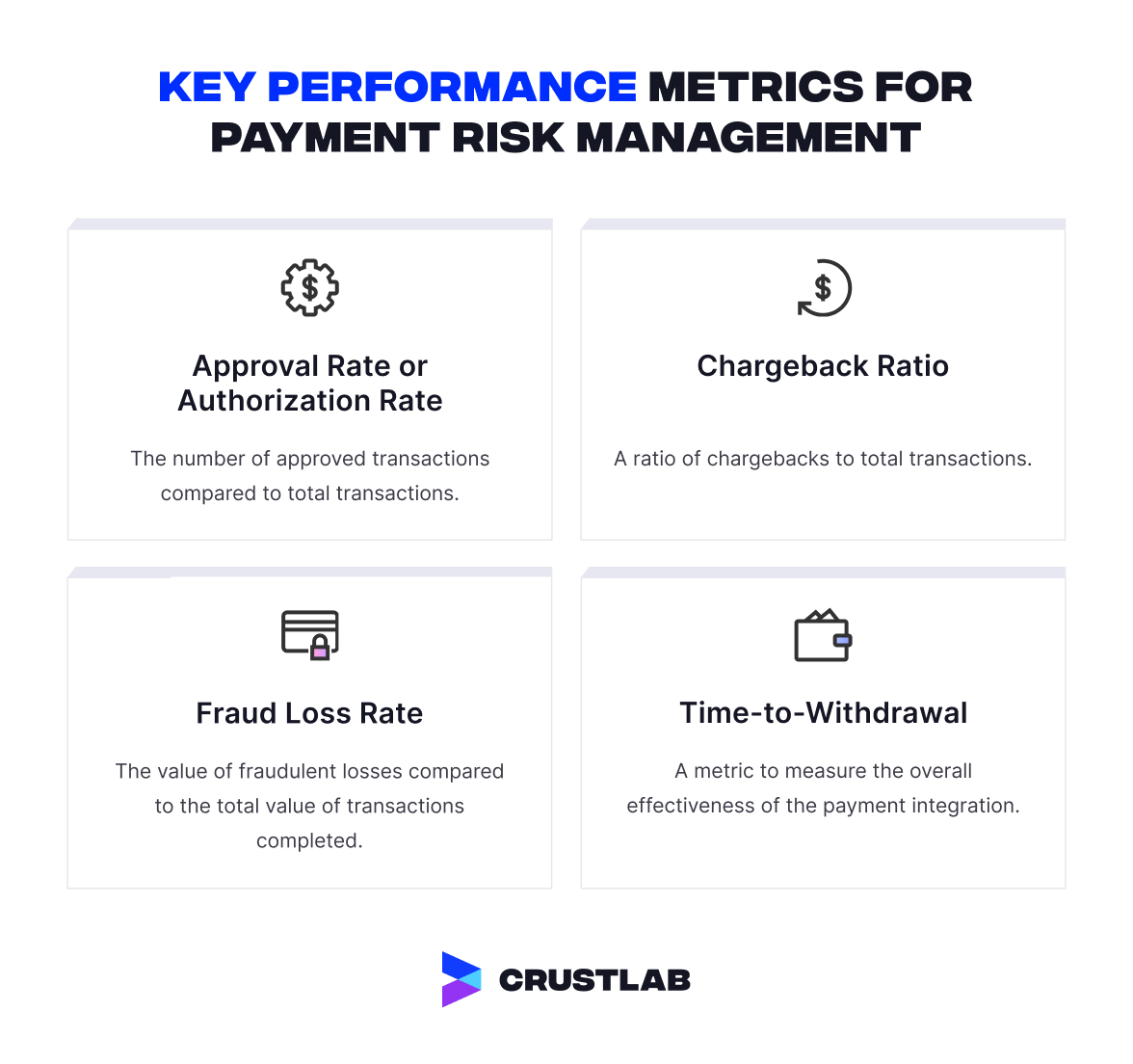
Payment risk management is measurable. Operators can track various metrics to evaluate their operational efficiency and assess how well their risk management and fraud prevention measures are working. These results can be compared to industry averages to gauge performance and make optimization decisions. Some of the most important metrics to track include:
- Approval Rate or Authorization Rate – This metric compares the number of approved transactions to total transactions to determine the effectiveness of the payment authorization workflow.
- Chargeback Ratio – The ratio of chargebacks to total transactions. If this exceeds the standard threshold, it might lead to heavy fines or an outright ban from processors.
- Fraud Loss Rate – This metric compares the value of fraudulent losses to the total value of transactions completed by the casino. You can compare this metric to the industry average to see how balanced your fraud detection controls are.
- Time-to-Withdrawal – While not a fraud detection metric, it measures the overall effectiveness of your payment integration. Faster withdrawal times improve user satisfaction, but speed must never come at the expense of security.
Analyzing Cost per Accepted Payment
The Average Cost per Accepted Payment (CAP) is an important metric used to measure the true cost of processing a transaction successfully. The CAP provides a clear view of what a casino is spending on each transaction, which is vital for budget optimization.
The CAP compares the total cost to the number of accepted payments. The total cost incorporates all expenses a casino incurs in processing a payment, including processing fees, operational overhead, and fraud costs.
Calculating CAP can help identify the biggest cost centers in transaction processing so you can optimize accordingly. It is also possible to calculate CAP for different payment methods. Casinos can use this data to identify the most cost-effective payment methods and prioritize them.
Monitoring Risk Model Performance
Operators rely on rule-based or AI-powered risk models to provide an objective, real-time assessment for every transaction or user action. As a core component of your payment risk management system, this model should be constantly monitored and periodically optimized.
To assess the fraud detection model’s accuracy, metrics such as precision, recall, and false positive rates can be used to measure the effectiveness of the model’s assessments against actual transaction outcomes. Since fraud patterns constantly evolve, the model needs a feedback loop and ongoing tuning to keep up with new fraud tactics.
Organizational Alignment and Risk Operations
Although managing payment risks relies heavily on technology, that is only half the battle. The people component is vital as well. As part of your payment risk mitigation efforts, you need to improve operational efficiency by strengthening internal collaboration between your product, compliance, risk management, and payment teams. The effectiveness and alignment of the cross-functional processes linking this team will determine the overall efficiency of your risk management operations.
Vendor and Technology Partner Selection
Selecting the right partner is an important criterion in securing your payment management system. A typical payment processing workflow involves multiple stakeholders such as payment service providers, data providers, vendors, and others. Each represents a potential point of failure with catastrophic effects if compromised. Before selecting a vendor partner, evaluate the effectiveness of their technology by investigating metrics like coverage and uptime. You also need to determine the quality of support you can expect in cases of failure. Finally, the right payment provider will align with you regarding regulatory compliance and player protection.
Incident Response and Continuous Improvement
Regardless of your best efforts, incidents and failures are almost inevitable. A crucial aspect of your organizational readiness for risk management is having a structured approach to managing adverse incidents such as fraud, hacks, system outages, and regulatory inquiries. Having a plan for failure helps maintain operational resilience. Some best practices to keep in mind include:
- Integrate automated systems for real-time monitoring to detect and report incidents immediately when they occur.
- Establish effective risk management tools and standard countermeasures for immediate remediation of common problems such as disabling vulnerable channels, blocking suspicious IPs, switching PSPs, and so on.
- Initiate remediation protocols right away.
- After every incident, carry out a comprehensive review to identify points of failure and optimize processes.
- Maintain a clear audit trail for all activities.
- After the event has been investigated, refine policies and make necessary changes.
Market Differences and Future Trends in iGaming Payments
The iGaming industry is dynamic. Things are rarely uniform across different markets, regions, and jurisdictions. Not only does consumer behavior vary widely, but regulators also have different rules specific to local conditions within their respective jurisdictions.
For instance, the US, EU, and emerging markets differ significantly in how they define acceptable methods for handling chargebacks, anti-money laundering, and player protection standards. Consequently, your knowledge of how to integrate a PSP or how to create a payment gateway in one market doesn’t necessarily carry over to others. This is why operators need to implement a highly localized risk-mitigation strategy for every market they intend to operate in.
High-Risk Processing and Rolling Reserves
Card networks and payment processors classify the online gambling industry as high risk. This is unsurprising considering the high-risk liabilities operators face, such as chargebacks, fraud risks, and regulatory fines.
To manage these potential financial liabilities, payment processors often impose stricter terms on iGaming businesses. One such term is the imposition of higher rolling reserves on iGaming merchants.
When a payment processor facilitates transactions for an iGaming business, they typically hold a percentage of the transaction volume in a non-interest-bearing account for a specific period. The funds are released over time to the operator on a rolling basis. While it is common for processors to set a high rolling balance, this practice is not healthy for cash flow management. Here are a few tips to help negotiate favorable rolling reserve rates:
- Present data to prove that your business is low-risk (such as your low and stable chargeback ratio).
- Negotiate a tiered model where the reserve rate drops gradually over time based on performance.
- Establish relationships with multiple payment service providers to find the most competitive deals.
- Treat reserved funds as non-liquid assets. Don’t rely on them as part of your cash flow.
Cryptocurrency and Digital Asset Payments
Cryptocurrency is an emerging trend in the casino payments space. Many operators are just beginning to understand how a crypto payment gateway works and other important details about this payment method. As they learn to implement this novel payment system, they also need to understand the compliance and risk management implications.
Integrating the best cryptocurrency payment gateway into your platform offers several risk management benefits. Cryptocurrency facilitates near-instant, low-cost, and fraud-resistant payments with no risk of chargebacks. These attributes explain why this payment method is gaining traction among casino operators.
However, cryptocurrency remains a gray area in many locations. Jurisdictions like Malta, Gibraltar, and certain US states allow it under specific regulatory frameworks, provided the operator and Virtual Asset Service Provider (VASP) adhere to KYC and Travel Rule requirements.
AI, Automation, and the Future of Payment Security
The future of payment security will be AI-driven in many ways. Given current technological trends, AI and machine learning will likely play major roles in analyzing data, building models, and helping operators predict the risk associated with individual transactions.
AI-powered automation is already being used to automate manual payment security workloads and improve efficiency. Another emerging trend is AI-driven continuous authentication (CA). This approach involves analyzing a user’s behavior throughout a session and triggering additional authentication if their behavior deviates from the established norm.
Experts also predict that network consortium data sharing will become popular. Future AI-powered risk assessment models will not rely solely on local data within a platform but will use pooled, anonymized data from multiple merchants and financial institutions.
Conclusion: Turning Risk Management into a Competitive Advantage
Risk management is a common challenge every operator in the iGaming industry must face. The implication is that anyone who implements a mature, adaptive payment risk framework gains a competitive edge.
This is why operators must look beyond simply checking a compliance box or avoiding lost revenue. Effective risk management helps build trust and optimize the gaming experience for your target audience, which is vital for customer retention.
To learn more about elevating payment risk management to a core business strategy, partner with an iGaming platform provider and software development company that understands the complexities of risk management.