Understanding How Live Casinos Work. Your Live Casino Business Guide
With the world going digital at such a rapid pace, one might think that good old-fashioned brick-and-mortar casinos have gone out of fashion. However, the appeal of Vegas-style casino gaming remains enduring. Although many people now prefer to play games on their phones and computers, some still yearn for the thrill and excitement of playing in a physical casino.
This segment of the gambling market is a viable opportunity for anyone looking to enter the online gaming business. With live casino gaming, operators can give punters the best of both worlds – the convenience of online gaming and the excitement of real-life gambling. In this article, we’ll take a deep dive into the world of live casino gaming, providing a comprehensive business guide for anyone considering starting a live casino software business.
- The live casino gaming business is a viable niche for operators looking to enter the iGaming business.
- Live casino gambling involves offering table games and game shows managed by real human dealers from specially set-up game studios.
- Live casino game providers have to set up studios with equipment to capture video, convert gaming action to data, and stream videos to players in real time.
Introduction to Live Casino Business
Live casino gaming is a segment of the online casino industry with great business potential. This niche of the iGaming industry involves providing players with games hosted by real dealers on an online platform instead of computer algorithms. Many online casinos now have whole sections dedicated to these live dealer casino games, and some casino software development companies specialize in creating and supplying these games to online casinos.
What Is a Live Casino?
A live casino is a type of online gambling solution that combines video streaming technology with the human touch of traditional casinos. These online casinos typically have real card or table games hosted by professional dealers or croupiers streaming from a specially set-up studio or a real-life casino.
Gamblers can join these live dealer casino games for real-time action on their phone or computer. They can place bets, watch the dealers do their thing, and have fun interacting with other users while playing like they would in a real casino.
Unlike RNG-controlled games, where everything is controlled by a programmed computer algorithm, a live casino game has real people on the other side. It offers the convenience of online play while still giving players the authentic feeling of stepping into a real-life land-based casino.
How the Live Casino Model Works
A live casino gaming model relies on a combination of technology and human interaction. Here’s a breakdown of how this model delivers an authentic casino experience to players online.
Real Dealers
A live casino game has a professional human dealer managing the game in real time. The croupier deals the cards, spins the roulette wheel, or performs any other action needed for the game to progress. Players can also interact with this dealer via live chat.
Gaming Environment – Studio/Casino Floor
A live dealer online casino game is streamed live from a specially set-up environment. A high-tech broadcast studio is the most common, but some game providers use a real land-based casino to replicate the true Vegas feeling. The studio has cameras set up to capture all the action from multiple angles.
Processing Player Bets
Each table in a live dealer casino game session is fitted with a Game Control Unit. A player connects to this GCU remotely when they join live gaming action. This live casino integration processes the user’s actions and reflects them in real time with near-instant synchronization for a seamless gaming experience. Optical Character Recognition (OCR) technology is also used to capture physical actions at the table and transmit the digital data.
Streaming Technology
Players receive a live video feed of all the action on their device as they play. This happens in real time, with advanced technology ensuring that there’s no lag or delay in data transmission from the server to the gaming platform’s user interface.
The Global Live Casino Market Size and Growth
Online gambling has never really been able to match the immersiveness and excitement of real-life gambling. But with live gaming gradually matching up thanks to advances in streaming technology, the size and revenue potential of this niche of the iGaming industry is growing at a rapid pace.
According to a recent study, the global live casino market size reached $11.8 billion in 2024, demonstrating the massive surge that the niche is currently experiencing. Experts project that the market will continue to grow at a CAGR of 12.6% from 2025 to 2033. Based on this forecast, the industry will be worth about $34.2 billion by 2033.
A more conservative projection expects that the industry will be worth $27.7 billion in 2034. Regardless of what projections say, live gambling is obviously one of the fastest-growing iGaming development segments. The growth of this niche is driven by various factors, including the enhanced user experience that live casino gaming offers.
How Live Casino Businesses Make Money – Revenue Streams
Operators and B2B providers in the live gambling niche make money in different ways. Some of the most common monetization structures are explained below:
- Revenue share: The B2B provider and online casino operator may share the gaming revenue generated by players playing games on the live gambling platform. The revenue is shared based on a predetermined percentage that has been agreed upon by both parties.
- Fixed monthly fees: The live casino software provider may charge operators a specific fee to be paid monthly. This cost is fixed, so both parties can conveniently plan their revenue and budget for the month regardless of how much traffic their platform generates.
- Hybrid agreements: In some cases, operators and game providers may implement a hybrid agreement where they both share revenue and pay a small monthly fee for platform maintenance and other services.
Understanding Player Lifetime Value, Game Margins, And House Edge
These metrics are all essential parts of game economics that operators looking to go into live casino gaming must understand. The lifetime value of a player refers to the total net profit that a casino expects to earn from that player over the entire duration of their relationship. Players with a high lifetime value are important to online casinos because the bulk of the site’s revenue comes from them.
To guarantee a casino’s profit, live gaming platforms build a statistical advantage into every game. This is known as the house edge, and it represents the percentage of the total wagered amount that is returned to the casino. The house edge varies for each game. However, games with a high house edge tend to be more profitable for the casino. Live dealer games often have a relatively low house edge, but the high volume of play typically makes up for this low house edge.
Cost Factors
A live casino platform will spend money on several things to deliver games to players. Unlike RNG games, where the algorithm controls and automates everything, a live gaming infrastructure has many moving wheels that you have to pay for, including professional dealers, technology infrastructure, location cost, and so on. The game margin is a figure that shows the difference between these cost factors and the revenue generated by a game.
Key Live Casino Software and B2B Providers in the Live Casino Industry
The live dealer games ecosystem depends on live casino software providers that set up game studios and stream games live to gambling platforms. Some of the best casino software providers in this niche of the iGaming industry include:
Evolution Gaming
Evolution Gaming is one of the older live casino software providers in the business. It was established as far back as 2006 and currently has over 700 tables in its portfolio, including some of the most popular casino games. The provider has game studios in America, Canada, Malta, Brazil, and the Philippines. In addition to offering traditional games like blackjack, poker, and baccarat, Evolution Gaming also came up with innovative live dealer game shows like Crazy Time, Monopoly Live, and Lightning Roulette, known for their highly engaging gaming experiences.
Playtech
Playtech is another live casino software provider that has been in the industry for decades. The game studio was established in 1999. Playtech supplies both RNG and live dealer games, with a portfolio of over 300 tables, focusing on live blackjack, roulette, and baccarat. Playtech’s state-of-the-art live gaming studios are located across Europe, North America, and Latin America.
Pragmatic Play
Pragmatic Play is an international live casino software provider with a vast selection of iGaming titles. The studio’s portfolio includes slots, bingo games, virtual sports, and over 100 live dealer tables. Pragmatic Play’s games are known for their multi-lingual and multi-currency support. Pragmatic Play live table games are streamed from studios in Romania, Bulgaria, Austria, and Colombia.
Ezugi
Ezugi is a casino software provider that builds multi-platform solutions for casino operators. Established over a decade ago, this game studio is now owned by Evolution Gaming. The company’s portfolio includes traditional live dealer games as well as new-generation games like Ultimate Roulette, Ultimate Andar Bahar, and Video Blackjack, among others. Ezugi broadcasts games from a casino in Cambodia. The company also has studios in Romania, Bulgaria, Latvia, Malta, and the United States.
OnAir Entertainment
OnAir Entertainment is a relatively new casino software provider compared to the others on this list. This game studio was established in 2020 with a focus on providing live dealer casino games and other interactive gaming experiences for operators in the iGaming industry. The company is focused on regulated markets in Europe, with studios in Latvia, Georgia, and Spain.
Imagine Live
Imagine Live is another modern game studio focused on live gaming and interactive entertainment. The company has only been in business for about three years, which is why it only has a small portfolio of about 15 tables. Some of the top games by this software provider include live blackjack, roulette, baccarat, and dynamite roulette. Imagine Live operates its dedicated studios for operators in Romania, Armenia, Georgia, and Belarus.
CrustLab
CrustLab is a software development company that specializes in creating bespoke and end-to-end solutions for operators, including those in the gambling industry. The company has expertise in building casino platforms, custom games, sports betting systems, and other iGaming solutions. Unlike the others on this list that focus on providing ready-made content, CrustLab focuses on custom software development, including creating scalable live gaming platforms.
Licensing and Regulation of Live Casino Operations
Across most jurisdictions, operators and game providers in the live gambling space are required to hold a valid license. In fact, they often face more regulatory scrutiny compared to other segments of the industry due to the high-stakes and real-time nature of live dealer games.
In some jurisdictions, such as Malta and Curacao, a single iGaming operator offers multiple “gaming verticals,” including live casino services. However, in some places like the UK, operators must obtain a specific remote gambling license which permits them to offer online casino games, including live gaming services to players.
In the United States, regulated states like New Jersey, Michigan, and Pennsylvania require operators and live studio providers to get state-specific licenses and approvals to launch legally and provide their services to Americans.
Importance of Local Permits
Live gambling platforms are highly vulnerable to money laundering, fraud, and other illegal activities. Games are fast-paced, and high-value transactions are common. This is why local licensing is essential in this niche of the industry. A license confirms an operator’s ability to implement procedures that protect players against illicit financial activities.
Technology Behind Live Casino Streaming
A live online casino business requires significant technical infrastructure. Live gaming software providers have to set up studios with various equipment to capture video, transmit it to users, and capture and transmit data both ways. The following are the major technological requirements for live streaming:
- The live studio setup typically includes live gaming tables. Multiple camera systems are also set up to capture the dealer and gaming action from various angles. A standard studio setup includes lighting and sound to ensure video clarity and capture the dealer’s voice.
- Optical Character Recognition (OCR) technology is used to convert video streams into digital data that users can see on their devices. For instance, if the dealer draws a King of Spades, the OCR system reads the symbol and displays the King of Spades digitally on the player’s screen.
- The captured video feed is encoded and distributed using specialized protocols designed for speed and reliability, such as WebRTC and CMAF. Live streams are routed through a global CDN to distribute the video content quickly and efficiently to players regardless of their geographic location. This minimizes regional latency issues, ensuring fairness for everyone.
- Each table has a Game Control Unit (GCU) that will scan and decode game data in real time.
- Some studios also have a central admin module that oversees game activity and ensures gameplay.
The Product: Types of Live Casino Game Shows and Entertainment
Live casinos try to replicate the physical casino experience by offering games you’ll typically find on a regular casino floor. Some of the player-favourite games commonly offered by live providers are listed below.
Classic Table Games
- Live roulette
- Live baccarat
- Live poker
- Blackjack
- Dragon tiger
Modern Innovations
- Game shows like Monopoly Live or Crazy Time
- Dice Games such as live Sic Bo
- Hybrid RNG/live experiences such as Lightning Roulette
How Casinos Diversify Their Offerings
To attract specific audience segments and differentiate their brands from others, operators may explore all kinds of customization and unique product offerings. Some common strategies include:
- Dedicated tables staffed by dealers who speak specific languages
- High-limit VIP tables with higher minimum bets
- Branded tables
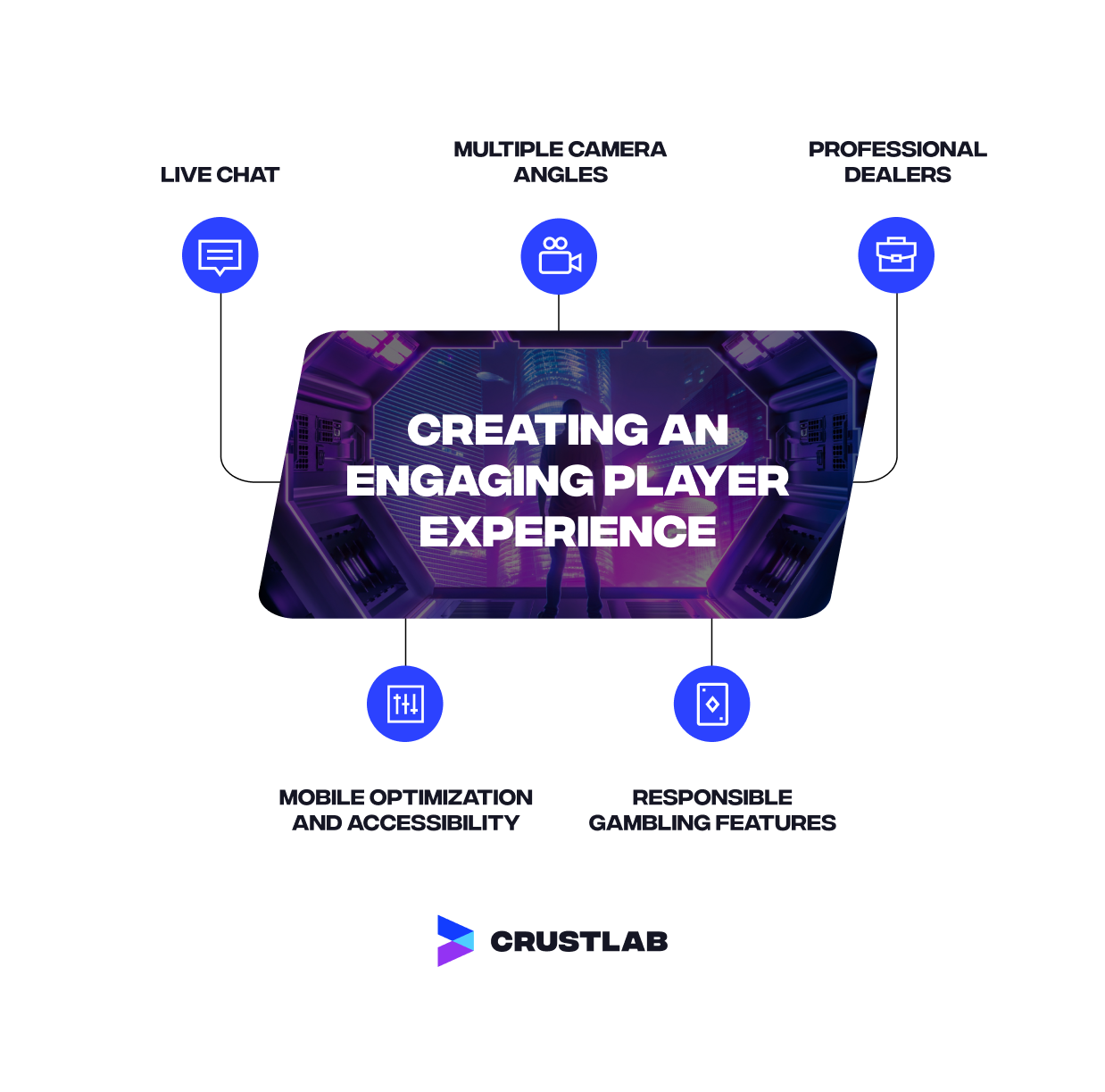
Creating an Engaging Player Experience
Live gaming isn’t just about playing table games online. It’s a complete experience meant to be as interactive as possible. The thrill and realistic experience is the main appeal of this type of gaming. The following are some of the ways live casinos drive engagement and user interaction in live dealer casino games.
- Live chat: Human interaction is one of the main reasons players enjoy spending time in real-life casinos. Operators try to replicate this in live dealer casino games with the chat function. This allows users to interact with the dealer and other players as they enjoy their game.
- Multiple camera angles: Live studios install cameras that show the game from multiple angles. This is important for transparency, but also helps to bring players as close to the action as possible.
- Professional dealers: A major distinction between live and RNG games is that live dealer casino games have real dealers managing them. These are typically professionals trained to coordinate the game effectively while also engaging with players actively.
- Mobile optimization and accessibility: Live casinos are accessible on mobile devices like smartphones and tablets. These platforms have a responsive design that allows them to work seamlessly across various devices and operating systems.
- Responsible gambling features: The best gambling platforms don’t just offer live dealer games. They try to balance user experience with compliance by providing features that help players gamble responsibly. Examples include session or deposit limits, reminders, and self-exclusion.
Payment Options, Security, and Risk Management
A live casino typically takes high transaction volumes. Unlike slots, the table games in live casinos have high limits, which means players get to spend more money. Consequently, payment processing is an essential step in setting up a live casino business. Here are some of the major payment setup requirements.
- Payment gateways: A live casino requires a payment gateway integration. This technical service processes online payments for the casino operator. They’re a bridge between the casino and the user’s bank.
- Card processors: A card processing service handles transactions made through traditional card payment options such as Visa and Mastercard. While many users now seem to favor alternatives like e-wallets and crypto, card payments are still quite popular.
- Wallets: Digital wallets such as PayPal, Skrill, and Neteller are extremely popular on online gambling platforms, including live casinos. They are faster and generally more convenient compared to traditional options. Players also love them because they’re secure.
- Open banking options: Services like Trustly leverage open regulations (like PSD2 in the EU) to allow players to initiate instant deposits and withdrawals directly from their bank accounts using their bank’s secure login credentials.
How Operators Manage Fraud Risks
Live gambling, like other forms of casino gaming, is prone to fraud risks. As a result, operators have to find a balance between providing players with convenience and protecting them from fraud. Fraud protection is also essential for regulatory and compliance reasons.
Know-Your-Customer verification is a mandatory process on any live casino platform. Players have to submit identification and contact data, such as their government-issued ID card, proof of address, and other related documents. This helps to prevent underage gambling and fraud.
Live casino operators must also have systems in place for continuous monitoring of transactions on their platform. This helps to detect, prevent, and report potential illicit financial activity. Some of the red flags that this system catches include unusual transaction sizes, rapid deposits with minimal play, followed by large withdrawals.
Marketing Strategies for Growing a Live Casino Business
Marketing is an important step in growing a live dealer casino business. Operators can leverage various digital marketing channels for player acquisition. They also need to prioritize personalized engagement and bonuses to retain the players they attract.
Player Acquisition Through Digital Marketing
Live casinos can attract new players through various digital channels. Some of the most popular strategies include:
- Search Engine Optimization (SEO): Operators can drive traffic to their website by optimizing it for high-intent keywords related to their niche, such as “live blackjack online,” “best live roulette bonus,” and so on. This gets them high-quality organic traffic.
- Affiliate Marketing: Casinos often partner with affiliate sites and casino review platforms, compensating them through a revenue share or CPA model.
- Paid Acquisition (PPC & Social Media Marketing): Running targeted ads on search engines, social media, and other channels can help live casinos with visibility and player acquisition.
Player Retention
- Bonuses and loyalty programs: In addition to welcome bonuses meant to attract new players, live casinos can also use ongoing promotions and Tiered loyalty programs to offer continuous rewards to players so they can keep playing.
- CRM automation: Casinos can integrate a customer relationship management software into their marketing workflow. This system uses data to segment users based on their behavior and delivers personalized marketing messages to them.
Compliance With Advertising Restrictions In Regulated Markets
The gambling laws in regulated jurisdictions often include guidelines for marketing and advertising. Regulators like the Malta Gaming Authority and the UK Gambling Commission prohibit operators from including certain words or messages in their ads. This typically includes words that exaggerate winning chances or imply that gambling is a guaranteed source of income.
Some countries even ban licensed casinos from signing up celebrity influencers to advertise their services. All promotions must also carry clear, prominent responsible gambling warnings and helpline information to protect users.
Measuring Success: KPIs and Analytics
After setting up your live dealer games platform and marketing it accordingly, you need to consistently monitor how well it performs. This is achieved by analyzing data and measuring key performance indicators that can provide insights into player behavior, engagement, and the overall health of your business. Some of the most important metrics to track include:
- Player retention: This metric measures the percentage of players who return to play on the casino site over a given period. A high retention rate shows that players are satisfied with the immersive experience that your live casino offers.
- Session length: The session length measures the average amount of time a player spends on the platform per visit. The goal is to get players to stay for as long as possible. This is an indicator that shows if players are getting high engagement and enjoyment on the platform.
- Average bet size: The average bet size shows the average amount a player wagers in each round they play. This metric is useful for segmenting players into casual or high-rollers for effective marketing.
- Churn rate: The churn rate measures how fast your casino platform is losing players. A high churn rate shows dissatisfaction with your service. This can be due to various factors, including poor UX, unappealing games, or technical issues.
Challenges and Risks in the Live Casino Industry
The live casino gambling industry faces a number of risks and challenges. Operators looking to venture into this niche of the gambling industry must be aware of the regulatory hurdles, technical challenges, and other issues they might likely face. Some of the biggest risks with this business are listed below:
- Regulatory uncertainty
- Payment friction
- High operating costs
- Shortage of high-quality dealers
- Technology failure
Strategies For Mitigating Challenges
The following strategies can help you minimize these risks and their potential impact on your business:
- Get licenses in multiple jurisdictions to diversify and enjoy operational stability if one market faces abrupt regulatory restrictions.
- Operate multiple live studios in different countries to avoid disruption.
- Implement full technical redundancy (backup servers, dual internet connections, UPS systems) and 24/7 proactive monitoring of latency and video quality.
- Integrate multiple payment service providers so players can always have alternatives when one option fails.
Future Trends in the Live Dealer Casino Business
The live casino industry relies significantly on technology, and this leaves significant room for innovation and evolution as new advances in technology are introduced. In the coming years, we’ll likely see technological advancements in the following areas:
Mixed-reality Gaming
By blending advanced graphics engines, virtual and augmented reality engines, live dealer casino game providers will be able to create immersive mixed reality experiences. These will be characterized by ever-changing digital backdrops, themed tables, and other elements that enhance live gaming experiences for players.
AI-assisted Dealers
Given the current trajectory of artificial intelligence, we can expect this technology to find some use in the live gaming niche. AI will provide dealers with real-time cues and data, leading to better-optimized experiences.
Personalized Camera Views
Instead of the generic multi-camera view that we see today, live gaming may evolve in the future to potentially allow players to select personalized camera angles or focus points not available to other players. This will help tailor the video stream to their preferences.
Content Differentiation
To keep up with growing competition from other providers venturing into the industry, operators of live gaming services may have to look beyond simply offering generic-like games to more exclusive or locally resonant content: Operators may consider deploying smaller, dedicated “micro-studios,” especially in highly regulated markets. These studios may offer personalized services, native-speaking dealers, or locally popular game variants for regional audiences.
Changing Regulations
Regulatory requirements are a major factor that drives evolution in an industry as tightly controlled as live gambling. Regulators may introduce new rules focused on player safety and potentially limiting features known to exacerbate risk in gameplay.
How to Choose the Best Live Dealer Casino Games Software?
For any operator looking to venture into the live casino business, selecting a casino software provider is an essential step. Gaming software providers are not created equal, which is why you must carefully consider your options to choose the most suitable providers. Some of the factors to consider when selecting a suitable live gaming partner for your business are listed below:
- Go for a provider with significant industry experience
- Consider the quality of the provider’s technical team and their ability to provide advanced feature integration
- Strong ties with reliable third-party providers can be beneficial
- Read reviews to determine the provider’s reputation and learn if there are potential issues to watch out for
- Enhanced security and transparency features
How to Start Your Own Live Casino Business
As an operator or entrepreneur looking to venture into the casino gaming industry, knowing where to start can be a little daunting. Below is a step-by-step guide on how to start an online casino business in the live gambling niche.
- Market research: Carry out market research to understand the business landscape in your target market. This will give you a clear picture of what the competition looks like, the nature of regulations, and the preferences of users who will be playing your games.
- Budget planning: Identify the major expenses that you’ll likely incur in setting up your gambling business and plan accordingly.
- Licensing: Choose a licensing jurisdiction based on your target market, budget, and business requirements. Learn about the licensing requirements and set plans in motion to get started.
- Selecting a software provider: A strategic partnership is an essential step in setting up an online casino business. Look for the right software providers that fit your unique business requirements.
- Integrating games: Set up your live gaming platform and integrate the games. You may consider a partnership with a game aggregator platform for seamless access to all the games you need in one place.
- Setting up payment systems: Integrate a secure payment gateway to handle transactions. It’s always recommended that you offer multiple options to provide variety to players and maximize deposit success.
- Compliance: Implement all the technical and non-technical tools needed to maintain compliance, such as mandatory identity verification and continuous monitoring systems to prevent fraud or money laundering.
- Launching with a marketing plan: Finally, your platform is ready to launch. Implement a multi-channel marketing strategy to attract users and retain them.
Building a Sustainable Live Casino Operation with CrustLab
CrustLab is a software development company that can help you build a sustainable live casino business. We specialize in custom software development, with domain experts who have specific experience in setting up gaming platforms. Our industry experience also allows us to provide tailored advice and recommendations for licensing, marketing, and other aspects of setting up your business.
We deliver end-to-end iGaming solutions, including intuitive UI/UX design for your platform, seamless third-party integration, player account management features, and payment gateway integration, among other services. Set up a modern, immersive platform with the help of our expert developers. Contact CrustLab today to learn how you can start offering players their favorite games.
FAQ
Instead of the automated RNG-controlled games in regular casinos, a live casino has games hosted in real time by real human dealers, streamed live from a game studio.
The cost of starting a live casino operation can vary widely. It ranges from as low as $200,000 all the way up to over a million dollars. Some of the major expenses include obtaining a license, developing the core software, integrating live content, and marketing.
The legal requirement for a live casino platform is the same as that of a conventional iGaming platform. However, some jurisdictions may include specific requirements for live gaming. Licensing conditions depend on the jurisdiction you’re registering in.
Yes. Owning a casino is a potentially profitable business. The house edge of casino games ensures that the casino makes a percentage of all player bets over time. However, how much profit you make depends on how well you can attract and retain players.