How Bookmakers Generate Odds? Sports Betting Odds Explained

- Betting Lines
- The Three Main Types of Odds (Decimal, Fractional, American)
- Understanding Implied Probability and True Probability
- Bookmaker Margin (Vig, Juice, Overround) and How It Works
- Odds Compilers and Traders: The People Behind the Numbers
- Using Historical Data, Statistics, and Predictive Models
- Market Benchmarking and Price Copying from Major Sportsbooks
- Risk Assessment and Exposure Management
- How Opening Odds Are Created
- Impact of Betting Volume and One-Sided Action
- Sharp Money: Why Professional Bettors Move Markets
- Breaking News, Injuries, and Game-Day Information
- In-Play Betting: Real-Time Odds Adjusted by Algorithms
- Balancing the Book and Minimizing Exposure
- House Edge Through Margin Rather Than Prediction
- Bet Limits, Payout Caps, and Other Risk Tools
- Moneyline Markets (Winners and Simple Outcomes)
- Point Spread and Handicap Markets
- Totals (Over/Under) Betting
- Player Props and Game Props
- Futures Markets and Long-Term Uncertainty
- Horse Racing Odds: Fixed Odds vs. Pari-Mutuel Pricing
- Odds Feeds, Data Providers, and Real-Time Market Synchronization
- Bookmaking Software, Algorithms, and Automated Risk Tools
- Pay-Per-Head (PPH) Services for Small Bookmakers
- Layoff Betting: How Bookies Hedge Their Own Risk
The concept of odds and probabilities is one of the central ideas in gambling and a key part of sports betting software development. Odds are primarily used to assign probabilities to outcomes, but they also determine how much players can win on a bet. The odds of an event will also influence how much profit bookmakers make from players.
Have you ever wondered how exactly sportsbooks calculate all the odds displayed on their sites? In this article, we’ll explore the concept of odds setting to determine how bookmakers calculate odds for different types of betting markets, how odds move, and how bettors can leverage this knowledge to their advantage.
- Odds are a mathematical representation of the bookmaker’s estimation of the likelihood of an event outcome.
- Bookies set odds by combining statistical probability with a built-in margin (vig) to ensure long-term profit regardless of the event outcome.
- Sports betting odds are constantly adjusted to reflect market sentiment, manage risks, and balance betting action.
- Modern odds setting relies heavily on historical data, real-time information, and third-party data providers, with proprietary algorithms overseeing risk and price accuracy.
What Are Bookmaker Odds and What Do They Represent?
Bookmaker odds are a mathematical representation of the likelihood of an outcome occurring in a sports event. They come in different formats (decimal, fractional, or American), but they all communicate the same thing: the implied probability of an outcome such as a win, loss, or draw.
In addition to expressing the likelihood of a specific outcome, sports betting odds also show how much risk a bettor is taking by making that bet and their potential reward if their prediction is correct. But betting odds don’t just express probabilities and payouts. Bookmakers adjust the odds to express market sentiments too. They also add a small margin to each odd to guarantee profit. Bookmaker odds are constantly adjusted in real time based on live match data, news, and shifting sports betting trends to ensure their prices remain competitive yet profitable.
Betting Lines
A betting line is a number set by a bookmaker to represent the expected outcome of an event. This line serves as a reference point for punters looking to bet on the event. It is also used to calculate the player’s total payout if the bet is successful. While odds tell you how much you can win, a betting line is a numerical “handicap” or threshold set by a bookmaker to level the playing field between two teams.
The moneyline is the most fundamental type of betting line, which involves simply picking a winner. However, to make a game more competitive and exciting, sportsbooks introduce other betting lines such as point spread lines and Over/Under totals.
The Three Main Types of Odds (Decimal, Fractional, American)
Bookmakers express sports betting odds in different ways. Although every odds format is meant to show the same thing (the likelihood of an outcome and potential payout), they differ in how they’re expressed and calculated. Understanding the main types of odds will help you learn how to properly interpret odds and make better-informed decisions.
Decimal Odds
Decimal odds are expressed as decimal numbers (such as 2.5). They’re the easiest bet type to understand, which is why most betting platforms use this format. The decimal odds show the total payout the punter will get per unit of their stake. For instance, if you wager $10 on a 2.5 odds bet, your return will be $25.
Fractional Odds
Fractional odds show the net total that a bettor should win on a successful bet relative to their stake. It is displayed as a fraction, representing the potential profit for the stake. For instance, a bet with odds of 5/2 means staking $2 will get you a payout of $7. The fractional format is more popular in Europe (particularly the UK and Ireland) and is more commonly associated with traditional betting markets like horse racing.
American Odds
American sportsbooks display sports betting odds as either positive or negative numbers (e.g., +200 or -150). The positive odds show how much profit you can make on a $100 stake. For instance, +200 odds means you’ll make a $200 profit, bringing your total return to $300. On the other hand, negative odds show how much you need to bet to make a $100 profit. In this case, -150 odds means you’ll have to stake $150 before you can make $100 in profit. The American odds format is more commonly associated with sports like American football and basketball.
Understanding Implied Probability and True Probability
The odds displayed on a sportsbook show the probability of an outcome. However, this isn’t the true probability but the implied probability of the prediction. The true probability is the actual chance of an event happening. It is based purely on market data and statistical models. Bookmakers adjust this true probability to get the implied probability by adding their own margin to the bet. Consequently, the implied probability is always higher than the true probability.
This is why bettors should learn how to reverse-engineer implied probability from the odds posted on the sportsbook. For decimal odds, you can determine the implied probability by dividing 1 by the odds and multiplying the answer by 100. For example, 2.000 odds means the prediction has a 50% chance (1/2 × 100). Fractional odds are calculated by the denominator divided by the sum of the numerator and denominator multiplied by 100.
Calculating the probability of American odds is a bit less straightforward because you have to use different calculations for positive and negative odds:
- Positive odds: (+200 = 100 / (200 + 100) = 33.33%).
- Negative odds: (-150 = 150 / (150 + 100) = 60%).
Bookmaker Margin (Vig, Juice, Overround) and How It Works
The odds presented by the sportsbooks are critical to their bottom line. The sportsbooks are in the business of making a profit regardless of event outcomes. This is why they build their own small margin into the odds. This small fee is also known as the Vig (vigorish, juice, or overround).
After using large databases and advanced statistical models to analyze the profitability of each outcome, they add about 5-10% as the vig when setting the odds. This is the sportsbooks’ profit margin on every bet.
Here’s a simple example to demonstrate how this works. Say you want to place a moneyline (win or lose) bet with odds of 2.00 for a win or a loss. In a perfectly fair world, you bet $10 on Team A to win while someone else bets $10 on Team A to lose. The bookmaker collects $20 from both parties but has to pay the winner $20. This leaves them with no profit.
To avoid this, the bookmaker simply lowers the payout. So instead of keeping the odds at 2.00, they might lower it to 1.91 on both sides. It means you’ll have to bet $11 to win $10. The bookmaker now collects $22 in total from both parties but only pays $21 to the winner. The $1 difference is the bookmaker’s profit or “Vig.”
History and Regulation: How Bookmaking Evolved Over Time
Since the early days of gambling, bookmakers have always had to create odds that reflect win probabilities. Although the goal has stayed the same, the methods and regulations have definitely changed over time.
In the days before the advent of advanced computer models, oddsmakers had to manually calculate odds. These skilled professionals had to huddle around chalkboards to brainstorm the right numbers while relying on information delivered through payphones and landlines. They created power rankings for different teams based on performance metrics, team efficiency, and past results.
However, because of how slow communication was back in the days, different bookmakers often had vastly different odds for the same event. Oddsmakers also had to rely heavily on their gut feeling and individual expertise.
The advent of technology has made the process of creating odds for sporting events a lot more uniform. Bookmakers now rely on robust algorithms that draw data from large databases and combine multiple data points to evaluate the probability of event outcomes. The numbers are no longer guessed or based on intuition but determined by calculative models.
Modern sports betting is also more regulated, ensuring transparency and consumer protection. Regulators require bookmakers to prove their math is fair. This technological evolution has blurred the lines between gambling and finance, introducing concepts like sports trading vs sports betting as alternative ways to make money through sports prediction.
How Do Bookies Set Odds? Step-by-Step Process
Sportsbooks are in the business of presenting attractive odds to players. Aided by modern algorithms, bookies combine hard data with an understanding of market dynamics to set the odds of every event. Here’s an overview of the core mechanics behind the odds you see on any gambling platform.
Odds Compilers and Traders: The People Behind the Numbers
Modern betting relies heavily on algorithms. However, we also have human professionals working behind the scenes to ensure sportsbooks display the right odds for every event. These professionals are responsible for analyzing data and finding the perfect balance between cold logic and unpredictable market reality.
Odds compilers and traders are the soul of odds setting, responsible for calculating and setting the odds for various events. Their goal is to ensure that the company remains profitable regardless of the actual outcome of wagers. They have to ensure the odds are attractive enough to attract bettors on both sides. They also monitor the market to ensure that the bookmaker’s odds are in the same range as those of other bookmakers in the market.
It is worth noting that sportsbooks these days no longer hire a massive internal army of mathematicians and statisticians to manually set every line. Instead of keeping such specialists exclusively on their payroll, they simply outsource the service to third-party B2B data providers and odds feed aggregators.
Companies like Sportradar, Genius Sports, and Kambi provide “turnkey” solutions where the odds, live data updates, and even risk management tools are delivered to the sportsbook via a real-time API.
Using Historical Data, Statistics, and Predictive Models
In modern sports betting, odds are calculated with historical data and statistics drawn from large databases and analyzed with computer algorithms. These algorithms, built on complex predictive models, combine and analyze millions of data points for each event to correctly evaluate the actual probability.
Predictive models compare advanced team performance metrics in any sporting event. Some models are even able to predict individual player form and fatigue using physical workload and training data.
But match performance goes beyond team and player data. Non-sporting data related to the environment and other external factors can also influence match outcomes. Things like weather patterns, player morale, venue trends, and even social media sentiments are all factored into sports betting odds calculations.
Market Benchmarking and Price Copying from Major Sportsbooks
Bookmakers don’t set sports betting odds in isolation. They compare their own odds to those of other sportsbooks in the market to stay competitive. There’s also a lot of copying and adjustment going on. In fact, only a few market-making giants do the actual work of calculating the odds from scratch. Many of the smaller bookmakers simply rely on market benchmarking to set their own odds.
The market makers set the initial lines while the smaller companies follow them. Even if they do their own calculations, smaller bookmakers don’t post their line first. They wait for the market makers to post their lines, then adjust theirs accordingly. This step plays a significant role in avoiding pricing inefficiencies.
Risk Assessment and Exposure Management
A bookmaker takes on financial liability each time they accept a bet. If more people bet on the winning side of any event, the sportsbook has to pay them out of its own pocket. For operators, setting the odds correctly is an essential aspect of sports betting risk management.
Ideally, a bookmaker wants the losing bets to cover the cost of the winning bets while they keep the “vig.” If too much cash flows to one side (in support of an extremely popular favorite), the bookmaker is at high risk.
To avoid this, bookmakers carry out rigorous risk assessment while setting the odds and try to balance out all the bets. The ultimate goal is to attract action on both sides of the bet, so the company doesn’t end up with a huge loss whether bettors win or lose. Bookmakers use real-time dashboards to track their risk exposure. They also maintain a rating system or profile for every customer account based on their betting habits. This profile may influence their betting limits and the odds presented to them.
How Opening Odds Are Created
A sportsbook is expected to establish odds and publish them long before the start of a match. These initial odds are known as the opening odds, and they represent the rawest estimation of an event’s outcome. But the raw odds aren’t posted right away. They first go through an internal probability modeling phase where the bookmaker’s margin is applied and the odds are adjusted based on public sentiment. Consequently, the published opening odds are no longer a raw prediction of how the bookmaker thinks the game will turn out. They have been adjusted to reflect how they think the public will bet.
Why Do Odds Move? Understanding Line Movement After Odds Are Set
Sports betting does not offer the same controlled certainty as a coin toss. That’s because sportsbooks consider factors beyond historical data or team performance when setting odds. The odds set at the beginning are bound to shift over time, even after they have been published. To understand why this happens, you need to be familiar with concepts like betting volume, the impact of professional bettors, and news on betting odds. All of these factors play a crucial role in determining how odds move.
Impact of Betting Volume and One-Sided Action
Contrary to what you might expect, sportsbooks don’t need everyone to lose before they make a profit. All they want is balance. Having equal action on both sides of a game is more beneficial for the betting company because it allows them to collect their guaranteed profit regardless of the outcome. So, when one side seems to be getting all the action, it makes sense that the bookmaker will adjust the odds to make the alternative option more attractive and rebalance the books.
Sharp Money: Why Professional Bettors Move Markets
Just like the stock market is swayed by institutional investors, betting trends can be affected by large wagers placed by professional, highly analytical bettors (sharp bettors). These bets are known as sharp money and can tilt the balance of the betting market quite significantly. The more sharp bettors backing an outcome, the higher the price goes. To avoid tipping the balance and changing the odds this way, professional bettors often wait until the lines are about to close before placing large bets.
Breaking News, Injuries, and Game-Day Information
Mathematical predictions respond to real-world events related to the teams or players participating in a betting event. For instance, if the favorite team in a matchup suddenly loses a star player some hours before the start of the game, the odds will definitely change. This is why smart bettors often follow reliable reporters and media outlets on social media to make informed betting decisions. If you get vital team news about unavailable players early enough, you may choose to place a bet before the bookmaker changes the odds.
In-Play Betting: Real-Time Odds Adjusted by Algorithms
Sports betting odds change in real time in response to live events as the game progresses. As soon as a match begins, bookmakers use dynamic algorithms to track live data and recalculate the odds every few seconds. Some bet options change in response to in-game events like goals or player turnovers. Others, such as the over/under totals, simply change due to time decay.
How Bookies Make Money from Odds: The Business Model Explained
Figuring out how to make money is an essential step in learning how to start a sportsbook business. On the surface, it may seem bookies make money from player losses. But this isn’t really the case. Instead of trying to beat bettors, they make money by pricing and accepting bets in a way that does not represent the true probability of outcomes. This allows them to make money regardless of match outcomes. Here’s an overview of the economic logic behind odds setting and what it means for bettors.
Balancing the Book and Minimizing Exposure
Bookmakers minimize exposure by making less popular outcomes more attractive to bettors. The most important thing for them is to ensure that the line is set in a way that splits betting action between both sides. This way, winning bets are settled by losing bets, and the operator gets to keep their profit margin. After setting the initial odds, they continue to monitor incoming bets and will adjust the line by reducing the odds on the most popular outcome. This will encourage bets on less popular options, balancing the books.
House Edge Through Margin Rather Than Prediction
Bookies don’t present the actual probability of an event. The odds they present have been adjusted with a margin meant to give them an edge. So, let’s say the true probability of an event is 2.0 odds; the bookmaker adds a margin that reduces it to 1.9 on both ends. This added margin ensures that the bookmaker makes a profit regardless of how the outcome swings.
Bet Limits, Payout Caps, and Other Risk Tools
Bookies invest heavily in risk management to minimize their exposure and avoid potential losses. Capping the maximum possible bets for certain events (especially events where the degree of uncertainty is really high) is one such strategy. They also set limits on the maximum amount a player can stake on a single bet and the maximum payout they can receive. The bookmaker’s software has risk management tools built in to track wins and losses. The software adjusts margins and sports odds accordingly to cover big losses and help operators make a profit.
How Odds Are Set for Different Types of Betting Markets
The odds-setting process varies slightly across various betting markets. While the underlying principle of combining probability with the sportsbook’s margin is the same for all bet types, the structure of the market determines how bookmakers set the numbers. Here’s an overview of how odds are set for the major betting markets.
Moneyline Markets (Winners and Simple Outcomes)
The moneyline market is the most straightforward since the goal here is simply to predict the outright winner. The bookmaker calculates the odds for this market based on the comparative strengths of both teams. Historical data is used to calculate and compare their form, winning percentages, and team dynamics. The final odds are direct (but slightly adjusted) probability estimations. The dominant team gets the lower odds, while the underdog gets the higher and more attractive odds.
Point Spread and Handicap Markets
The point spread, or handicap markets, attempt to balance the playing field between two mismatched teams. The bookmaker adds a virtual point or goal deficit to the stronger team while giving the weaker team a lead. In a point spread market, you’ll likely see both teams listed with the same odds (e.g., -110 on both sides). This turns a lopsided event into a competitive betting event and pushes some bettors to wager on the underdog.
Totals (Over/Under) Betting
The over/under market predicts the scoring efficiency of each team rather than the outcome of the match. Bookmakers consider data specifically related to team efficiency, such as past scoring patterns, player form, unavailable players, pace of play (possession), and power play efficiency. The head-to-head (H2H) rating of the teams is also considered in setting the odds. Totals tend to be more sensitive to external or environmental factors such as weather conditions, time of day, and stadium specifics. This is particularly true for outdoor sports.
Player Props and Game Props
Micro-markets are priced based on team dynamics and individual player statistics. Props isolate a single variable across several possibilities. Such markets are highly unpredictable. Several factors can affect the outcome of a prop bet. Some of these factors cannot be effectively covered by statistics. For instance, when punters bet a player will score a certain number of goals, the player can get injured or sent off in the first minute of the match, rendering the bet a bust. Due to the high volatility of prop bets, bookies often include a higher margin as insurance.
Futures Markets and Long-Term Uncertainty
Futures are bets on season-long outcomes, posted long in advance with several possible outcomes. Due to the long-term uncertainty, futures markets start wide at the beginning of the season. As more statistical data comes in during the season, the odds are adjusted accordingly. Futures bets also carry higher margins to protect the operator from the season-long unpredictability. The odds tend to be quite dynamic and will respond to every major event during the season.
Horse Racing Odds: Fixed Odds vs. Pari-Mutuel Pricing
There are two different ways to bet on horse races. The most common system on most tracks is the pari-mutuel pricing model, where punters bet into a giant pool of money along with other bettors.
In the pari-mutuel system, the payout is divided equally among all winning tickets. The exact odds aren’t fixed at the start of the event since the final payout depends on the number of people with a correct prediction at the end of the race. So, if you bet on a horse at 10/1 odds, the final payout might drop to 2/1 if many more people bet on the same horse before the race starts.
UK and Australian horse racing tracks use the fixed odds system. Here, bettors bet against the bookmaker. Once the bet is placed, the price is locked in based on current odds. The bettor is guaranteed a payout regardless of the number of winning bets at the end of the race.
Technology Behind Modern Odds Setting
Traditional odds setting required manual calculations by human professionals. Today, the betting industry relies heavily on technology. Behind the scenes, powerful software powered by sophisticated algorithms crunches the numbers to deliver the most favorable odds to players. The best sportsbook software providers either create their own systems or rely on third-party providers for accurate odds feeds. From live data feeds to automated risk systems, here are the advanced technologies behind the operation of your sports betting app.
Odds Feeds, Data Providers, and Real-Time Market Synchronization
To offer thousands of betting markets in real-time, many sportsbooks rely on specialized technology from third-party providers, including oddsmaking firms and data providers. These providers specialize in data collection and are often in partnership with major leagues and sports organizations across the world. Many sportsbooks even go as far as getting data from small leagues and college football.
The data providers also partner with scouts and leverage high-tech sensors (GPS and optical tracking) to capture live events. They use proprietary machine learning algorithms to combine decades-worth of historical data, market trends, and current stats. The algorithms set pre-match and live odds, assess risk, and adjust lines for the benefit of their partners. The more data they can get, the better the prediction. The integration of machine learning and AI in odds setting is expected to reduce the reliance on human input in the future.
Odds providers also prioritize market synchronization. The algorithm recalculates and updates the odds within seconds in response to live events within a match. The updated odds are pushed via API to every licensed sportsbook simultaneously without delay. Providers also use a suspension trigger to automatically lock the market after a major event until the new odds have been calculated and updated.
Bookmaking Software, Algorithms, and Automated Risk Tools
Apart from setting odds, bookmakers use technology to minimize risk and maintain a balanced book. They rely on sophisticated software suites designed to process data in real time, track exposure, and adjust odds based on automated financial safeguards that have been put in place. These tools don’t just watch the match; they track the market too. They can calculate the impact of every new bet on the operator’s risk exposure and will automatically take action to balance the book once the exposure exceeds a set threshold. They also have dynamic limits.
Pay-Per-Head (PPH) Services for Small Bookmakers
Smaller or mid-size bookies with smaller budgets often partner with turnkey solution providers. This gives them access to live odds, risk management tools, and even a betting interface. The independent bookie pays a flat weekly fee for every active player using their platform instead of a fixed monthly subscription. This way, they save money while getting access to the same high-quality and high-speed data feeds used by bigger bookmakers.
Layoff Betting: How Bookies Hedge Their Own Risk
Bookies have a final secret weapon that they use to balance risks, known as the layoff bet. This is simply a bet placed by one sportsbook with another (typically larger) sportsbook to cover its own potential losses.
For instance, say a small bookie has a large percentage of its customers bet on a team to win. It means the bookie now has a massive payout debt that the opposite “underdog” bets can’t fully cover. To protect themselves from this liability, the bookie can take some of the money they’ve collected and place a large bet on the same team with another bookmaker or betting exchange. If the majority prediction is correct, the bookie’s winnings can be used to pay off their own punters. But if the majority prediction ends up being wrong, they no longer have a huge liability on their neck.
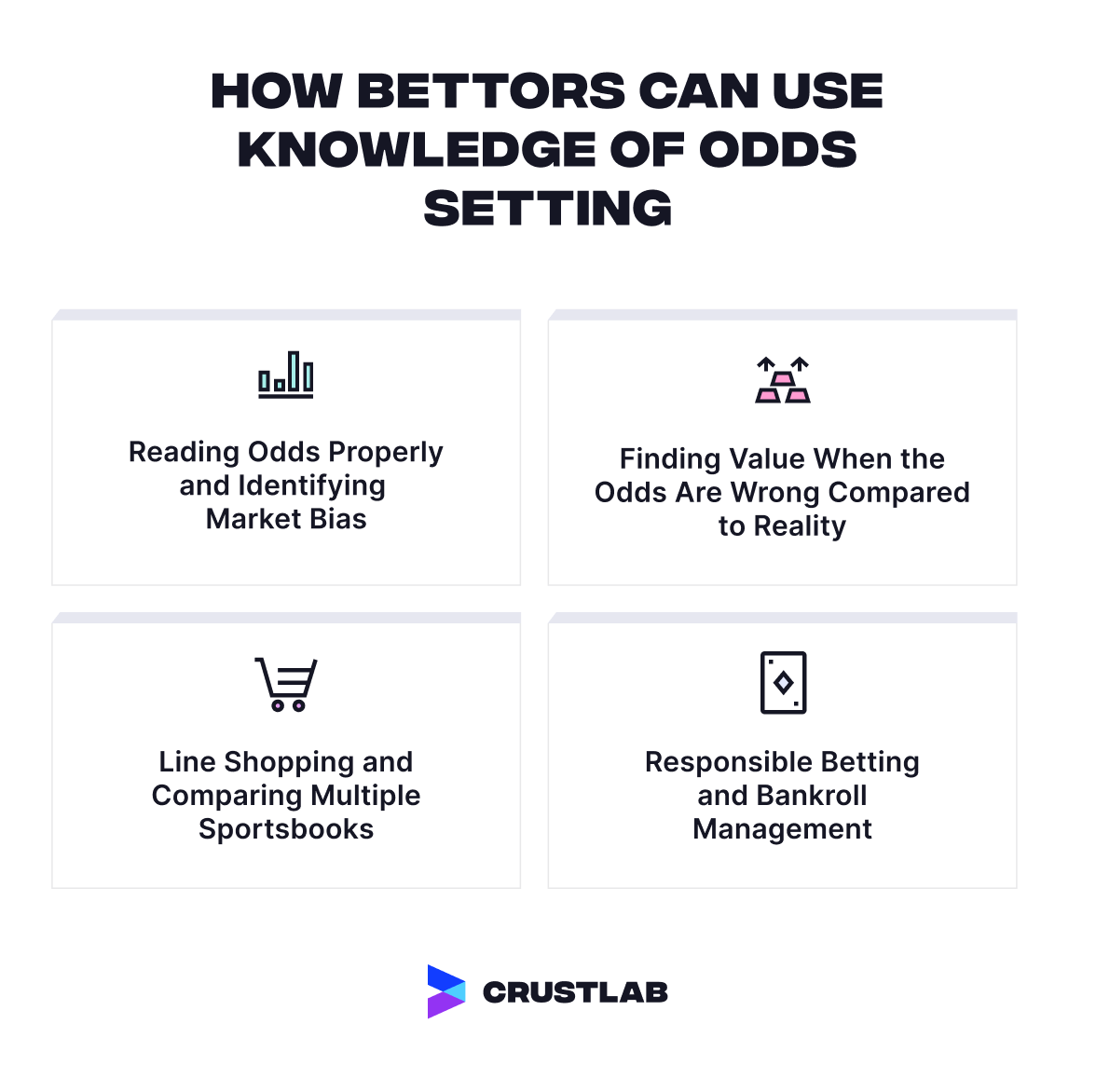
How Bettors Can Use Knowledge of Odds Setting to Their Advantage
For bettors, sports odds are more than just a way to calculate payouts; neither is it a pure prediction of match outcomes. It’s a valuable tool that helps them make informed decisions and more profitable bets. Instead of depending on gut feeling and individual expertise alone, here are some ways bettors can leverage their knowledge of odds-setting:
- Reading Odds Properly and Identifying Market Bias: since bookmakers adjust odds to manage risk, the final line is often a reflection of the sentiments of the betting public and market bias rather than what will happen in the match.
- Finding Value When the Odds Are Wrong Compared to Reality: The odds displayed by the bookmaker are the implied probability. This means it might not always reflect reality. Bettors can look out for bets that have been underestimated by the oddsmaker (value bet) and maximize their chances with them.
- Line Shopping and Comparing Multiple Sportsbooks: Line shopping involves checking multiple apps to find the best possible price. This works because different sportsbooks use different data providers, algorithms, and market data. Bettors can always shop around for the best deals before making a final decision.
- Responsible Betting and Bankroll Management: Smart bettors know that odds aren’t everything. It’s not even a true prediction of what will happen in a match, which means it can’t be truly trusted. At the end of the day, the house always wins, and the best way to approach betting is to see it as entertainment rather than a way to make more money.
Conclusion
Sportsbooks are in the business of giving bettors the best odds. That means odds that are attractive enough to get punters to commit, but still very profitable for the bookie. Thanks to technology, setting sports odds has gotten more convenient for bookmakers. It’s all about partnering with the right people, including the best oddsmaking consultants, data providers, and a specialized software development company like CrustLab to put it all together. Contact us to discuss your project and learn more about how to make a betting website that generates profit.