Sports Betting Risk Management: Smart Strategies to Avoid Risk in Online Betting Business

- How Risk Management Works for Operators vs. Bettors
- Why Investors Evaluate Risk Management Capability
- Financial and Market Risks
- Operational and Technology Risks
- Fraud and Integrity Risks
- Regulatory, Compliance, and Reputation Risks
- Liability and Exposure Management
- Odds and Pricing Management
- Limit Setting and Stake Controls
- Risk Teams and Trading Operations
- Data Infrastructure and Real-Time Market Feeds
- Risk Engines and Automated Monitoring Systems
- AI and Machine Learning Applications
- Player Profiling and Behaviour Analysis
- Player Protection Frameworks Required by Regulators
- Behavioural Monitoring and Mandatory Interventions
- Continuous Model Calibration and System Optimization
- Cross-Department Risk Coordination and Governance
- Staff Training, Protocols, and Incident Response
- The Rise of AI-Driven Risk Systems
- Personalized Limits and Player-Specific Risk Profiles
- Growing Global Regulation and Enforcement
Sports betting risk management is vital for maintaining the profitability and stability of modern sportsbooks. As online betting becomes increasingly competitive, operators must manage financial exposure, fraud, technology failures, and regulatory pressure simultaneously.
Effective risk management combines trading expertise, data-driven systems, and clear operational rules. It also depends heavily on reliable platforms built through professional sports betting software development that support real-time monitoring and automation. This article explains how risk management works in practice and why it matters for all stakeholders in the sports betting industry.
- Sports betting risk management protects profitability and stability by controlling exposure, pricing odds accurately, and responding to fast-changing betting markets.
- Technology-driven risk controls are essential as modern sportsbooks rely on real-time data, automation, AI, and monitoring systems to manage fraud, market, and operational risks.
- Regulation and responsible gambling are core risk pillars, requiring strong compliance frameworks, player protection tools, and coordinated governance across teams.
- High-performing operators use structured, continuous risk management strategies to support long-term growth and boost investor confidence.
What Is Sports Betting Risk Management?
Sports betting risk management refers to the processes and systems sportsbooks use to identify, assess, and control potential losses across their operations. It focuses on protecting the business from financial exposure, fraud, operational failures, and regulatory breaches. At its core, risk management strikes a balance between bookmaker profitability, market fairness, and platform stability.
This discipline combines data analysis, trading rules, automated controls, and human oversight to manage how bets are accepted, priced, and limited. It also ensures that abnormal betting behaviour, suspicious activity, and compliance risks are detected early. When applied correctly, risk management enables sportsbooks to operate sustainably while maintaining trust with players, investors, and regulators.
How Risk Management Works for Operators vs. Bettors
For operators, sports betting risk management is a business function closely tied to revenue protection and regulatory compliance. Meanwhile, players see it as a personal discipline aimed at reducing volatility and preventing harmful behavior. While both manage risk, their tools, strategies, and consequences are fundamentally different.
| Aspect | Operators | Bettors |
| Primary goal | Protect profitability, control exposure, and ensure business stability. | Protect personal funds and avoid unsustainable losses. |
| Risk focus | Market imbalance, odds mispricing, fraud, regulatory breaches, and large liabilities. | Poor bankroll control, emotional betting, and chasing losses. |
| Tools | Trading teams, automated risk engines, real-time market data, and internal limits. | Budget planning, staking discipline, and selective betting. |
| Risk controls | Dynamic betting limits, odds adjustments, market suspensions, and exposure balancing. | Bet sizing, stop-loss limits, and avoidance of high-risk bets. |
Why Investors Evaluate Risk Management Capability
Investors closely examine sports betting risk management because it directly reflects the resilience and scalability of a sportsbook business. Strong risk controls signal that an operator can handle volatility, protect margins, and survive unexpected market shocks. Weak risk management, on the other hand, exposes investors to sudden losses, regulatory penalties, and reputational damage.
From an investment perspective, risk capability goes beyond odds trading. It includes governance structure, compliance maturity, fraud controls, and the reliability of the technology stack. Investors also look for clear reporting, automated monitoring, and experienced risk teams that can adapt as betting volume grows. For anyone exploring how to start a sportsbook business, these systems are often the difference between short-term traction and long-term viability.
Types of Risks in Sports Betting Industry
The sports betting market is fraught with diverse threats that can impact a sportsbook’s bottom line. Effective risk management requires a multi-layered approach to address these risks.
Financial and Market Risks
Financial and market risks are central to risk management in sports betting because they directly affect financial performance and long-term financial stability. These risks occur when odds are set incorrectly, when too much money is placed on one outcome, or when liquidity in a betting market is too low to absorb volume. In fast-paced sports betting markets, the smallest pricing mistakes can escalate into significant financial losses.
Market risks increase when betting lines fail to reflect new information, such as late injuries or sudden shifts in betting patterns. If exposure is not balanced in time, sportsbooks may face concentrated payouts that damage profitability.
Operational and Technology Risks
Operational and technology risks affect the day-to-day business operations of a sportsbook. These operational risks include system downtime, failed integrations, delayed data feeds, and human error during manual trading decisions. In an online betting business, technical failures can prevent risk controls from activating when they are needed most.
Live sports betting environments are particularly vulnerable to technological risks, including inaccurate real-time data, latency issues, and data breaches. Cyber threats and unstable platforms may also lead to incorrect odds or lost transaction visibility.
Fraud and Integrity Risks
Fraud and integrity risks pose a threat to both the financial health and credibility of a sports betting business. These risks arise from users or external actors attempting to exploit pricing gaps, system weaknesses, or promotional offers. Common fraud risks include arbitrage betting, multi-accounting, bonus abuse, and coordinated betting patterns designed to bypass limits.
More severe threats involve match fixing or the use of insider information, which can distort markets and attract regulatory scrutiny. If left unmanaged, these activities increase payouts, undermine fair play, and damage trust with regulators and partners.
Regulatory, Compliance, and Reputation Risks
Due to heavy regulations, sportsbook operators must meet strict licensing, AML, KYC, and responsible gambling requirements. When these obligations are not met, betting operators face fines, license suspension, or complete market exit. These regulatory risks can quickly disrupt business continuity and long-term profitability.
Compliance gaps also lead to reputational risks that are more difficult to rectify than financial losses. Public breaches related to player protection, unfair practices, or data handling reduce trust among users, partners, and investors.
Read our guide on sports trading vs sports betting to see how their regulatory expectations differ.
Core Components of Sportsbook Risk Management Strategy
A sportsbook risk management strategy is built on a structured set of policies, tools, and operational controls that work together to manage risk at scale. These components define how betting operators identify potential risks, control exposure, and respond to fast-changing market conditions.
Liability and Exposure Management
Liability and exposure management focus on controlling how much a sportsbook stands to lose on any single outcome. This is a crucial aspect of risk management in sports betting, as unbalanced exposure can quickly turn popular markets into significant financial risks. When too much money flows toward one side, sportsbooks must act to protect overall financial stability.
Operators manage exposure by tracking betting volume, monitoring outcome concentration, and adjusting betting limits in real time. This may include reducing stakes on high-risk markets or spreading action across alternative betting options. Effective risk management practices rely on ongoing monitoring and clear thresholds to prevent liabilities from growing beyond acceptable risk tolerance levels.
Odds and Pricing Management
Odds and pricing management determine how risk enters the sportsbook in the first place. Accurate odds reflect real probabilities, market demand, and current information. This helps operators avoid unnecessary financial risks.
Modern sportsbooks use a mix of automated models and trader oversight to create and adjust betting lines. As new information enters the betting market, operators adjust odds based on betting patterns, market movement, and real-time data. This dynamic pricing approach helps maintain competitive odds while protecting margins. Read our article on how do bookies set odds to understand how pricing decisions directly support effective risk management strategies.
Limit Setting and Stake Controls
Limit setting and stake controls are essential tools for managing risk in the sports betting business. By controlling how much can be wagered on specific markets, operators reduce the chance that a single bet or bettor can cause outsized financial losses. These controls are particularly important in volatile or low-liquidity markets.
Sportsbooks set betting limits dynamically based on market confidence, bettor profile, and event risk. This may include lowering maximum stakes, restricting certain betting options, or requiring manual approval for large wagers. Betting limits also help control exposure to sharp bettors and abnormal betting behavior.
Risk Teams and Trading Operations
Risk teams and trading operations are responsible for implementing risk management plans in real-time. These teams monitor betting markets and make rapid decisions that protect the sportsbook during live and pre-match events. Hence, their role combines data analysis, market awareness, and operational judgment.
On a daily basis, trading teams track betting patterns, move betting lines, suspend markets when risk spikes, and review high-value wagers. They also identify sharp activity, emotional betting, and abnormal behavior that may indicate potential risks. Effective risk management relies on clear workflows, escalation rules, and close coordination between traders, compliance teams, and technology staff.
Risk Management Tools and Software for Modern Sportsbooks
Risk management software enables sportsbooks to automate decision-making, minimize human errors, and scale operations securely. However, choosing the right infrastructure is critical. This is why many operators evaluate solutions from the best sportsbook software providers when building or upgrading a sports betting app or platform.
Data Infrastructure and Real-Time Market Feeds
The foundation of any risk strategy is the quality and speed of its data. Sportsbook operators depend on fast and accurate market data to price betting lines and respond to sudden market shifts. Without trusted feeds, risk management strategies break down and financial risks increase.
High-quality providers deliver real-time data across multiple sports betting markets, including live scores, odds movements, and player statistics. This data helps traders adjust odds quickly and enables automated systems to react to abnormal betting patterns.
Risk Engines and Automated Monitoring Systems
Risk engines and automated monitoring systems allow sportsbooks to detect potential risks before they escalate by analyzing large volumes of bets in real time. Automation reduces reliance on manual intervention and helps betting operators respond quickly to changing market conditions.
Automated tools track exposure and block wagers that exceed predefined risk tolerance. They also support continuous monitoring by scanning for suspicious transactions and abnormal behavior across betting platforms.
AI and Machine Learning Applications
AI and machine learning are changing how operators neutralize threats. These technologies help sportsbooks move beyond static rules and react dynamically to changing conditions in the betting market. By analyzing huge data sets, AI-driven systems identify patterns that traditional tools may miss, making AI in sports betting an indispensable asset.
Machine learning models support predictive analytics, odds optimization, and advanced fraud detection. They analyze betting behavior, historical outcomes, and real-time data to highlight potential risks early.
Player Profiling and Behaviour Analysis
Player profiling and behaviour analysis help sportsbooks understand how different users interact with betting platforms. This approach is a key part of risk management in sports betting because it allows operators to distinguish between casual players, high-value customers, and accounts that present potential risks.
Profiling models examine betting behavior, stake sizes, frequency, and market selection to identify sharp bettors and bonus abuse. These insights allow betting operators to apply tailored betting limits, trigger responsible gambling interventions, and reduce exposure without harming the overall user experience.
Fraud Prevention, AML, and Compliance Requirements
Fraud prevention, AML, and compliance are core pillars of risk management in sports betting. Sports betting operators must monitor transactions and meet strict regulatory standards to protect both financial stability and licensing status.
AML/KYC Controls
Anti-money laundering (AML) and know-your-customer (KYC) controls are essential for managing risk in the sports betting industry and meeting regulatory expectations. These measures verify player identity, monitor transactions, and assess the source of funds to reduce risks of financial crime. AML/KYC processes also help betting operators prevent reputational damage.
Fraud Detection Techniques
Fraud detection and prevention techniques focus on identifying and stopping abusive activity before it impacts the sportsbook. These techniques are a vital part of risk management, as fraud can directly lead to financial losses and regulatory action.
Common methods include geolocation checks, device fingerprinting, and monitoring betting patterns across accounts. Advanced fraud detection tools also rely on real-time monitoring and machine learning to identify suspicious transactions and coordinated behavior.
Regulatory Responsibilities for Licensed Sportsbooks
Compliance is a continuous obligation for sports betting businesses. Regulatory responsibilities include meeting licensing conditions, submitting regular audits, maintaining transparent reporting, and protecting player funds. Failure to meet these requirements exposes operators to financial penalties and potential loss of operating licenses.
Regulators also expect sportsbooks to demonstrate effective risk management practices, including clear governance, documented procedures, and ongoing monitoring of business operations. Compliance teams work closely with legal experts and risk managers to ensure that systems, controls, and data handling processes align with local and international standards.
Responsible Gambling as an Operational and Regulatory Priority
Responsible gambling is a mandatory requirement for the modern sports betting industry and a key part of risk management in sports betting. Regulators expect betting operators to actively protect players and intervene when risky behavior appears.
Player Protection Frameworks Required by Regulators
Player protection frameworks are a core regulatory requirement for betting operators. Regulators mandate clear systems that help manage risk at the player level and prevent harm before it escalates. These frameworks are designed to balance commercial goals with consumer protection.
Common requirements include deposit caps, loss limits, session tracking, and affordability checks that reflect individual risk tolerance. Sportsbooks must also provide self-exclusion tools and cooling-off periods to support responsible gambling obligations.
Behavioural Monitoring and Mandatory Interventions
Behavioural monitoring allows betting operators to identify early signs of harm and escalating risk. This process is a key part of risk management, as regulators expect proactive intervention rather than reactive responses. By tracking betting behavior over time, sportsbooks can spot patterns linked to potential risks.
Mandatory interventions may include warnings, deposit restrictions, enforced breaks, or account suspension when thresholds are breached. These actions are driven by continuous monitoring and data analytics, rather than manual judgment.
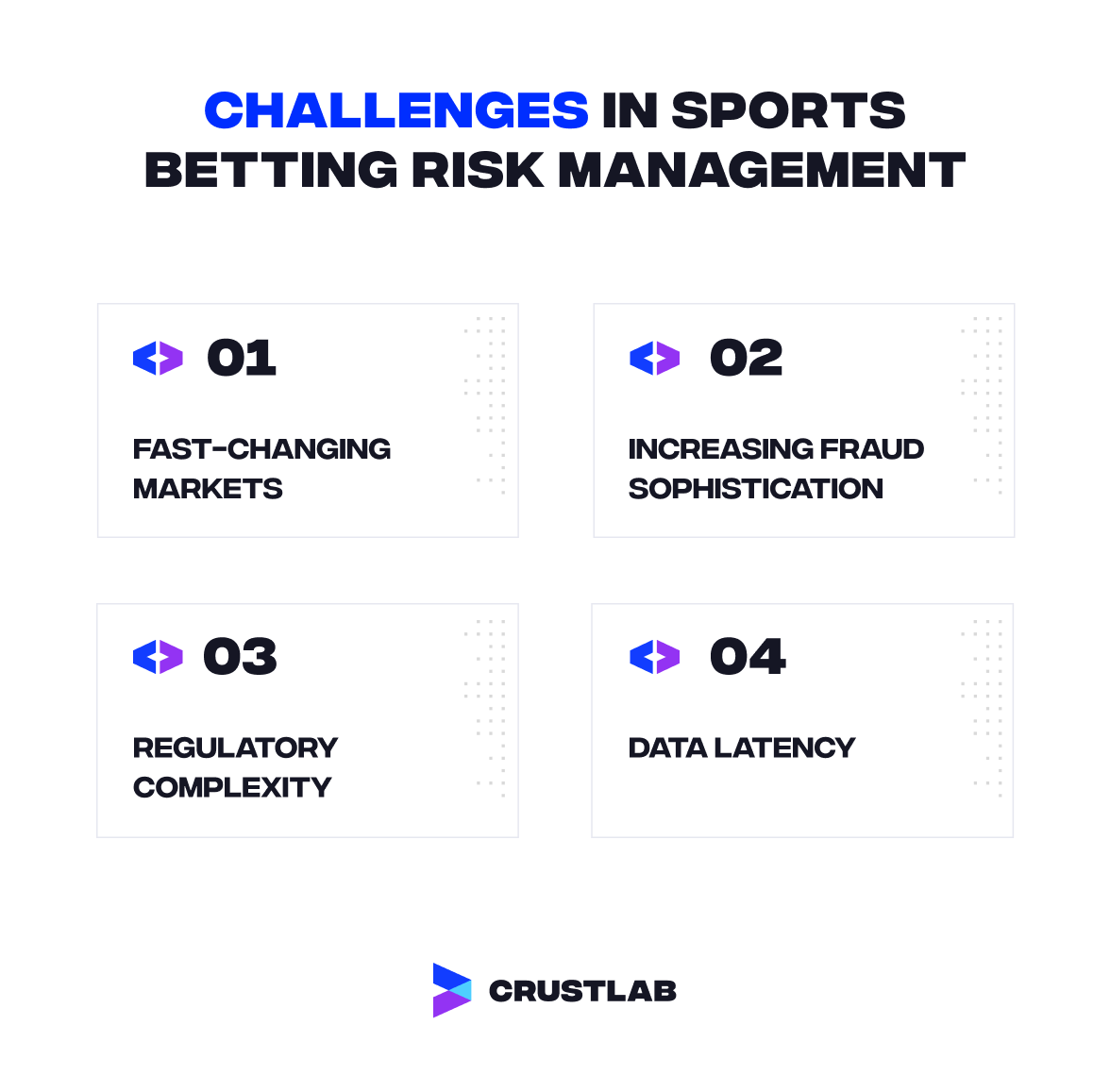
Challenges in Modern Sports Betting Risk Management
The rapid evolution of technology and global markets has introduced a new set of hurdles for sportsbook operators. Successful navigation of these challenges requires constant adaptation of your risk management strategies.
- Fast-changing markets: The rise of micro-betting (e.g., “next ball” in cricket) demands millisecond-level accuracy in odds and trade suspensions.
- Increasing fraud sophistication: Fraudsters are now using AI-driven botnets to exploit bonuses and coordinate large-scale arbitrage attacks across multiple platforms.
- Regulatory complexity: To manage a global sportsbook, you must adhere to a fragmented landscape of laws, with compliance requirements changing frequently across different countries and U.S. states.
- Data latency: Any delay in receiving sports data can lead to courtsiding. This is when bettors at a live event exploit the time gap before the sportsbook can update its odds.
Best Practices for High-Performing Sportsbook Risk Management
High-performing sportsbooks treat risk management as a structured and ongoing discipline instead of a reactive function. Best practices focus on aligning people, processes, and technology to manage risk consistently across the business.
Continuous Model Calibration and System Optimization
Continuous model calibration and system optimization ensure that your risk management plan remains effective as markets evolve. Betting markets change constantly due to shifting betting trends and changes in player behavior. Even well-built risk models lose accuracy over time without regular updates.
High-performing sportsbooks continuously review pricing models, exposure rules, and automation logic using data analytics and performance feedback. This process helps adjust odds, refine betting limits, and reduce financial risks before they impact results.
Cross-Department Risk Coordination and Governance
Effective sports betting risk management requires strong coordination across departments. Risk cannot be managed in isolation, as trading, compliance, technology, and operations all influence exposure and control. Clear governance structures ensure that responsibilities are defined and decisions are aligned across the business.
High-performing sportsbooks establish shared risk management plans, escalation protocols, and regular reporting between teams. This collaboration helps manage potential risks and respond quickly to incidents. Strong governance also improves transparency for investors and supports long-term success in the sports betting business.
Staff Training, Protocols, and Incident Response
The best software still requires human expertise. Regardless of your system’s quality, it will fail without clear protocols and staff who know how to respond under pressure. Training ensures that employees understand risk management practices, regulatory duties, and escalation procedures.
Clear incident response protocols help sportsbooks act quickly during system failures, fraud attempts, or market disruptions. Regular drills and defined responsibilities reduce operational risks and limit financial losses when issues occur.
Future Trends in Sports Betting Risk Management
The future of risk management in sports betting is shaped by automation, personalization, and stricter oversight. As betting markets grow more complex, operators must adopt smarter risk management strategies to manage risk at scale and stay ahead of sports betting trends.
The Rise of AI-Driven Risk Systems
Artificial Intelligence has moved beyond pilot projects into the core architecture of modern sportsbooks. These systems now coordinate odds, promotions, and fraud detection in a unified environment.
By processing millions of data points, AI-driven risk engines can adjust market prices within milliseconds. This effectively neutralizes courtsiding and human error.
Beyond pricing, these tools utilize deep learning to identify previously invisible patterns of “non-recreational” play. This allows operators to detect sophisticated betting syndicates and automated botnets before they can impact the bottom line.
Personalized Limits and Player-Specific Risk Profiles
Personalized limits and player-specific risk profiles represent a shift toward more precise risk management. Instead of applying the same controls to every user, sportsbooks increasingly tailor limits based on individual betting behavior and risk tolerance. This approach helps manage risk without restricting the wider player base.
By analyzing data and betting patterns, operators can support responsible gambling more effectively. Player profiling allows sportsbooks to protect financial performance while improving user experience.
Growing Global Regulation and Enforcement
As more jurisdictions regulate online gambling, risk management must adapt to differing legal frameworks and higher compliance expectations. This shift places greater pressure on betting operators to demonstrate transparency and control.
Stronger enforcement means failures in compliance are more likely to result in penalties and license restrictions. To manage regulatory risks, sportsbooks must invest in compliance teams, ongoing monitoring, and adaptable systems that can respond to local rules. Keeping pace with regulatory change is now essential for long-term profitability and sustainable growth in the betting industry.
Conclusion: Building a Safer, Smarter, and More Profitable Betting Environment
Sports betting risk management is no longer optional for operators that want to compete and survive in a heavily regulated market. Strong risk management strategies protect financial stability, prevent fraud, support responsible gambling, and strengthen trust with regulators and investors. When risk is managed effectively, sportsbooks can scale with confidence while maintaining control over exposure and operations.
Building this level of maturity requires the right technology and expertise. Working with an experienced software development company helps operators design systems that support automation, compliance, and long-term profitability. If you are just getting into the industry, follow our guide on how to make a betting website.